
Classification vs Regression in Machine Learning: A Complete Guide for Beginners
Introduction
Machine Learning is an important part of Artificial Intelligence (AI). It helps computers learn patterns from historical data and make predictions or decisions without explicitly programming every rule.
In Supervised Learning, a Machine Learning model learns from labeled training data. Each training example contains input features and a known output. The model learns the relationship between these inputs and outputs and uses it to predict results for new data.
Want to build practical AI skills? Explore our AI Training Program and take the next step in your AI learning journey
Two of the most important types of Supervised Learning are Classification and Regression.
Although both techniques learn from labeled data and make predictions, they differ in the type of output they produce.
- Classification predicts a category or class.
- Regression predicts a numerical value.
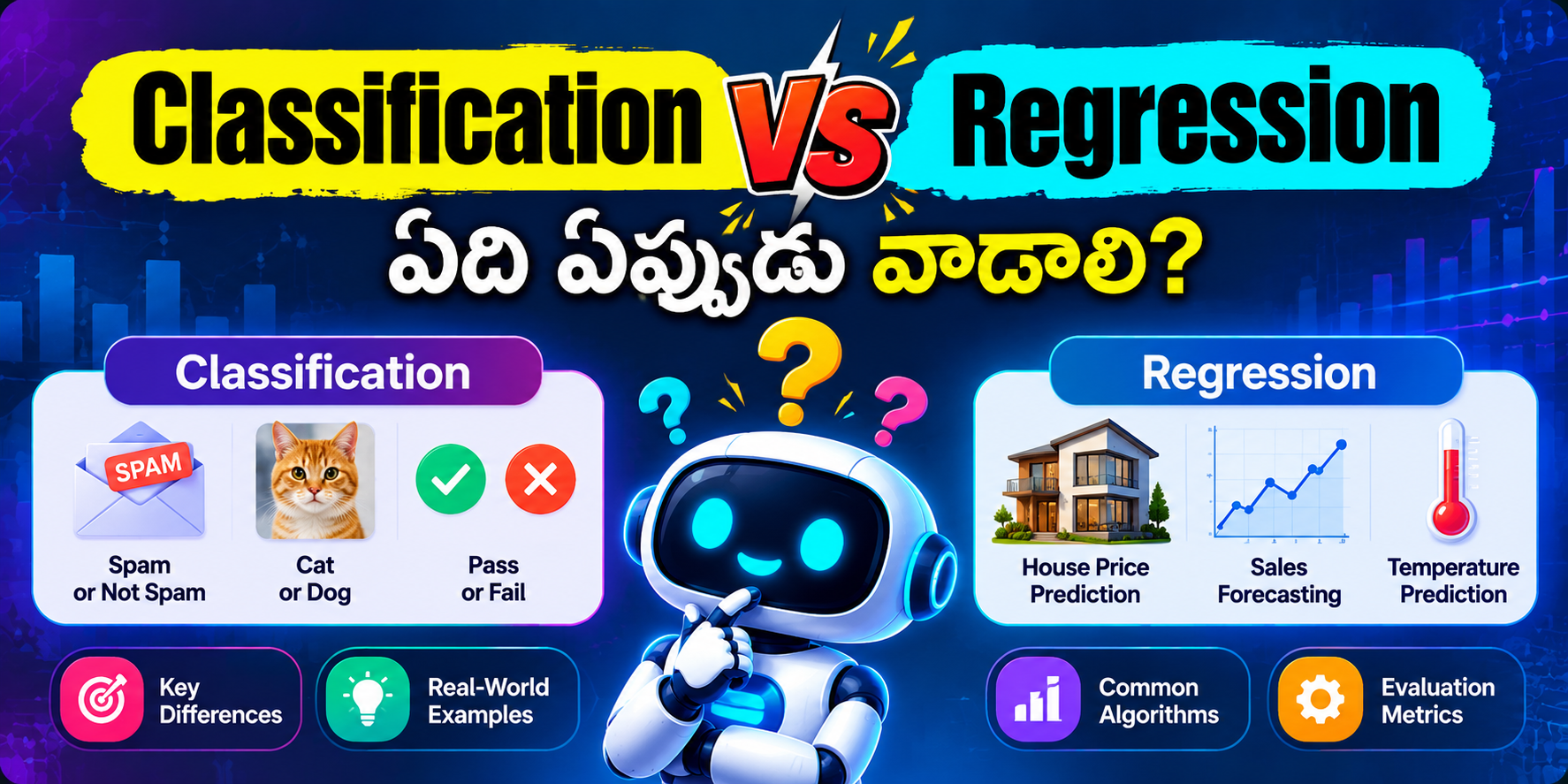
For example, an email spam detection system predicts whether an email is Spam or Not Spam. This is Classification. On the other hand, a house price prediction system estimates the price of a house, making it a Regression problem.
In this article, we will explore Classification and Regression, their differences, real-world examples, common algorithms, applications, and how to choose the right technique for a Machine Learning project.
What Is Classification in Machine Learning?
Classification is a Supervised Machine Learning technique used to predict a category or class for a given input.
In Classification, the model learns from labeled examples and uses the patterns it identifies to assign new data to one of the predefined classes.
The output represents a category rather than a continuous numerical measurement.
Simple Example of Classification
Imagine a school wants to predict whether students will pass or fail an examination.
The school has historical information about students, including:
- Previous examination marks
- Attendance percentage
- Number of study hours
- Assignment completion
- Previous academic performance
The Machine Learning model learns patterns from historical student data. After training, it can predict whether a new student is likely to Pass or Fail.
The output belongs to one of two categories:
- Pass
- Fail
Therefore, this is a Classification problem.
Real-World Examples of Classification
Classification is used in many industries to categorize data and support decision-making.
- Email Spam Detection: Classifies emails as Spam or Not Spam.
- Medical Diagnosis Support: Predicts categories such as Disease or No Disease based on available patient data. Such predictions require appropriate clinical validation.
- Banking Fraud Detection: Classifies transactions as potentially Fraudulent or Legitimate.
- Customer Churn Prediction: Predicts whether a customer is likely to leave a service or continue using it.
- Image Recognition: Classifies images into categories such as Cat, Dog, Car, or Bicycle.
- Sentiment Analysis: Categorizes customer reviews as Positive, Negative, or Neutral.
- Loan Approval Support: Predicts predefined application outcome categories based on applicant data and the model’s training target.
Types of Classification
1. Binary Classification
Binary Classification predicts one of two possible classes.
Examples:
- Spam or Not Spam
- Fraud or Legitimate
- Pass or Fail
- Churn or No Churn
2. Multiclass Classification
Multiclass Classification predicts one class from three or more mutually exclusive categories.
Examples:
- Predicting whether an image contains a Cat, Dog, or Bird
- Classifying a customer query as Billing, Technical Support, or Account Management
- Recognizing handwritten digits from 0 to 9
3. Multilabel Classification
Multilabel Classification allows a single input to belong to multiple classes simultaneously.
For example, a photograph might contain both a Person and a Car. An article might be tagged as AI, Technology, and Education.
Common Classification Algorithms
Some commonly used Classification algorithms include:
- Logistic Regression
- Decision Tree Classifier
- Random Forest Classifier
- Support Vector Machine (SVM)
- K-Nearest Neighbors (KNN)
- Naive Bayes
- Neural Networks
The appropriate algorithm depends on the dataset, problem complexity, interpretability requirements, computational resources, and performance goals.
How Do We Evaluate a Classification Model?
Classification models are evaluated by comparing their predictions with the actual class labels.
Common evaluation metrics include:
- Accuracy: The proportion of predictions that are correct.
- Precision: Of all the cases predicted as positive, how many were actually positive?
- Recall: Of all the actual positive cases, how many did the model correctly identify?
- F1-Score: A combined measure of Precision and Recall using their harmonic mean.
- Confusion Matrix: A table that summarizes correct and incorrect predictions by class.
Accuracy alone may be misleading when the dataset is highly imbalanced. For example, if only 1% of transactions are fraudulent, a model that predicts every transaction as legitimate can achieve 99% accuracy while failing to detect fraud. In such cases, Precision, Recall, and other relevant metrics become especially important.
What Is Regression in Machine Learning?
Regression is a Supervised Machine Learning technique used to predict a numerical value.
The model learns the relationship between input features and numerical target values from historical data. It then uses those learned patterns to estimate a numerical output for new inputs.
Unlike Classification, which predicts a class, Regression predicts a quantity.
Simple Example of Regression
Imagine a real estate company wants to estimate house prices.
The company collects historical information about houses, including:
- House size
- Number of bedrooms
- Location
- Property age
- Number of bathrooms
- Previous selling price
A Regression model learns how these features relate to house prices.
After training, the model might estimate that a particular house is worth ₹50 lakhs.
The output is a numerical value representing the predicted price. Therefore, this is a Regression problem.
The prediction is an estimate, not a guarantee of the actual selling price.
Real-World Examples of Regression
Regression is used whenever the goal is to estimate a numerical quantity.
- House Price Prediction: Estimates property prices based on size, location, and other features.
- Car Price Prediction: Estimates a vehicle’s price based on age, mileage, model, and condition.
- Sales Forecasting: Estimates future sales revenue or product demand.
- Salary Prediction: Estimates salary based on experience, skills, location, and other relevant information.
- Temperature Prediction: Estimates a numerical temperature value from relevant historical and environmental data.
- Energy Consumption Forecasting: Estimates electricity usage for a building or region.
- Delivery Time Estimation: Predicts how many minutes a delivery might take.
Types of Regression
1. Linear Regression
Linear Regression models the relationship between input variables and a numerical target using a linear equation.
For example, a company may use advertising expenditure to estimate sales revenue.
A simple Linear Regression equation is:
\hat{y} = b_0 + b_1x
\]
Here:
- x: Input feature
- ŷ: Predicted numerical output
- b₀: Intercept
- b₁: Coefficient representing the estimated change in output for a one-unit change in the input
2. Multiple Linear Regression
Multiple Linear Regression uses two or more input features to predict a numerical value.
For example, house price prediction might use house size, location-related features, and number of bedrooms.
3. Polynomial Regression
Polynomial Regression models curved relationships by including polynomial terms of the input features.
It can be useful when a straight line does not adequately represent the relationship between the inputs and the numerical target.
4. Decision Tree Regression
Decision Tree Regression divides data into regions based on feature conditions and predicts a numerical value for each resulting region.
5. Random Forest Regression
Random Forest Regression combines predictions from multiple decision trees to produce a numerical estimate. It can capture complex relationships in suitable datasets.
6. Gradient Boosting Regression
Gradient Boosting Regression builds a sequence of models, with later models learning to improve on errors made by earlier ones. Implementations include XGBoost and other gradient boosting libraries.
How Do We Evaluate a Regression Model?
Regression models are evaluated by measuring how close their predicted numerical values are to the actual values.
Common evaluation metrics include:
- Mean Absolute Error (MAE): The average absolute difference between predicted and actual values.
- Mean Squared Error (MSE): The average of squared prediction errors, which penalizes larger errors more heavily.
- Root Mean Squared Error (RMSE): The square root of MSE, expressed in the same units as the target variable.
- R-squared (R²): Measures how well the model explains variation in the target relative to a baseline, with interpretation depending on the evaluation setting.
For example, if a model predicts a house price of ₹48 lakhs while the actual price is ₹50 lakhs, the absolute error is ₹2 lakhs.
A good Regression model aims to minimize prediction errors while performing well on data it has not seen during training.
Classification vs Regression: Key Differences
The main difference between Classification and Regression is the type of target the model predicts.
| Feature | Classification | Regression |
|---|---|---|
| Goal | Predict a category | Predict a numerical value |
| Output | Class or label | Number or quantity |
| Example | Spam or Not Spam | House price of ₹50 lakhs |
| Target type | Categorical | Numerical |
| Common algorithms | Logistic Regression, Decision Tree Classifier, SVM | Linear Regression, Random Forest Regressor |
| Common metrics | Accuracy, Precision, Recall, F1-Score | MAE, MSE, RMSE, R² |
| Business use | Fraud classification, image recognition | Price estimation, demand forecasting |
Ready to learn AI from basics to advanced concepts? Visit our AI Training Website to explore our training programs.
Classification vs Regression: A Simple Real-Life Example
Imagine a school wants to use Machine Learning to understand student performance.
The school has information about students’ attendance, study hours, assignment completion, and previous marks.
Scenario 1: Predicting Pass or Fail
The school wants to predict whether a student will Pass or Fail.
The model’s output is one of two categories:
- Pass
- Fail
This is Classification because the target is a category.
Scenario 2: Predicting Exam Marks
The school wants to estimate how many marks a student might score in the next examination.
The model might predict 78 marks out of 100.
This is Regression because the target is a numerical value.
The same dataset can support either task, depending on the target we want to predict and how the problem is defined.
How to Choose Between Classification and Regression
Choosing the right technique starts with understanding the question you want your Machine Learning model to answer.
Use Classification when:
- You want to assign an input to a category.
- The target variable represents a class or label.
- Your goal is to identify categories such as Fraud or Legitimate, Pass or Fail, or Positive or Negative.
Use Regression when:
- You want to estimate a numerical quantity.
- The target variable represents a value such as price, sales, temperature, or delivery time.
- Your goal is to predict how much, how many, or how long.
Important note: The data type alone does not always determine the best approach. The prediction objective matters. For example, predicting an exact age is usually a Regression task, while predicting an age group such as Child, Teenager, or Adult is a Classification task.
Common Mistakes Beginners Should Avoid
- Confusing categories with numbers: A numeric-looking label does not automatically make a problem Regression. For example, predicting a digit category from 0 to 9 is often Classification.
- Using the wrong evaluation metric: Accuracy is generally suitable for Classification, while MAE and RMSE are commonly used for Regression.
- Ignoring class imbalance: A high Classification accuracy score does not always mean the model detects important minority classes well.
- Evaluating only on training data: Always evaluate the model using appropriate validation and test data to understand how well it generalizes.
- Assuming every prediction is correct: Both Classification and Regression models can make mistakes, so their predictions should be evaluated carefully.
Conclusion
Classification and Regression are two fundamental techniques in Supervised Machine Learning. Both learn patterns from labeled data, but they solve different types of prediction problems.
Classification predicts categories, such as Spam or Not Spam, Fraud or Legitimate, and Pass or Fail.
Regression predicts numerical values, such as house prices, sales revenue, salary, and temperature.
The easiest way to remember the difference is:
- Classification = Which category?
- Regression = How much or how many?
Understanding these two concepts is an important first step toward learning Machine Learning algorithms, building predictive models, and solving real-world problems using data.
As you continue learning Machine Learning, practice identifying whether a problem requires a category or a numerical prediction. This simple habit will help you choose the appropriate modeling approach for your project.
SEO Title: Classification vs Regression in Machine Learning: Differences and Examples
Meta Description: Learn the difference between Classification and Regression in Machine Learning with simple examples, common algorithms, evaluation metrics, and real-world applications.
Suggested URL Slug: classification-vs-regression-machine-learning
Primary Keywords: Classification vs Regression, Classification in Machine Learning, Regression in Machine Learning, Supervised Learning, Machine Learning Examples
Interested in building a career in Artificial Intelligence? Click here to explore our AI Training Program and start learning today.
Read Our More Articles here:
What Is Quantization in AI? How Does It Make AI Models Smaller and Faster?

