
Supervised Learning vs Unsupervised Learning: Key Differences, Examples, and Applications
Introduction to Supervised and Unsupervised Learning
Machine Learning is an important branch of Artificial Intelligence that enables computers to learn patterns from data and make predictions or discover useful information without being explicitly programmed for every task.
Machine Learning includes different learning approaches, and two of the most important approaches are Supervised Learning and Unsupervised Learning. Both methods learn from data, but they differ in the type of data they use and the way they learn.
Supervised Learning uses labeled data, where the correct answers are already provided during training. Unsupervised Learning uses unlabeled data, where the correct answers are not provided. Instead, the model analyzes the data and discovers patterns, similarities, or groups on its own.
Understanding the difference between these two approaches is essential for anyone who wants to learn Artificial Intelligence, Machine Learning, Data Science, or AI Engineering.
Explore our AI Training Program at www.crsinfosolutions.com
What Is Supervised Learning?
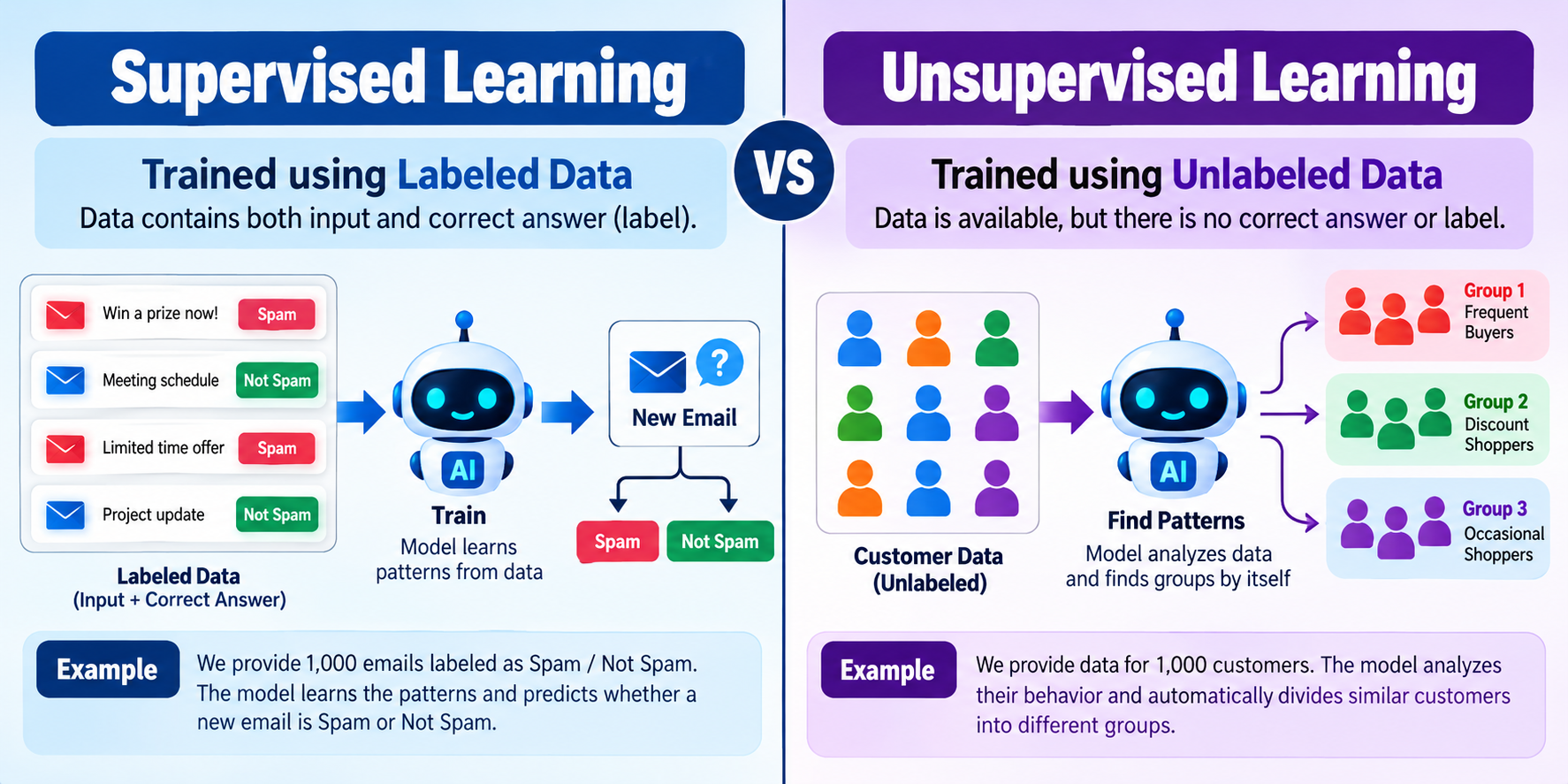
Supervised Learning is a Machine Learning approach in which a model is trained using labeled data. Labeled data contains input information along with the correct output or answer associated with that input.
During training, the model analyzes the relationship between the inputs and their corresponding labels. By learning these patterns, the model attempts to predict the correct output when it receives new data that it has not seen before.
For example, imagine that we want to build an AI system that identifies spam emails. We provide the model with 1,000 emails. Each email is labeled as either Spam or Not Spam. The model analyzes the email content, sender information, and other relevant patterns to learn how spam emails differ from legitimate emails.
After training, when a new email arrives, the model uses the patterns it learned to predict whether the email is Spam or Not Spam. The prediction may be correct or incorrect, depending on the quality of the training data and the patterns learned by the model.
In simple terms, Supervised Learning is similar to learning with the help of a teacher who provides questions along with their correct answers. The model learns from these examples and uses that knowledge to make predictions.
How Does Supervised Learning Work?
Supervised Learning begins with collecting a dataset that contains input features and their corresponding labels. The dataset is then used to train a Machine Learning model. During training, the model generates predictions and compares them with the correct labels. A learning algorithm adjusts the model to reduce prediction errors.
Once training is complete, the model can be evaluated using data that was not used during training. This helps us understand how well the model performs on new examples.
For instance, a house price prediction model may be trained using information about previously sold houses. The input features could include the house size, location, number of bedrooms, and age of the property. The selling price acts as the label. By learning from historical examples, the model can estimate the price of another house based on its features.
Types of Supervised Learning
Supervised Learning is commonly divided into two main types: Classification and Regression.
Classification is used when the model predicts a category or class. For example, an email may be classified as Spam or Not Spam, a transaction as Fraudulent or Legitimate, or a student result as Pass or Fail.
Regression is used when the model predicts a numerical value. For example, a model may estimate house prices, monthly sales, product demand, or delivery time.
Both Classification and Regression learn from labeled training data, but the type of output they predict is different.
Real-World Applications of Supervised Learning
Supervised Learning is widely used in different industries. In banking, it can help identify potentially fraudulent transactions by learning from previously labeled transaction records. In healthcare, models can support the analysis of medical data to predict particular outcomes. In e-commerce, Supervised Learning can help forecast product demand or estimate delivery times.
In education, a model may use historical student data to estimate exam scores or identify students who may need additional academic support. In email services, spam detection systems can learn from examples of spam and legitimate messages.
These applications show how Supervised Learning uses existing examples with known outcomes to make predictions about new situations.
What Is Unsupervised Learning?
Unsupervised Learning is a Machine Learning approach in which a model is trained using unlabeled data. In this case, the dataset contains information, but the correct answers or target labels are not provided.
Instead of learning to predict a known answer, the model analyzes the available data to identify patterns, similarities, differences, or hidden structures.
For example, imagine that a business has information about 1,000 customers. The dataset includes purchase history, spending habits, product preferences, and shopping frequency. However, the customers have not been assigned to predefined groups.
An Unsupervised Learning algorithm can analyze this information and group customers with similar behavior. It may discover one group of frequent buyers, another group of customers who purchase mainly during discounts, and a third group of occasional shoppers.
These groups are discovered from patterns in the data rather than from labels provided during training. The business can then use these insights to better understand its customers and plan suitable marketing strategies.
In simple terms, Unsupervised Learning is like giving a student a collection of objects without providing the answers. The student observes the objects, identifies similarities, and organizes them into groups.
How Does Unsupervised Learning Work?
Unsupervised Learning begins with collecting and preparing unlabeled data. The algorithm analyzes the data to identify relationships, similarities, or structures. Depending on the algorithm, it may group similar data points, reduce the number of dimensions used to represent the data, or identify unusual observations.
Unlike Supervised Learning, there are no provided target labels against which the model directly compares its predictions during training. Instead, the quality of the discovered patterns is evaluated using appropriate methods, such as clustering metrics, visualization, domain knowledge, or practical usefulness.
For example, a retail store may analyze thousands of customer purchase records. The model may identify customers who frequently purchase similar products or have similar shopping habits. These patterns can help the store understand customer behavior even when the original data contains no customer group labels.
Types of Unsupervised Learning
One major type of Unsupervised Learning is Clustering. Clustering groups data points according to their similarities. For example, a business can group customers based on their shopping behavior, while a news platform can group articles that discuss similar topics.
Another important technique is Dimensionality Reduction. It reduces the number of features used to represent a dataset while attempting to preserve useful information. Principal Component Analysis (PCA) is a commonly used dimensionality reduction technique. It can make complex datasets easier to analyze and visualize.
Anomaly Detection is another related task that can sometimes be approached using unsupervised methods. It focuses on identifying observations that differ significantly from typical patterns in the data. For example, an organization may investigate unusual patterns in system activity or transactions. However, anomaly detection can also use supervised or semi-supervised approaches, depending on the problem and available labels.
Real-World Applications of Unsupervised Learning
Unsupervised Learning is useful when a large amount of data is available but predefined labels are missing or expensive to create.
In retail and e-commerce, businesses can use clustering to discover customer segments based on purchasing patterns. In banking, unsupervised methods can help identify unusual transaction patterns that deserve further investigation. In healthcare research, these methods can help explore similarities among patient records, although discovered groups require careful validation before being used for clinical decisions.
In document analysis, Unsupervised Learning can help group similar documents or identify common themes. In manufacturing, it can help explore patterns in sensor data and detect unusual behavior. In data analysis, dimensionality reduction can help researchers visualize complex datasets containing many features.
The main benefit is that these techniques can reveal useful structures in data without requiring every example to have a predefined label.
Supervised Learning vs Unsupervised Learning: Key Differences
The most important difference between Supervised Learning and Unsupervised Learning is the type of training data they use and their learning objectives.
Supervised Learning works with labeled data and learns a relationship between inputs and known outputs. Its goal is generally to predict an output for new data. Unsupervised Learning works with unlabeled data and attempts to discover meaningful patterns, groups, or structures.
Consider a dataset containing information about 1,000 customers. If each customer is already labeled as a high-value customer or a regular customer, a Supervised Learning model can learn to predict the customer category for new records. If the dataset contains only customer information without predefined categories, an Unsupervised Learning model can explore the data and discover groups of customers with similar behavior.
The evaluation methods are also different. Supervised Learning predictions can often be compared with known answers using metrics such as accuracy, precision, recall, F1-score, or mean absolute error, depending on the task. Unsupervised Learning requires methods suited to the specific objective, such as cluster evaluation metrics, visualization, expert review, or the usefulness of the discovered patterns.
Neither approach is universally better than the other. The right choice depends on the problem, the availability of labeled data, and the result the organization wants to achieve.
Simple Everyday Example to Understand the Difference
Imagine that a teacher wants to help students learn about different fruits.
In the first situation, the teacher shows students pictures of apples, bananas, oranges, and grapes. Each picture includes the correct fruit name. Students learn by observing the pictures and their labels. Later, when they see a new fruit picture, they try to identify its name. This is similar to Supervised Learning because the training examples include the correct answers.
In the second situation, the teacher gives students a collection of fruit pictures without providing any names. Students observe the pictures and organize them according to similarities, such as color, shape, or size. They might place similar-looking fruits into the same groups. This is similar to Unsupervised Learning because the students discover patterns without being given the correct group labels.
This example highlights the central difference: Supervised Learning learns from labeled examples, while Unsupervised Learning discovers structure from unlabeled data.
Can Supervised Learning and Unsupervised Learning Be Used Together?
Yes. In real-world Machine Learning projects, these approaches can complement each other.
For example, a company may initially use Unsupervised Learning to group customers according to their shopping behavior. After business experts review these groups and assign meaningful labels, the company may train a Supervised Learning model to predict which group a new customer is likely to belong to.
Similarly, Unsupervised Learning can help explore and understand a dataset before a Supervised Learning model is developed. This can reveal patterns, potential data quality issues, or useful features that deserve further investigation.
The combination of different techniques depends on the business problem and the quality of the available data. It is not necessary to use both approaches in every project, but understanding both gives Machine Learning practitioners more options.
Looking to build your career in Artificial Intelligence? Join our AI Training Program to strengthen your AI knowledge, gain practical skills, and work toward building real-world AI applications.
Advantages and Limitations of Supervised Learning
One important advantage of Supervised Learning is that its predictions can be evaluated against known labels. When a suitable labeled dataset is available, the model can learn to perform specific tasks such as identifying categories or estimating numerical values.
However, creating labeled data can require considerable time, money, and human effort. The model may also learn incorrect or biased patterns if the training examples are poor quality or do not represent the real-world data it will encounter. Its performance on new data depends on the suitability of the training process and evaluation.
Advantages and Limitations of Unsupervised Learning
A major advantage of Unsupervised Learning is that it can analyze unlabeled datasets and reveal patterns that may not be obvious to people. This is particularly useful when organizations collect large volumes of data but do not have predefined categories for every record.
However, the patterns discovered by an algorithm are not automatically meaningful or correct. A clustering algorithm may produce groups, but a human expert may need to interpret what those groups represent and whether they are useful. Results can also vary depending on the algorithm, data preparation, and parameter choices.
Therefore, Unsupervised Learning is valuable for exploring data, but its results should be evaluated carefully before being used to make important decisions.
Conclusion
Supervised Learning and Unsupervised Learning are two fundamental approaches in Machine Learning. Both help models learn from data, but they serve different purposes.
Supervised Learning uses labeled data to learn from examples with known answers and predict outputs for new data. It is commonly used for Classification and Regression tasks, such as spam detection and house price prediction.
Unsupervised Learning uses unlabeled data to discover patterns, similarities, and hidden structures. It is commonly used for Clustering, Dimensionality Reduction, and exploring unusual data patterns.
The easiest way to remember the difference is this: Supervised Learning learns from data that includes the correct answers, while Unsupervised Learning explores data without predefined answers to discover useful patterns.
Understanding these concepts provides a strong foundation for learning more advanced Machine Learning techniques and building practical Artificial Intelligence applications.
Read our More Articles :
Classification vs Regression in Machine Learning: A Complete Guide for Beginners
Caterpillar Software Engineer Interview Questions
What Is Quantization in AI? How Does It Make AI Models Smaller and Faster?

