
What Is Learning Rate in Machine Learning? Definition, Examples, and Importance
Introduction to Learning Rate in Machine Learning
Machine Learning is a branch of Artificial Intelligence that enables computers to learn patterns from data and make predictions. During the training process, a Machine Learning model makes predictions, measures its errors, and updates its internal parameters to improve its performance. One important factor that influences how these updates happen is called the Learning Rate.
The Learning Rate determines how large a step a model takes when updating its parameters during training. It plays an important role in deciding how quickly a model learns and how effectively it approaches a solution that minimizes its errors.
If the Learning Rate is too high, the model may make large updates and move past a good solution. If it is too low, the model may learn very slowly and require many more training iterations. Therefore, selecting a suitable Learning Rate is an important part of building an effective Machine Learning model.
In this article, we will explore what Learning Rate means, how it works, what happens when it is too high or too low, and how to choose an appropriate value using simple examples.
Want to Learn AI with Practical Training?
Take your first step toward building practical AI skills with our AI Training Program. Learn Machine Learning, Generative AI, and essential AI concepts through real-world examples, hands-on practice, and project-based learning.
What Is Learning Rate in Machine Learning?
Learning Rate is a hyperparameter that controls the size of the updates made to a Machine Learning model’s parameters during training. It is commonly used by optimization algorithms such as Gradient Descent and its variations.
A Machine Learning model has parameters that are adjusted during training to improve predictions. For example, in a neural network, these parameters include weights and biases. The training process calculates how the model’s error changes with respect to its parameters and uses this information to determine how the parameters should be updated.
The Learning Rate controls the size of the update. A larger Learning Rate generally produces larger parameter changes, while a smaller Learning Rate generally produces smaller changes, assuming the same gradient and optimization method.
In simple words, the Learning Rate determines how big a step the model takes while trying to reduce its prediction error.
How Does Learning Rate Work?
To understand Learning Rate, imagine that a Machine Learning model is trying to predict house prices. Initially, the model may produce predictions that are far from the actual selling prices. During training, an optimization algorithm adjusts the model’s parameters to reduce the difference between the predicted prices and the actual prices.
The model uses a loss function to measure how inaccurate its predictions are. An optimization algorithm then uses information about the loss to update the model’s parameters. The Learning Rate controls the scale of those updates.
For example, if the model’s current parameters are not producing accurate predictions, a larger update may move the model closer to a better solution. However, if the update is too large, the model may move past that solution and produce even larger errors. A smaller update provides more gradual changes, but it may take longer to make sufficient progress.
This process repeats over many training iterations. The goal is to find parameter values that minimize the loss function and help the model make more accurate predictions on unseen data.
Understanding Learning Rate with a Simple Everyday Example
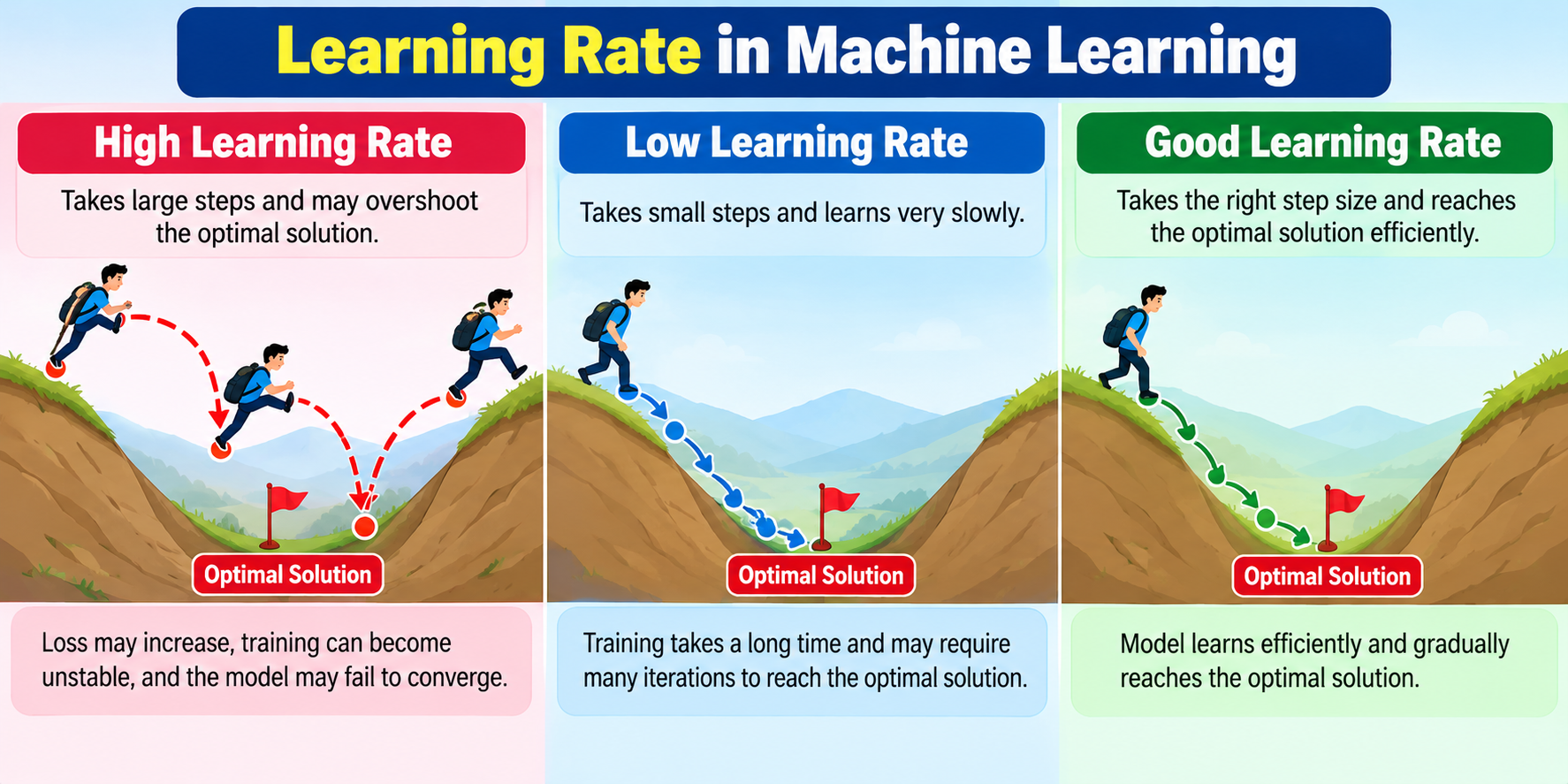
Imagine that you are standing on a hill and want to reach the lowest point in a valley. You cannot see the entire landscape, so you take steps based on the slope beneath your feet.
If you take very large steps, you might cross the lowest point and end up on the opposite side. Repeating this process may make it difficult to reach the bottom. This is similar to using a Learning Rate that is too high.
Now imagine taking extremely small steps. You are less likely to move far past the lowest point in a single step, but reaching the destination may take a very long time. This is similar to using a Learning Rate that is too low.
A suitable step size allows you to move toward the lowest point efficiently without repeatedly moving too far past it. In Machine Learning, a suitable Learning Rate helps the model make useful progress while training.
This example provides an intuitive explanation, although real optimization problems can be more complex than walking down a simple hill.
What Happens If the Learning Rate Is Too High?
When the Learning Rate is too high, the model makes large parameter updates during training. These updates may cause the optimization process to move past a good solution instead of gradually approaching it.
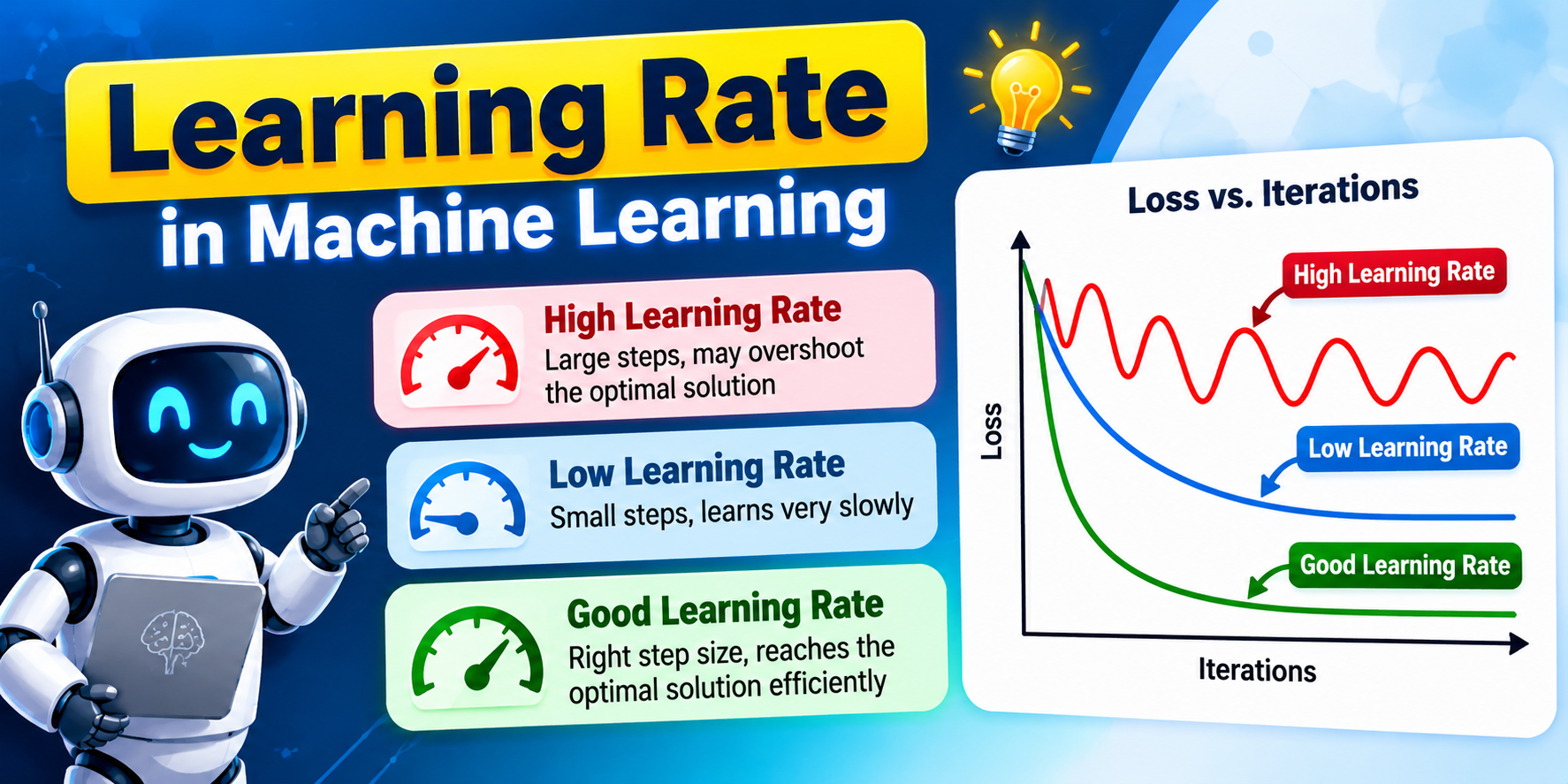
One possible result is that the loss fluctuates significantly rather than decreasing consistently. The model may repeatedly move between parameter values that produce high and low errors. In more difficult cases, the loss may increase, training may become unstable, or the optimization process may fail to converge.
For example, imagine that a model is learning to classify emails as Spam or Not Spam. If its parameters change too aggressively during training, the model may improve on one update but become less accurate after the next update. This can make the training process unstable.
A high Learning Rate is not always bad. It can help a model make faster progress at the beginning of training when the optimization landscape allows it. However, the value must be appropriate for the model, dataset, optimizer, and training process.
Example of a Learning Rate That Is Too High
Suppose a model is training with a Learning Rate of 0.1. In some training problems, this value may be suitable. In others, it may produce updates that are too large. The model might overshoot a region with lower loss and move into a region with higher loss.
The important point is that a value such as 0.1 is not automatically too high for every model. Whether it is appropriate depends on the specific training setup.
What Happens If the Learning Rate Is Too Low?
When the Learning Rate is too low, the model makes very small parameter updates. These updates may be stable, but they can also slow down the training process considerably.
The model may require many iterations to reduce its loss, increasing training time and computational cost. In some cases, progress may appear to stop because the updates are too small to produce noticeable improvements over a reasonable period.
For example, imagine training a neural network using a Learning Rate of 0.000001. Depending on the model and optimizer, the parameter updates may be so small that the loss decreases very slowly. The model may need substantially more training iterations to make useful progress.
However, a small Learning Rate can be helpful in situations where fine adjustments are needed. It is also commonly used during fine-tuning of pretrained models, depending on the training objective and method.
Example of a Learning Rate That Is Too Low
Suppose a model is trained using a Learning Rate of 0.0001. This value may work well for one problem but may be too small for another. If the loss barely changes across many training iterations, the Learning Rate may be one of the factors worth investigating.
Training performance should be evaluated alongside other factors, including the optimizer, model architecture, data quality, and loss function, before deciding that the Learning Rate is the cause.
What Is the Right Learning Rate?
The right Learning Rate is a value that allows the model to make effective progress during training without causing unstable updates or unnecessarily slow learning.
There is no single Learning Rate that works best for every Machine Learning model. The appropriate value depends on factors such as the dataset, model architecture, optimization algorithm, loss function, and training objective.
For example, a Learning Rate that works well for a simple regression model may not work equally well for a deep neural network. Similarly, training a model from scratch may require a different Learning Rate from fine-tuning a pretrained model.
The goal is to select a value that helps the model reduce its loss efficiently while maintaining stable training behavior. This is usually done by experimenting with different values and monitoring the training results.
Common Learning Rate Values in Machine Learning
Learning Rate values are often small positive numbers. Some commonly tested examples include 0.1, 0.01, 0.001, and 0.0001.
A value of 0.1 may be appropriate for certain models and optimizers, while 0.001 or 0.0001 may be more suitable for other training setups. These values are examples rather than universal recommendations.
When selecting a Learning Rate, it is important to observe how the model’s loss changes during training. If the loss fluctuates heavily or increases, the Learning Rate may be too high. If the loss decreases extremely slowly, it may be too low, although other causes should also be investigated.
Testing several values and comparing their training behavior is often a practical way to find a suitable starting point.
Learning Rate and Gradient Descent
Gradient Descent is a widely used optimization algorithm in Machine Learning. It adjusts a model’s parameters in a direction intended to reduce the loss function.
The Learning Rate controls the size of the update made in that direction. A simplified Gradient Descent update rule can be written as:
New Parameter = Old Parameter − Learning Rate × Gradient
The gradient provides information about how the loss changes as a parameter changes. The Learning Rate determines how strongly the parameter is adjusted based on that gradient.
If the Learning Rate is large, the parameter update may be large. If the Learning Rate is small, the update may be small. The minus sign indicates movement in the direction opposite to the gradient, which is the direction of steepest local decrease for a differentiable loss function.
This equation illustrates why the Learning Rate is an important component of the optimization process.
Learning Rate vs. Loss Function
Learning Rate and Loss Function are related to training, but they serve different purposes.
A Loss Function measures how far a model’s predictions are from the desired outputs. For example, Mean Squared Error is commonly used in regression, while cross-entropy loss is commonly used in classification tasks.
The Learning Rate, on the other hand, controls the size of the parameter updates made by an optimizer. The loss function helps measure the model’s error, while the Learning Rate influences how the model changes its parameters to reduce that error.
For example, a model may use cross-entropy loss to measure errors in a classification task and Gradient Descent to update its parameters. The Learning Rate controls the scale of those updates.
Both are important, but they have different roles in the training process.
Learning Rate vs. Number of Epochs
The Learning Rate and the number of epochs are also different concepts.
An epoch represents one complete pass through the training dataset. If a model trains for 20 epochs, it has processed the training dataset 20 times, although the exact number of parameter updates depends on how the data is divided into batches and how the optimizer is configured.
The Learning Rate controls the size of parameter updates, while the number of epochs determines how many times the model goes through the training data.
A model trained for many epochs with an unsuitable Learning Rate may still perform poorly. Similarly, a suitable Learning Rate may not be enough if the model has not trained for a sufficient number of epochs.
Choosing both settings appropriately helps improve the training process.
How to Choose the Learning Rate
One common approach is to begin with a reasonable starting value and monitor the training loss. If training is unstable or the loss repeatedly increases, testing a smaller Learning Rate may help. If the loss decreases very slowly, testing a larger value may help, provided the training process remains stable.
Another approach is Learning Rate Scheduling. Instead of using the same Learning Rate throughout training, the value is adjusted according to a predefined schedule or other training signals. For example, a model may begin with a relatively larger Learning Rate and gradually reduce it as training progresses.
Adaptive optimizers such as Adam adjust parameter updates using information about the gradients. They can make optimization more practical in many situations, but they still use a Learning Rate setting that needs to be chosen appropriately.
The best choice should be based on observed training behavior and validation performance rather than assuming that one particular value is always correct.
What Is Learning Rate Scheduling?
Learning Rate Scheduling is a technique in which the Learning Rate changes during training. Rather than maintaining one fixed value from beginning to end, a schedule adjusts the Learning Rate according to the training stage.
For example, a model may begin training with a larger Learning Rate to make faster progress. Later, the Learning Rate may be reduced so that the model can make smaller, more controlled updates as it approaches a good solution.
Common scheduling strategies include step decay, exponential decay, cosine scheduling, and warm-up followed by decay. Different strategies are suitable for different models and training objectives.
Learning Rate Scheduling can help balance faster progress during early training with more careful parameter updates later in training.
Learn from experienced industry professionals through live and interactive classes, practical exercises, and real-world projects.
Explore our AI Training Programs and take the next step in your AI learning journey.
Visit:
www.crsinfosolutions.com
Common Mistakes When Choosing a Learning Rate
One common mistake is assuming that a higher Learning Rate always makes training better because the model learns faster. Although larger updates can speed up progress in some situations, they can also make training unstable or prevent the optimizer from reaching a good solution.
Another mistake is choosing an extremely small Learning Rate without checking whether training is making sufficient progress. A small value may provide gradual updates, but it can increase training time unnecessarily.
It is also a mistake to assume that a Learning Rate that works well for one model will automatically work for another. Different architectures, datasets, optimizers, and training objectives may require different settings.
Finally, the Learning Rate should not be evaluated in isolation. Data preprocessing, model design, batch size, optimizer selection, and loss function can all influence training behavior.
Real-World Applications of Learning Rate
Learning Rate is important in many Machine Learning applications because it influences how models learn from training data.
In image classification, a neural network learns to identify objects by updating its parameters based on training errors. The Learning Rate affects how quickly these updates happen and whether training remains stable.
In Natural Language Processing, models learn patterns in text and may use Learning Rate settings during pretraining or fine-tuning. Choosing a suitable value is particularly important when adapting an existing model to a new task.
In sales forecasting, a regression model learns relationships between historical sales and relevant features. The Learning Rate influences how the model’s parameters are adjusted as the training process attempts to reduce prediction errors.
Across these applications, the specific value depends on the model and training configuration. Monitoring loss and validation performance is essential when selecting suitable settings.
Conclusion
Learning Rate is an important hyperparameter in Machine Learning that determines the size of parameter updates during model training. It influences how quickly a model learns and how effectively an optimization algorithm can reduce the loss function.
If the Learning Rate is too high, the model may overshoot a good solution, produce unstable updates, or fail to converge. If it is too low, training may progress very slowly and require many additional iterations.
A suitable Learning Rate helps the model make effective progress while maintaining stable training behavior. The best value depends on the model, dataset, optimizer, and training objective, so it should be selected through experimentation and careful monitoring.
In simple words, the Learning Rate determines how big a step a Machine Learning model takes when updating its parameters during training.
Read Our More Articles:
Supervised Learning vs Unsupervised Learning: Key Differences, Examples, and Applications
Classification vs Regression in Machine Learning: A Complete Guide for Beginners

