
What Is Clustering in Machine Learning? A Complete Guide with Real-World Examples
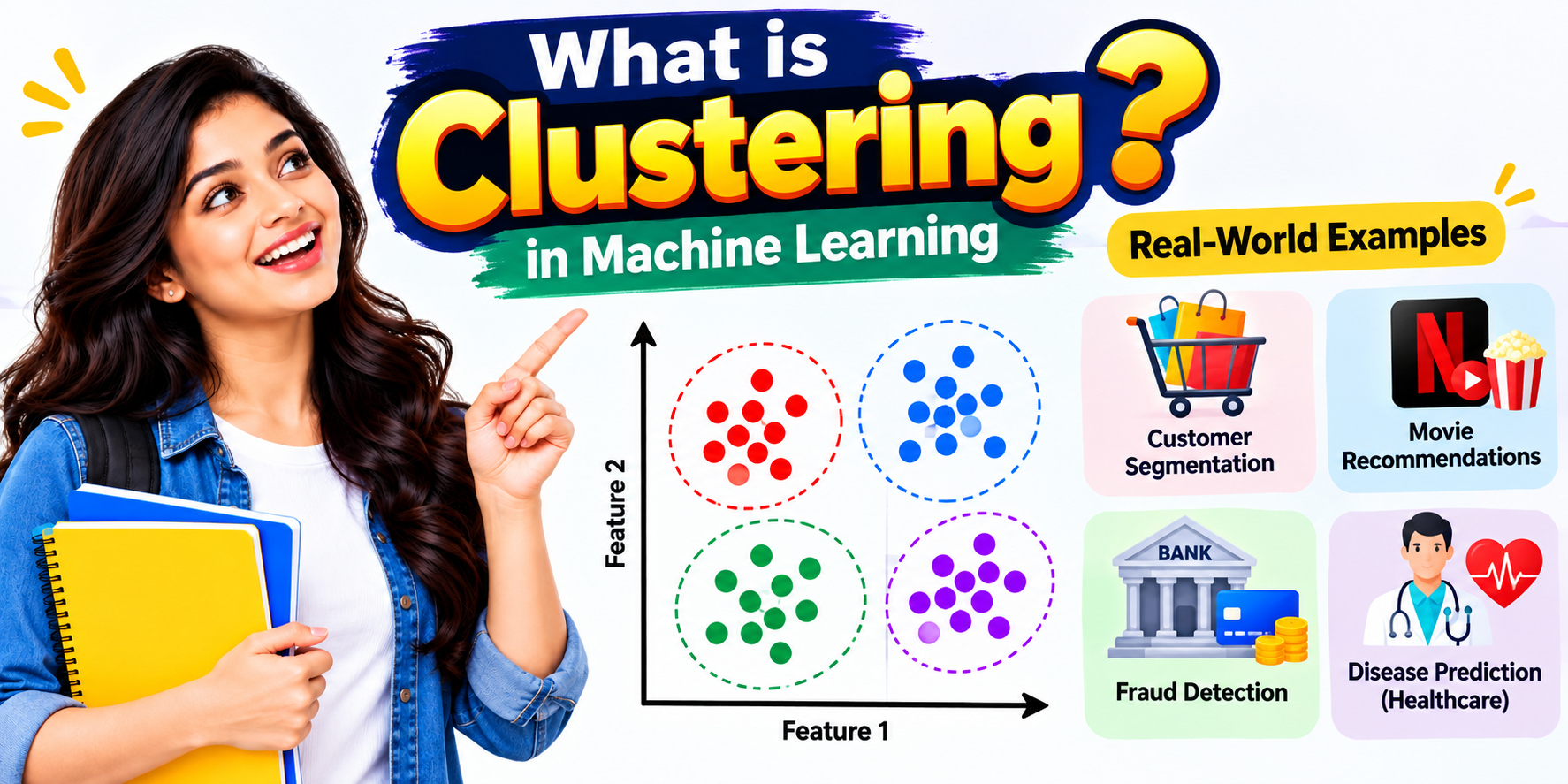
Clustering in Machine Learning is an important technique used to identify patterns in data and group similar data points into meaningful groups called clusters. It is a type of Unsupervised Learning in which the model analyzes data and discovers similarities without requiring predefined labels for each data point.
In today’s data-driven world, companies collect huge amounts of information from websites, shopping applications, banking systems, healthcare platforms, and social media. Clustering helps organize this information, discover hidden patterns, and support better business decisions.
Want to Learn Artificial Intelligence (AI)?
Join Our Complete AI Training Program!
Learn Python, Machine Learning, Generative AI, LLMs, RAG, and Real-Time Projects with practical, hands-on learning.
Ready to start your AI learning journey? Click below to join!
Start Learning Today with CRS Info Solutions
Understanding Clustering with a Simple Example
Imagine an e-commerce website has one lakh customers. Some customers frequently purchase electronics, some prefer clothing, some buy home products, and others mainly shop during discount offers.
The company can use a clustering algorithm to analyze customer purchase history, spending patterns, and shopping behavior. The algorithm automatically groups customers with similar characteristics into different clusters.
Here, we do not tell the AI in advance which customer belongs to which group. Instead, the algorithm discovers similarities from the available data. This process is called Clustering.
What Is Unsupervised Learning?
Clustering is a technique used in Unsupervised Learning. Unlike Supervised Learning, where the model learns from labeled data, Unsupervised Learning works with data that does not have predefined target labels for the task.
For example, a model trained with emails labeled as Spam and Not Spam performs classification. However, when a shopping website provides customer purchase records without predefined customer categories, clustering can discover groups of customers with similar purchasing behavior.
How Does Clustering Work in Machine Learning?
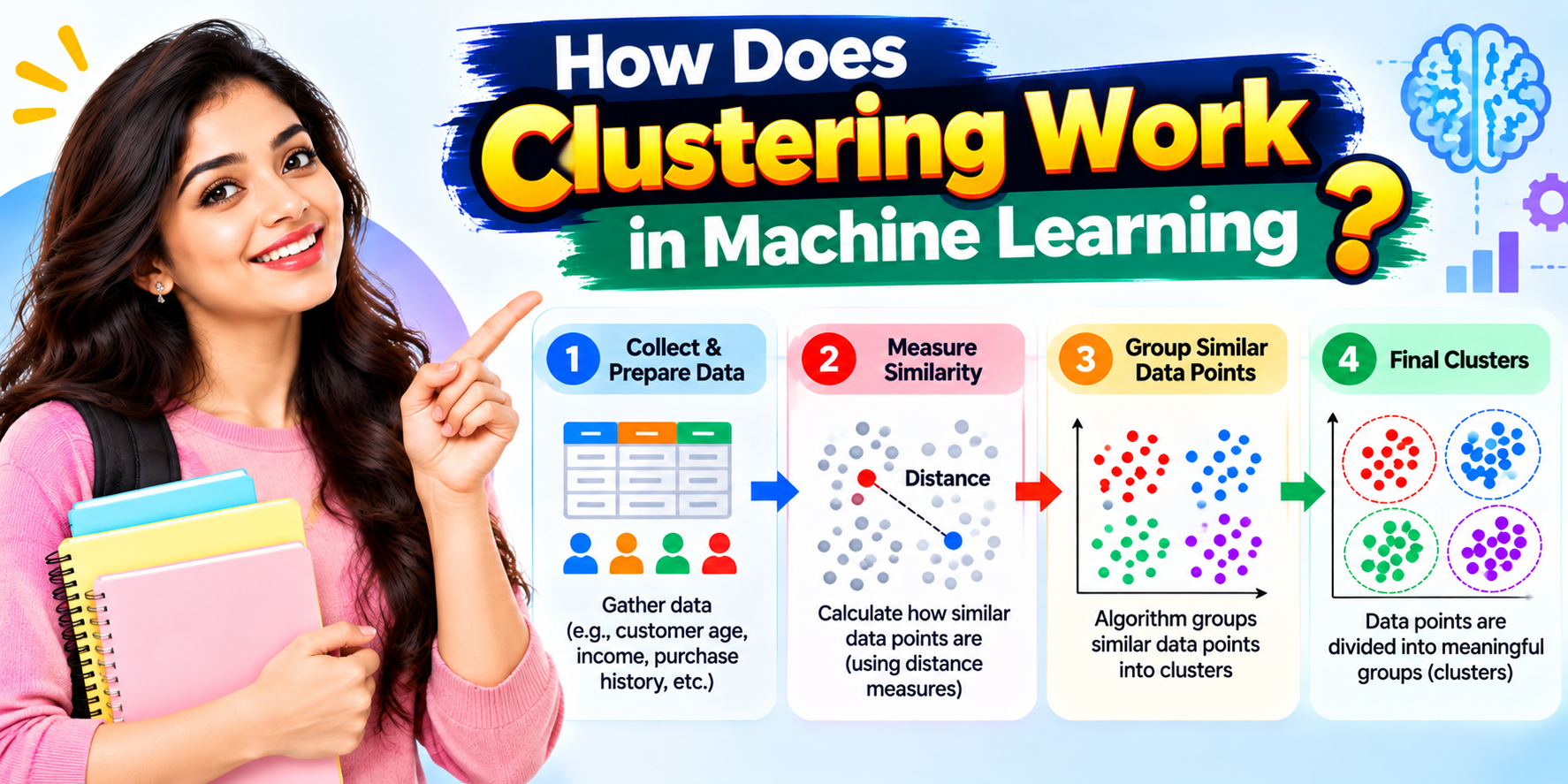
The process starts with collecting and preparing data. The dataset may contain customer age, income, purchase frequency, spending amount, product preferences, and website activity.
The clustering algorithm analyzes the selected features and measures similarities or distances between data points. Based on the algorithm and its settings, similar data points are grouped into clusters.
After clustering, data scientists examine the characteristics of each group to understand the patterns. For example, one cluster may contain frequent shoppers who spend smaller amounts, while another may contain customers who purchase less frequently but spend more per transaction.
Popular Clustering Algorithms in Machine Learning
K-Means Clustering is one of the most popular algorithms. It divides data into a specified number of clusters by assigning data points to the nearest cluster center and updating those centers repeatedly.
Hierarchical Clustering creates a hierarchy of clusters that can be represented using a tree-like diagram called a dendrogram. It helps analyze relationships between data points at different levels.
DBSCAN stands for Density-Based Spatial Clustering of Applications with Noise. It identifies clusters based on the density of data points and can identify some points as noise or outliers.
Each algorithm has its own advantages and limitations. The appropriate algorithm depends on the dataset, data distribution, business problem, and desired results.
Real-World Applications of Clustering
Customer Segmentation
Companies use clustering to group customers based on their interests, spending habits, purchase frequency, and preferences. These groups help businesses understand customer behavior and create more relevant marketing campaigns.
E-Commerce
Online shopping platforms can analyze purchase patterns to identify customers with similar interests. Clustering can support customer analysis and product recommendation systems, although real-world recommendation systems often combine several techniques.
Banking and Financial Services
Banks can group customers based on transaction patterns, spending habits, and account activity. Clustering can also help analysts investigate unusual transaction patterns, but an unusual pattern alone does not confirm fraud.
Healthcare
Healthcare researchers can use clustering to identify groups of patients with similar characteristics, symptoms, or medical measurements. These findings can support exploratory research but require appropriate clinical validation.
Netflix and OTT Platforms
Streaming platforms can analyze viewing behavior to identify groups of users with similar entertainment preferences. This information can support content discovery and recommendation systems.
Marketing and Business Analytics
Companies can group customers according to campaign engagement, product preferences, and purchasing behavior. These insights help businesses understand different customer segments and improve their marketing strategies.
Difference Between Clustering and Classification
Clustering and classification solve different problems in Machine Learning.
Classification is a Supervised Learning technique that predicts predefined categories using labeled training data. For example, an email classification model predicts whether an email is Spam or Not Spam.
Clustering is an Unsupervised Learning technique that discovers groups of similar data points without requiring predefined class labels.
In simple terms, classification predicts known categories, whereas clustering discovers groups in data.
Advantages and Limitations of Clustering
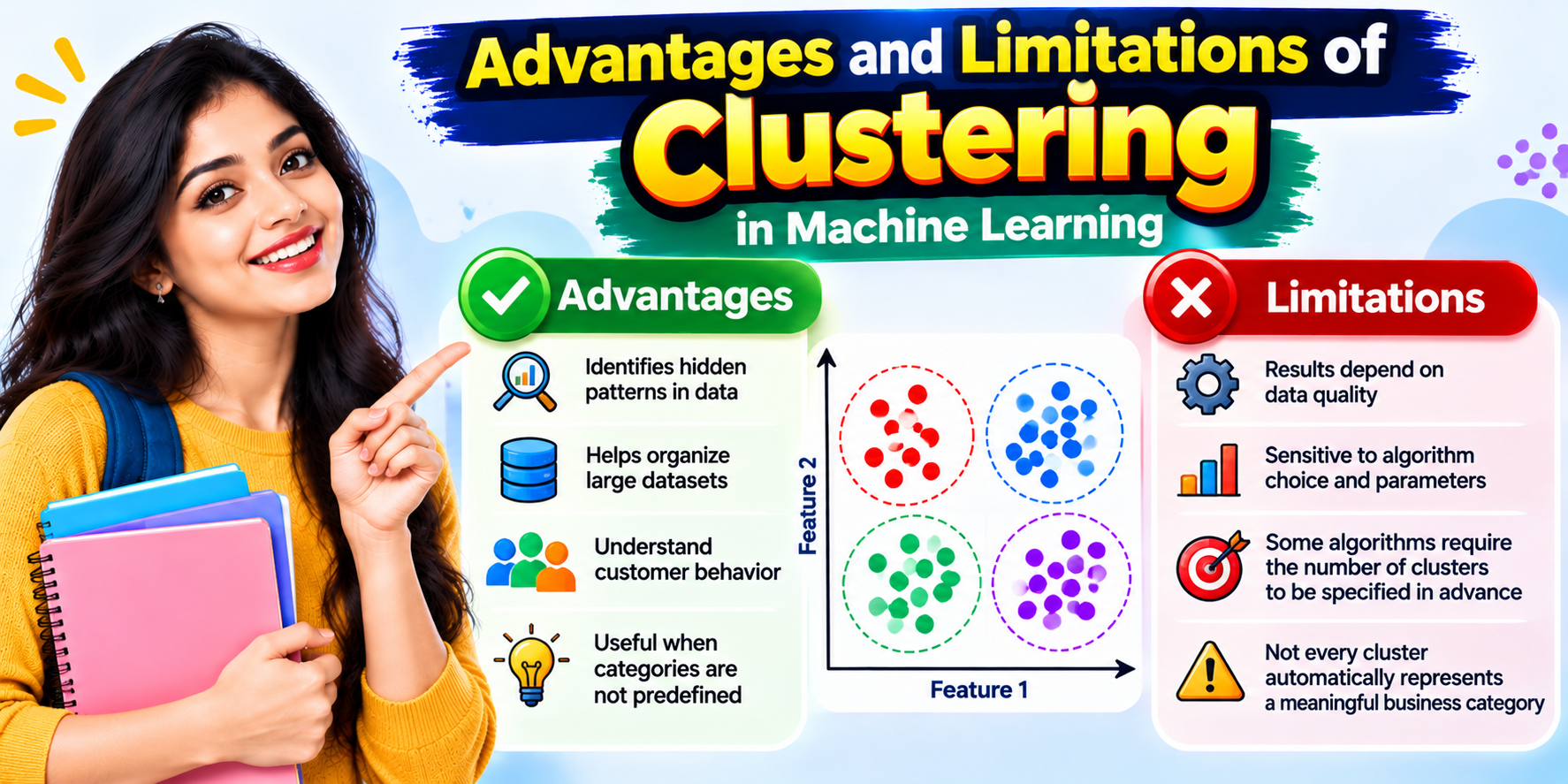
Clustering helps identify hidden patterns, organize large datasets, understand customer behavior, and discover meaningful groups. It is useful when the categories within a dataset are not already known.
However, clustering results depend on data quality, selected features, algorithm choice, and parameter settings. Some algorithms require the number of clusters to be specified in advance. The resulting groups also need to be interpreted carefully because not every cluster automatically represents a meaningful business category.
How Do You Evaluate Clustering Results?
Clustering performance can be evaluated using metrics such as the Silhouette Score, Davies-Bouldin Index, and Calinski-Harabasz Index. These metrics measure different aspects of cluster separation and cohesion.
The evaluation method depends on the algorithm and dataset. In real-world projects, mathematical metrics should also be considered alongside domain knowledge to determine whether the clusters are useful for the intended problem.
Conclusion: Why Is Clustering Important in Machine Learning?
Clustering is an important Machine Learning technique that automatically groups similar data points into clusters. It helps organizations discover patterns, understand customer behavior, analyze transactions, and explore large datasets.
From e-commerce customer segmentation to banking analysis and streaming recommendations, clustering has many real-world applications. Learning clustering provides a strong foundation for understanding Unsupervised Learning and building practical Machine Learning projects.
In simple terms, Clustering means automatically grouping similar data points into different groups called clusters.
Read Our More Articles:
What Is Learning Rate in Machine Learning? Definition, Examples, and Importance
Supervised Learning vs Unsupervised Learning: Key Differences, Examples, and Applications
Classification vs Regression in Machine Learning: A Complete Guide for Beginners

