
Ready to Build Your Future with AI In Hyderabad?
Are you interested in learning Artificial Intelligence but confused about where to start? Do you want to build practical AI applications and develop the skills required to work with the latest AI technologies? Artificial Intelligence is transforming the IT industry, and technologies such as Generative AI, Large Language Models, Retrieval-Augmented Generation, and Agentic AI are creating new opportunities for software professionals and aspiring AI engineers. Learning how to build AI-powered applications, integrate intelligent agents, and automate business workflows can help you prepare for the changing technology landscape.
CRS Info Solutions offers Complete Generative AI and Agentic AI Training in Hyderabad, designed to take learners from Generative AI fundamentals to advanced production-level AI engineering concepts. This comprehensive 50-hour training program covers LLMs, Prompt Engineering, RAG, Fine-Tuning, AI Agent Design Patterns, LangChain, LangGraph, CrewAI, OpenAI Agents SDK, MCP, A2A, Agent Memory, Evaluation, Security, and Cloud Deployment. The course follows a practical learning approach with live instructor-led classes, hands-on labs, real-world projects, and a guided capstone project.
Whether you are a software developer, student, fresher, data engineer, QA professional, DevOps engineer, or working professional looking to upgrade your technical skills, this course helps you understand how modern AI applications are designed, developed, evaluated, and deployed.
Why Choose CRS Info Solutions For AI Training in Hyderabad?
20+ Years of Industry Expertise
Learn from experienced industry professionals with 20+ years of industry expertise and practical knowledge of real-world technology environments. Our training approach focuses on explaining technical concepts through practical examples, live demonstrations, and implementation-oriented sessions. Instead of simply learning definitions and theoretical concepts, you will understand how Generative AI and Agentic AI technologies are used in actual business applications. Industry guidance also helps you understand project architecture, development challenges, technology selection, and the practical considerations involved in building AI-powered solutions.
100% Live and Interactive Classes
Our AI training program provides 100% live and interactive classes, allowing you to learn directly from experienced trainers instead of depending only on pre-recorded videos. During every session, you can interact with the trainer, ask questions, clarify doubts, and understand technical concepts through live coding and practical demonstrations. Complex topics such as RAG pipelines, AI agent workflows, MCP integration, and multi-agent systems are explained step by step. This interactive learning environment helps learners understand not only how a technology works but also how to implement it in real-world development scenarios.
10+ Real-Time Projects and Hands-on Experience
Practical experience is one of the most important parts of becoming an AI engineer. Our course includes 10 real-world projects placed throughout the curriculum, along with a final capstone project. These projects cover different business domains and practical AI applications, including insurance knowledge assistants, intelligent document processing, meeting minutes generation, code and test case generation, stock market research, AI travel planning, customer support automation, conversational data analysis, and agentic coding. You will apply the concepts learned in each module to practical development activities and progressively improve your projects by adding evaluation, security, and deployment capabilities.
Updated Generative AI and Agentic AI Curriculum
Artificial Intelligence is evolving rapidly, and organizations are looking for professionals who can build more than basic AI demonstrations. Our updated curriculum focuses on the technologies and engineering skills used in modern Generative AI and Agentic AI applications. You will learn OpenAI, Anthropic Claude, Google Gemini, open-source models, Prompt Engineering, Embeddings, Vector Databases, RAG, Fine-Tuning, LangGraph, CrewAI, Agno, OpenAI Agents SDK, MCP, A2A, Memory Engineering, Agent Evaluation, Observability, Guardrails, and Cloud Deployment. The curriculum is structured to help you progress from understanding language models to developing intelligent multi-agent applications.
Class Recordings Available
We understand that students and working professionals may sometimes be unable to attend a live session because of personal or professional commitments. To support continuous learning, class recordings are available for revision and reference. You can revisit the topics explained during the sessions, review live coding demonstrations, and practice important implementation steps whenever required. This gives learners additional flexibility to strengthen their understanding and keep up with the course curriculum.
Resume and Career Support
Developing technical skills is important, but presenting those skills effectively is equally valuable when applying for AI-related opportunities. Our training includes resume and career support to help learners showcase their Generative AI knowledge, Agentic AI projects, and practical implementation experience. You will receive guidance on explaining project architecture, describing the technologies used, preparing professional resume points, and presenting your project work on platforms such as GitHub and LinkedIn. The course also introduces important interview topics and helps you understand the technical discussions commonly associated with AI engineering roles.
EMI Option Available
Learning a new technology is an investment in your professional development. To make the training more convenient, an EMI option is available for learners. You do not need to pay the complete course fee at once if you prefer an eligible installment option. Contact CRS Info Solutions to understand the available fee structure, payment flexibility, and EMI details before enrolling in the program.
Monday to Friday – Daily 1 Hour Live Class
Our training schedule is designed to provide a consistent learning experience without requiring learners to attend lengthy sessions every day. Classes are conducted from Monday to Friday, with one hour of live instruction daily. The complete program includes 50 instructional hours and is structured over approximately 10 weeks. Each module follows a learning rhythm that includes concept explanation, live implementation, hands-on lab practice, and discussion. This approach gives learners regular opportunities to understand new concepts and apply them through practical exercises.
Free Demo Class Available
Are you unsure whether this AI course is suitable for your learning goals? Attend our free demo class before enrolling. The demo session gives you an opportunity to understand the trainer’s teaching approach, course structure, practical learning methodology, and the technologies covered in the program. You can also understand how live sessions are conducted and how technical concepts are explained through practical examples. Join the demo class and take the first step toward learning Generative AI and Agentic AI.
Generative AI and Agentic AI Course Syllabus
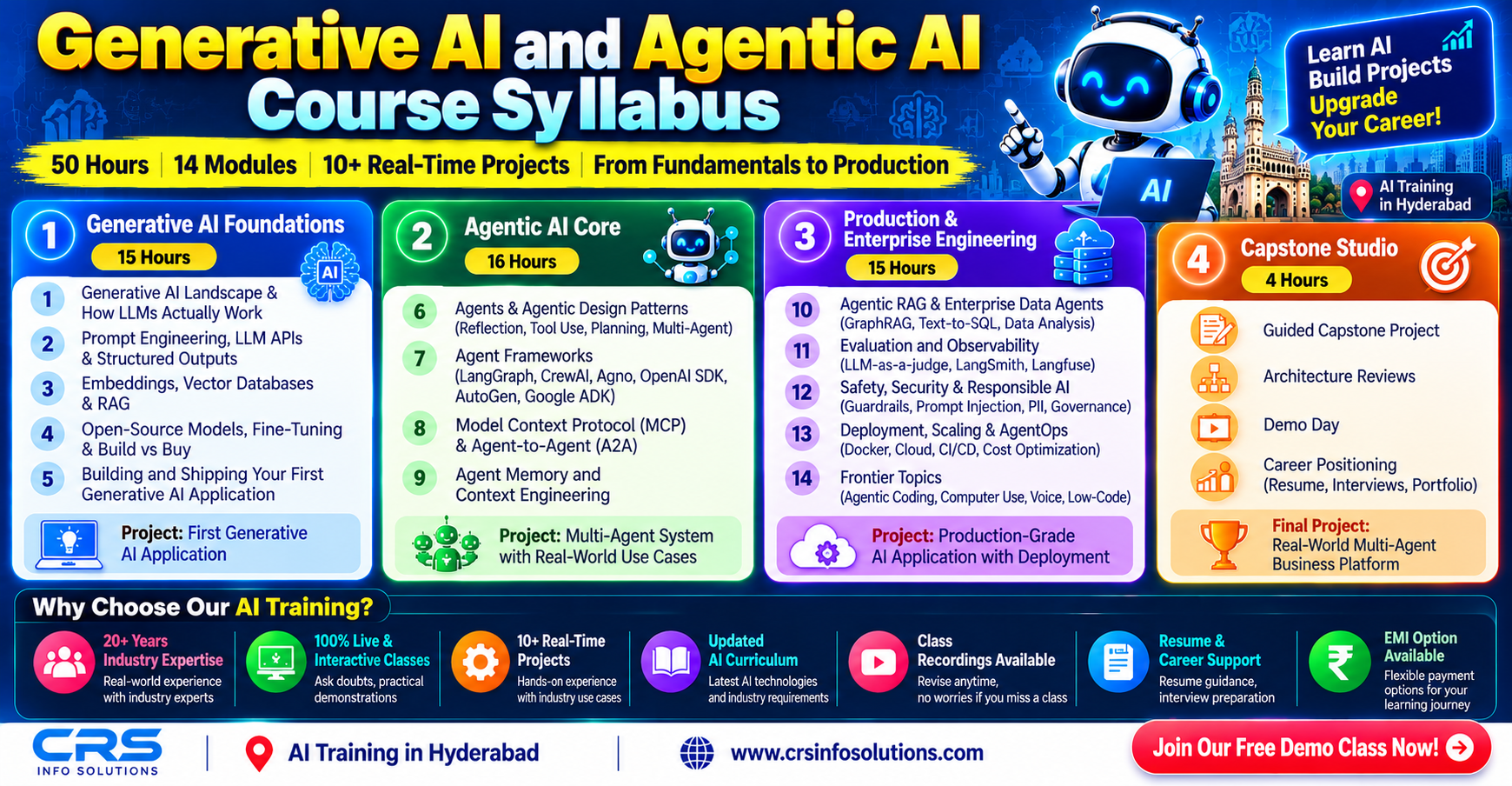
Our 50-hour AI training program is divided into four major sections that cover the complete learning journey from Generative AI foundations to production-oriented Agentic AI engineering. The curriculum begins with Large Language Models, prompting, RAG, and application development. It then progresses into agent design patterns, frameworks, MCP, A2A, memory, and context engineering. The final technical section focuses on enterprise data agents, evaluation, observability, safety, security, deployment, and emerging AI technologies. The course concludes with a guided capstone studio where learners bring together the concepts covered throughout the program.
Section A: Generative AI Foundations – 15 Hours
This section builds the foundation required to develop Generative AI applications. You will understand how Large Language Models work, how to communicate with them through APIs, how to design effective prompts, and how to connect models with external knowledge sources. The modules also introduce open-source models, fine-tuning approaches, and the development of complete GenAI applications. Through practical labs, you will learn how to compare models, work with structured outputs, create retrieval pipelines, and build your first AI-powered application.
Module 1: The Generative AI Landscape and How LLMs Actually Work
Learn the fundamentals of Generative AI and understand how modern Large Language Models are changing traditional software development. This module explains the transition from traditional software applications to AI-native applications and introduces the basic working principles of LLMs, including tokens, embeddings, attention, and next-token prediction. You will explore popular model families such as GPT, Claude, Gemini, Llama, Mistral, DeepSeek, and Qwen, along with the differences between proprietary and open-weight models. The module also covers reasoning models, context windows, token pricing, latency, rate limits, multimodal capabilities, hallucinations, and model-selection strategies. Through a hands-on lab, you will compare different AI models using business tasks such as summarization, information extraction, reasoning, and coding, and understand how to select a suitable model based on capability, cost, latency, and data privacy.
Module 2: Prompt Engineering, LLM APIs, and Structured Outputs
Understand how to interact with Large Language Models programmatically using APIs and develop the skills required to create reliable AI-powered applications. This module covers OpenAI, Anthropic, and Google Gemini APIs, including chat messages, system prompts, streaming responses, and SDK patterns. You will learn practical prompting techniques such as few-shot prompting, role prompting, task decomposition, and structured output generation. The course also introduces JSON Schema enforcement, Pydantic models, function calling, tool calling, context engineering, prompt versioning, prompt caching, and batching techniques for cost optimization. Through practical implementation, you will build a document extraction service that converts unstructured contracts and invoices into validated JSON using structured outputs, retry mechanisms, and provider fallback logic.
Module 3: Embeddings, Vector Databases, and Retrieval-Augmented Generation (RAG)
Retrieval-Augmented Generation is one of the important technologies used to build AI applications that work with private and domain-specific information. In this module, you will understand why RAG is required, how embeddings represent meaning, and how semantic search helps retrieve relevant information from large collections of documents. You will explore document ingestion, parsing, cleaning, chunking strategies, and vector databases such as Pinecone, Chroma, Qdrant, Weaviate, and pgvector. The module covers the complete RAG pipeline, including document ingestion, retrieval, prompt assembly, response generation, and citations. You will also learn advanced retrieval techniques such as hybrid search, reranking, query rewriting, metadata filtering, and parent-document retrieval. The hands-on lab helps you build a complete RAG pipeline and understand how chunking and retrieval settings influence the quality of generated responses.
Module 4: Open-Source Models, Fine-Tuning, and the Build-vs-Buy Decision
Learn how organizations work with open-source models and decide whether to use prompting, RAG, fine-tuning, or other approaches for their AI applications. This module introduces the Hugging Face ecosystem, including models, datasets, and inference concepts. You will explore running models locally using Ollama and understand production-oriented model serving with vLLM. The course explains fine-tuning concepts such as LoRA and QLoRA, dataset preparation, and evaluating whether fine-tuning improves model performance. You will also understand small language models, model routing, inference cost optimization, and data privacy considerations. Through a practical lab, you will fine-tune a small open-source model for a domain-specific task and compare its quality and cost with a prompted frontier model.
Module 5: Building and Shipping Your First Generative AI Application
Move from understanding individual AI concepts to building a complete Generative AI application. This module introduces common application architectures using FastAPI for backend development, Streamlit or Gradio for rapid user interfaces, and React for product-oriented frontends. You will understand how AI-assisted engineering tools such as Claude Code, Cursor, and GitHub Copilot can support application development. The module also covers API key management, rate limiting, retries, timeouts, provider fallbacks, audio processing, speech-to-text pipelines, streaming responses, logging, and basic cloud deployment concepts. During the hands-on lab, you will build an application skeleton using FastAPI and a user interface, implement streaming and fallback functionality, and understand how to prepare the application for further development.
Section B: Agentic AI Core – 16 Hours
After learning the foundations of Generative AI, you will explore how AI systems can move beyond generating responses and start performing tasks through tools, planning, and autonomous workflows. This section introduces the architecture of AI agents and explains how agents perceive information, plan actions, execute tasks, and observe results. You will learn important agentic design patterns and explore popular development frameworks such as LangGraph, CrewAI, Agno, OpenAI Agents SDK, and AutoGen. The section also covers MCP and A2A communication protocols, agent memory, and context engineering, which are important for developing connected and intelligent AI systems.
Module 6: From Generation to Action – Agents and Agentic Design Patterns
Understand the difference between a basic Generative AI application and an AI agent that can take actions to complete a goal. This module introduces the agent execution cycle of perceiving information, planning, acting, and observing results. You will learn the difference between workflows and autonomous agents and explore the four important agentic design patterns: Reflection, Tool Use, Planning, and Multi-Agent Collaboration. The module also covers ReAct, function and tool calling, tool schema design, error handling, idempotency, and common agent failure modes such as infinite loops, tool misuse, and uncontrolled costs. You will build a research agent from scratch using Python with web search, calculator, and file tools, and add a reflection step to understand how an agent can improve its output quality.
Module 7: Agent Frameworks – LangGraph, CrewAI, OpenAI Agents SDK, Agno, and AutoGen
Explore the frameworks used to build and orchestrate modern AI agents. This module provides a detailed introduction to LangGraph, including graphs, nodes, edges, typed state, conditional routing, persistence, and checkpointers. You will learn production-oriented patterns such as human-in-the-loop approvals, parallel branches, supervisor architectures, and subgraphs. The course also introduces CrewAI and its role-based agents, tasks, hierarchical processes, and workflows. You will explore Agno, OpenAI Agents SDK, AutoGen/AG2, and Google ADK, understanding their capabilities and suitable use cases. The module also explains multi-agent architectures such as supervisor, hierarchical, network, and pipeline patterns. Through a hands-on lab, you will build the same workflow using LangGraph and CrewAI and compare their architecture and implementation approaches.
Module 8: Agent Interoperability – MCP and A2A
Learn how AI agents connect with external tools, business applications, databases, and other agents using modern interoperability protocols. This module introduces Model Context Protocol (MCP) architecture, including hosts, clients, servers, tools, resources, prompts, and local or remote communication. You will learn how to build an MCP server using Python and expose internal databases, APIs, and business systems to MCP-compatible AI applications. The course also explains how to connect MCP tools with frameworks such as CrewAI, LangGraph, and Agno. In addition, you will explore Agent-to-Agent (A2A) communication, agent cards, tasks, artifacts, and how agents developed by different systems can discover and delegate work to one another. The practical lab involves building an MCP server and connecting it to an AI assistant and an agent application.
Module 9: Agent Memory and Context Engineering
Understand how AI agents maintain information, remember previous interactions, and use relevant context while completing long-running tasks. This module introduces context engineering and explains how instructions, retrieved knowledge, tool results, and conversation history must be managed within a limited context window. You will learn about context failure modes, memory taxonomy, short-term memory, long-term memory, episodic memory, semantic memory, and procedural memory. The course also explores vector-based memory retrieval, structured memory stores, Mem0, LangMem, and LangGraph persistence using checkpointers and threads. You will understand how to manage user preferences and historical information safely, including privacy considerations and memory hygiene. In the hands-on lab, you will add cross-session memory to an AI travel planner so that it can remember traveler preferences and improve recommendations.
Section C: Production and Enterprise Engineering – 15 Hours
Building an AI agent is only one part of professional AI engineering. To use an AI application in a real business environment, developers must also understand evaluation, reliability, security, deployment, monitoring, and cost management. This section focuses on preparing AI applications for practical and enterprise usage. You will learn Agentic RAG, conversational data analysis, evaluation techniques, observability tools, safety and security practices, cloud deployment, and emerging agentic technologies. The objective is to help learners understand the complete engineering process involved in developing and operating AI-powered systems.
Module 10: Agentic RAG and Enterprise Data Agents
Explore how Retrieval-Augmented Generation can be combined with agent reasoning and planning to develop more advanced information retrieval systems. This module introduces Agentic RAG, query planning, multi-hop retrieval, source selection, and self-correcting retrieval workflows. You will also learn about GraphRAG and how knowledge graphs can help answer questions involving multiple documents and relationships. The module covers Text-to-SQL agents, database schema awareness, semantic layers, query validation, and read-only controls for safer database access. You will understand how conversational analytics can transform natural-language questions into database queries, charts, and business insights. The hands-on lab involves upgrading an insurance knowledge assistant with an agentic retrieval workflow and measuring its performance on multi-hop questions.
Module 11: Evaluation and Observability – Making Agents Reliable
Understand why testing and evaluating AI applications is essential before using them in production environments. Unlike traditional software systems, AI applications may produce different responses for similar inputs, making systematic evaluation an important part of development. This module introduces golden datasets, error analysis, deterministic checks, LLM-as-a-judge evaluation, human review, and RAG-specific evaluation metrics such as faithfulness and context precision or recall. You will also explore agent-specific evaluation methods, including trajectory analysis, tool-selection accuracy, and task completion rate. The course introduces observability tools such as LangSmith and Langfuse, along with tracing, monitoring, cost dashboards, latency tracking, and regression testing. During the hands-on lab, you will build an evaluation and tracing setup for an AI customer support application and understand how evaluation results can be used to improve reliability.
Module 12: Safety, Security, and Responsible AI
Security and responsible AI practices are essential when AI agents interact with external tools, sensitive information, and business systems. This module introduces important security risks associated with Large Language Models and agent-based applications, including prompt injection, insecure output handling, data leakage, and excessive agency. You will understand how indirect prompt injection can affect an agent through malicious documents or webpages and explore techniques for reducing these risks. The module also covers guardrails, input and output validation, PII detection, data redaction, least-privilege tool access, sandboxing, action budgets, and human-in-the-loop approvals. You will be introduced to responsible AI and governance frameworks, including the NIST AI Risk Management Framework, EU AI Act awareness, and relevant compliance considerations. The practical lab involves testing your own agents against prompt-injection attacks and adding appropriate security controls.
Module 13: Deployment, Scaling, and AgentOps
Learn how to transform a working AI agent into a deployable service that can support real-world usage. This module introduces deployment architectures using FastAPI agent services, Docker containers, queues, and background workers for long-running tasks. You will explore managed agent platforms such as LangGraph Platform, Amazon Bedrock AgentCore, Azure AI Foundry, and Vertex AI Agent Engine. The course also covers session storage, concurrency, idempotency, interrupted agent runs, prompt caching, model routing, output limits, and cost optimization. You will understand how CI/CD practices can be applied to AI systems through prompt versioning, model updates, canary releases, and rollback strategies. During the hands-on lab, you will containerize a conversational data analyst application, deploy it to a cloud service, configure tracing and cost monitoring, and perform load testing.
Module 14: The Expanding Frontier – Agentic Coding, Computer Use, Voice, and Low-Code
Explore emerging developments in Agentic AI and understand how intelligent systems are changing software development and business automation. This module introduces agentic coding workflows using Claude Code, including project conventions, plan mode, subagents, hooks, and autonomous multi-file changes with test verification. You will also explore Cursor, GitHub Copilot, and autonomous pull-request workflows. The course introduces computer-use and browser agents that can interact with software applications, real-time voice agents, speech-to-speech models, and telephony integration. You will also understand where low-code automation platforms such as n8n, Make, and Copilot Studio fit into AI development. The module concludes with career positioning and guidance on presenting your AI engineering knowledge, projects, GitHub portfolio, and resume.
Section D: Capstone Studio – 4 Hours
The Capstone Studio is the final stage of the course, where you apply the concepts learned across Generative AI, RAG, Agentic AI, frameworks, MCP, memory, evaluation, security, and deployment. Instead of focusing only on lectures, this section follows a guided project-building approach. You will work on project planning, architecture design, implementation, review, and demonstration with structured support. The goal is to help you bring multiple AI technologies together and demonstrate your understanding through a practical project.
Guided Capstone Project and Architecture Review
You will plan and develop a production-oriented AI application or extend one of the earlier projects based on your own industry interests. The capstone process begins with project scoping and architecture planning, where you prepare a design and receive feedback from the instructor. You will then work through implementation challenges related to integration, evaluation, and deployment. Architecture reviews help you understand the design decisions behind your application and improve the overall structure of your solution.
Demo Day and Career Positioning
At the end of the capstone, you will demonstrate your working application and explain its architecture, functionality, and evaluation results. This gives you an opportunity to present your technical work and understand how to communicate project outcomes. You will also receive guidance on organizing projects on GitHub and LinkedIn, preparing results-oriented resume points, and practicing interview questions based on relevant AI engineering job descriptions.
10+ Real-World AI Projects Covered in the Training
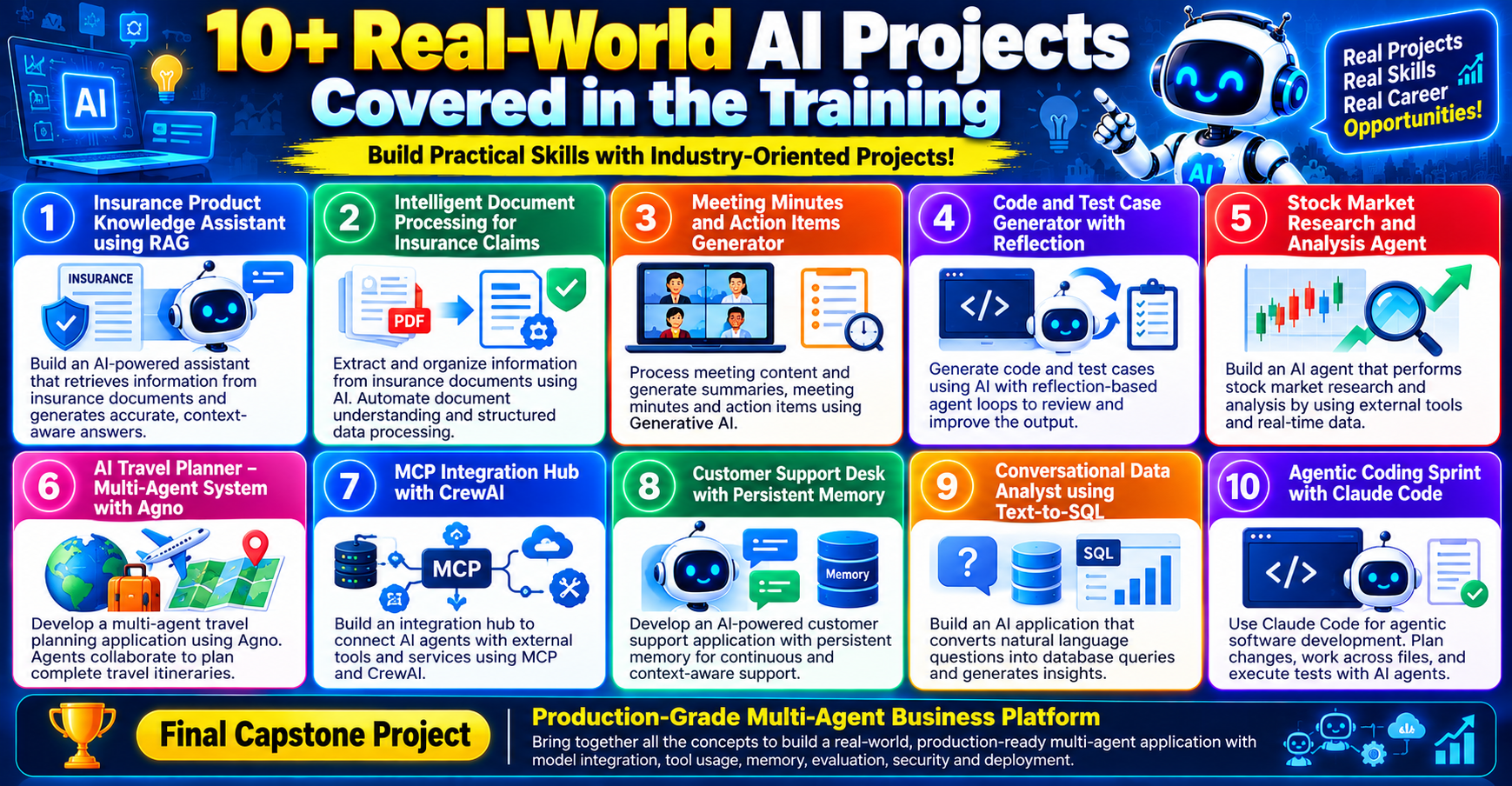
Our training follows a project-based learning approach in which practical projects are introduced after the modules that provide the required technical foundation. This helps learners immediately apply what they have learned instead of waiting until the end of the course to start implementation. The projects cover different business scenarios, including insurance, document processing, software development, financial research, travel planning, customer support, analytics, and AI-driven software delivery. Evaluation, security, and deployment concepts are progressively applied to earlier projects so that learners understand how to improve an application beyond its initial working version.
Project 1: Insurance Product Knowledge Assistant using RAG
Build an AI-powered knowledge assistant that can retrieve relevant information from insurance documents and generate context-aware answers. This project helps you apply embeddings, vector databases, document ingestion, retrieval, and response generation concepts covered in the RAG module.
Project 2: Intelligent Document Processing for Insurance Claims
Develop a document-processing application that helps extract and organize information from insurance-related documents. Understand how AI can support document understanding, information extraction, and structured processing workflows.
Project 3: Meeting Minutes and Action Items Generator
Build a Generative AI application that can process meeting content and generate meeting summaries, minutes, and action items. This project introduces practical full-stack GenAI application development and demonstrates how language models can support workplace productivity.
Project 4: Code and Test Case Generator with Reflection
Develop an AI-powered coding assistant that can generate code and test cases while using reflection-based agent loops to review and improve its output. This project helps you understand how AI agents can support software development activities.
Project 5: Stock Market Research and Analysis Agent
Build a tool-using AI agent that can perform research and analysis by interacting with external tools. Understand how an agent can combine language models, tool calling, and reasoning to support research-oriented tasks.
Project 6: AI Travel Planner – Multi-Agent System with Agno
Develop a multi-agent travel planning application using Agno. Explore how different agents can collaborate to handle different parts of a travel planning workflow and how multi-agent collaboration can help organize complex tasks.
Project 7: MCP Integration Hub with CrewAI
Build an integration hub that demonstrates how MCP can connect AI agents with external tools and services. Use CrewAI to understand how agent workflows can consume tools through a structured interoperability approach.
Project 8: Customer Support Desk with Persistent Memory
Develop an AI-powered customer support application that can maintain relevant information across interactions. Understand how agent memory, context management, and human-in-the-loop controls can support more continuous customer service workflows.
Project 9: Conversational Data Analyst using Text-to-SQL
Build an AI application that can interpret natural-language questions and convert them into database queries. Explore how conversational agents can support data analysis while applying schema awareness, query validation, and read-only controls.
Project 10: Agentic Coding Sprint with Claude Code
Work with Claude Code to perform a practical software development task using agentic coding capabilities. Understand how coding agents can plan changes, work across multiple files, execute tests, and support a structured software development workflow.
Final Capstone: Production-Grade Multi-Agent Business Platform
Bring together the major concepts covered throughout the training program to develop a production-oriented multi-agent application. The capstone provides an opportunity to demonstrate your understanding of AI models, agent orchestration, tool integration, memory, evaluation, security, and deployment through one integrated project.
Tools and Technologies Covered in Our AI Training
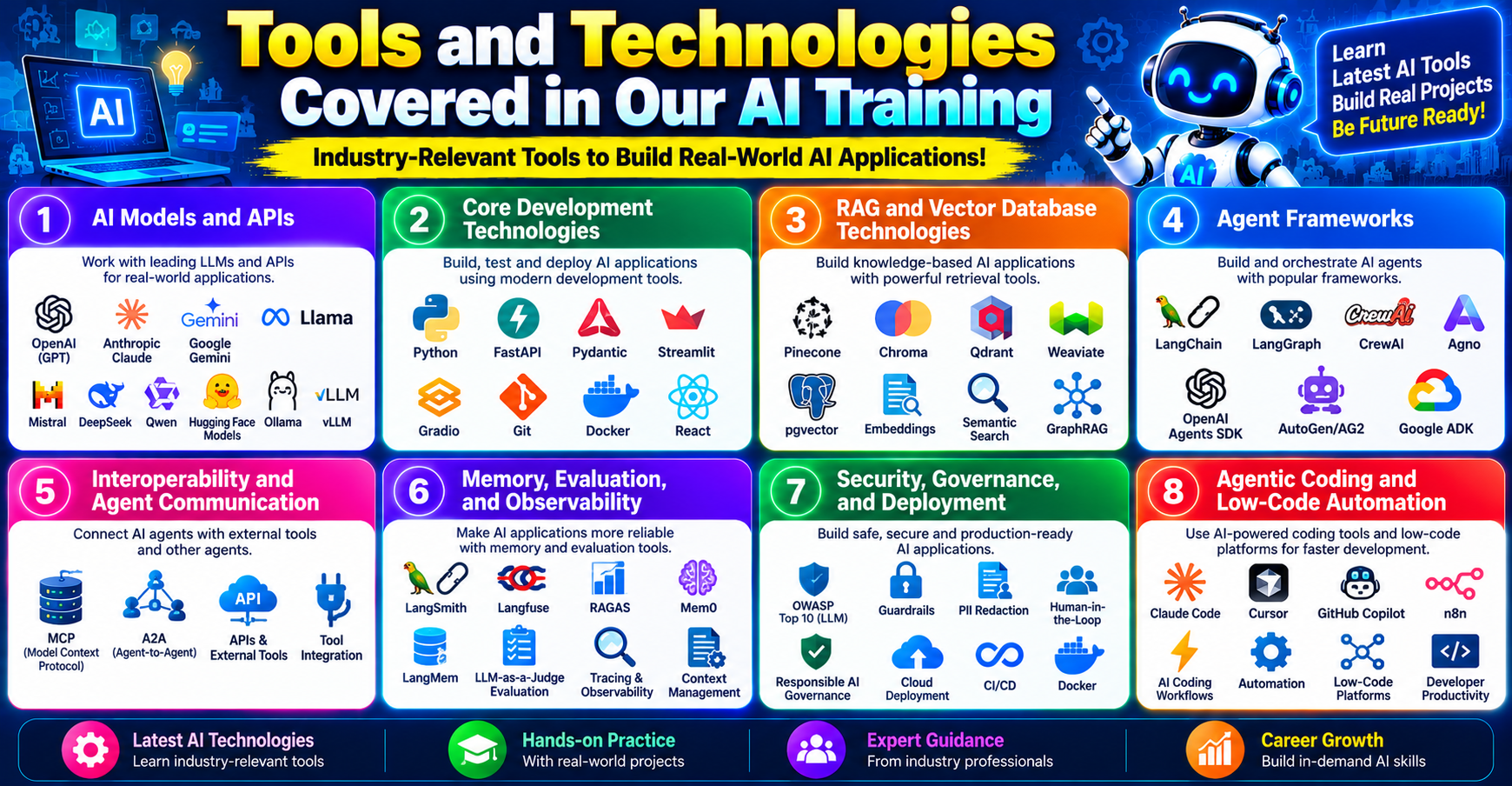
The course introduces a broad set of tools and technologies used in Generative AI and Agentic AI development. You will work with popular model APIs, Python-based development tools, vector databases, agent frameworks, interoperability protocols, evaluation platforms, and deployment technologies. The objective is to understand not only individual tools but also how they work together when developing complete AI-powered applications.
AI Models and APIs
Learn about OpenAI GPT models, Anthropic Claude, Google Gemini, Llama, Mistral, DeepSeek, and other model options. Explore the Hugging Face ecosystem, Ollama, and vLLM for working with open-weight models and local inference.
Core Development Technologies
Understand how Python, FastAPI, Pydantic, Streamlit, Gradio, Git, and Docker are used in building and deploying AI applications. These technologies help connect AI models with application backends, user interfaces, and deployment environments.
RAG and Vector Database Technologies
Work with embedding models, Pinecone, Chroma, Qdrant, and pgvector. Understand semantic search, hybrid retrieval, reranking, RAG evaluation, and GraphRAG concepts used in knowledge-based AI applications.
Agent Frameworks
Explore LangChain, LangGraph, CrewAI, Agno, OpenAI Agents SDK, AutoGen/AG2, and Google ADK. Understand how these frameworks support agent orchestration, workflow management, tool integration, and multi-agent collaboration.
Interoperability and Agent Communication
Learn how to build and consume MCP servers and understand A2A protocol concepts and architecture. Explore how these protocols help connect AI agents with tools, services, and other agent-based systems.
Memory, Evaluation, and Observability
Explore LangGraph checkpointers, Mem0, LangMem, context management, LangSmith, Langfuse, RAGAS, LLM-as-a-judge evaluation, and tracing concepts. Understand how memory and evaluation contribute to building more reliable AI applications.
Security, Governance, and Deployment
Understand OWASP Top 10 considerations for LLM applications, guardrails, PII redaction, human-in-the-loop patterns, and responsible AI governance concepts. Learn deployment fundamentals using Docker, cloud deployment patterns, and CI/CD practices for AI applications.
Agentic Coding and Low-Code Automation
Explore Claude Code, Cursor, GitHub Copilot, and n8n. Understand how coding agents and low-code automation tools can support software development and business workflow automation.
What Will You Gain from This AI Training?
By completing this training program and dedicating additional time to project practice, you will gain a structured understanding of Generative AI and Agentic AI development. You will understand how to work with popular LLM APIs, develop RAG pipelines, build agents using modern frameworks, connect applications through MCP, and explore A2A communication. You will also gain exposure to agent memory, evaluation, observability, security, and deployment practices. The ten real-world projects and final capstone are designed to help you develop a portfolio that demonstrates practical implementation experience rather than only theoretical knowledge.
You will also understand important engineering decisions such as choosing between prompting, RAG, and fine-tuning; selecting an appropriate agent framework; deciding when to use an agent instead of a fixed workflow; and matching the level of autonomy to the risk involved in a task. Along with technical learning, the course provides resume and career guidance to help you present your projects and skills more effectively when exploring AI engineering opportunities.
Who Can Join This Complete AI Training?
This program is primarily designed for software engineers, full-stack developers, backend developers, solution architects, technical leads, data engineers, QA and automation engineers, DevOps and SRE professionals, engineering managers, and technology professionals who want to move into Generative AI and Agentic AI engineering. It is suitable for professionals who already have working knowledge of Python, including scripts, functions, and classes, along with familiarity with APIs and JSON. Previous experience in machine learning, data science, or advanced mathematics is not required for this course. However, basic Python and API knowledge are recommended to get the best learning experience from the practical engineering modules.
Start Your AI Career Journey with CRS Info Solutions
Artificial Intelligence is creating new opportunities in software development, automation, enterprise applications, and business operations. Learning how to build Generative AI applications and intelligent agents can help you understand the technologies behind this transformation. However, becoming a capable AI engineer requires more than learning how to write prompts or use an AI chatbot. You need to understand LLM APIs, RAG pipelines, agent frameworks, tool integration, memory, evaluation, security, and deployment. This is why our course focuses on practical engineering skills, real-world projects, and a complete learning journey from fundamentals to production-oriented AI systems.
At CRS Info Solutions, you can learn through 100% live interactive classes, guidance from experienced industry professionals, 10 real-world projects, a final capstone, class recordings, and resume and career support. With a structured Monday-to-Friday schedule and one-hour live classes every day, you can steadily develop your AI skills while managing your other commitments.
Are you ready to learn AI, build real-world projects, and upgrade your career? Join our Complete Generative AI and Agentic AI Training in Hyderabad. Attend a free demo class, understand the course structure, and take your first step toward becoming an AI engineer.
Join Our Free Demo Class Today!
