
How Do AI Agents Communicate with Each Other? Understanding Multi-Agent Communication
Introduction
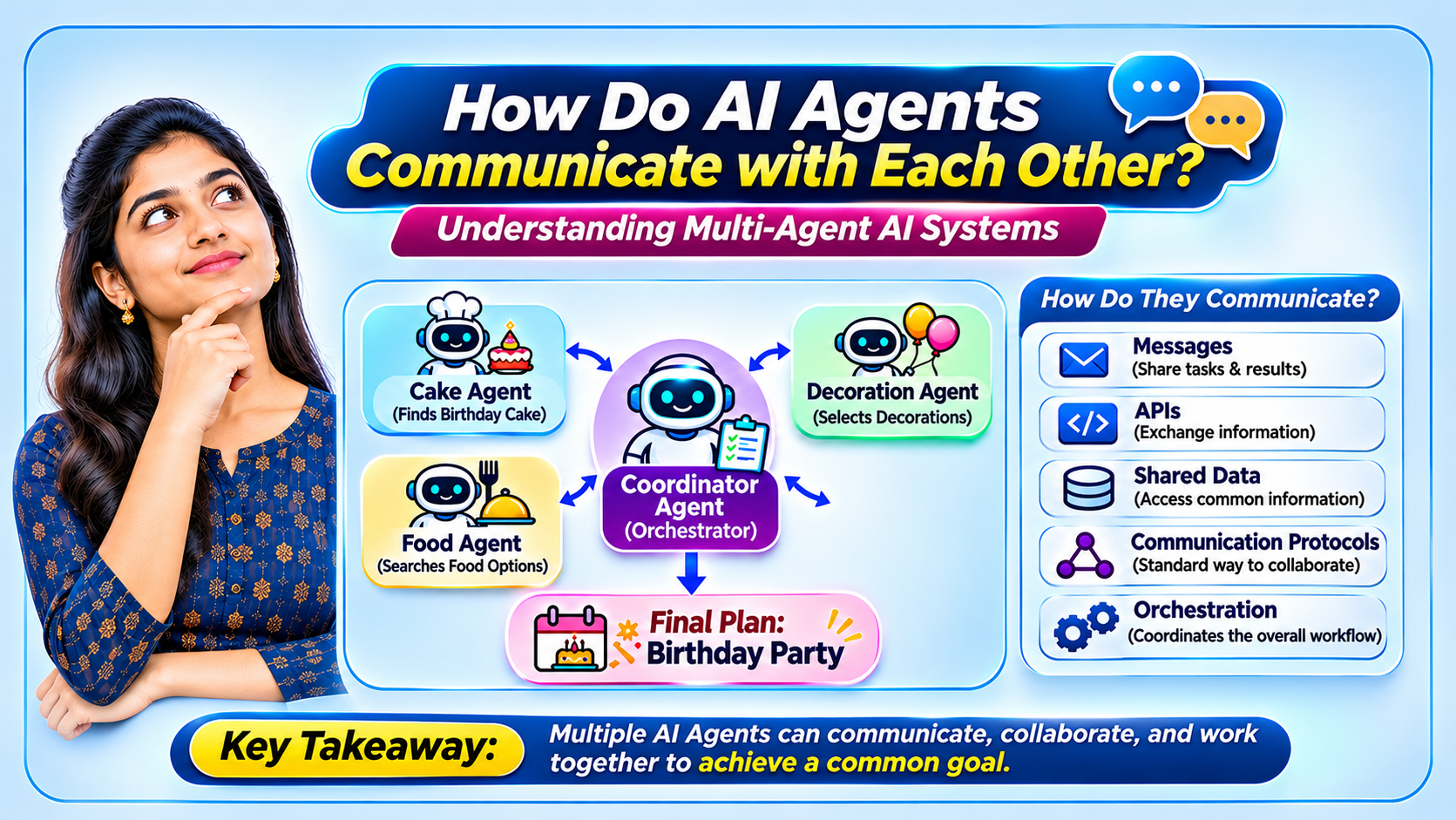
Artificial Intelligence is evolving beyond simple chatbots and individual AI applications. Modern AI systems are becoming more capable of handling complex tasks by using multiple AI Agents that collaborate with each other. Instead of depending on a single AI Agent to complete every activity, organizations can build systems where different AI Agents work together, exchange information, share responsibilities, and achieve a common goal. This approach is known as Multi-Agent AI Systems.
But how do these AI Agents communicate with each other? How does one AI Agent request information from another? How do they share task details, exchange results, and coordinate their activities?
AI Agents communicate through structured messages, APIs, shared data, communication protocols, and orchestration mechanisms. These communication methods allow individual agents to perform specialized tasks while working together as part of a larger AI application.
Understanding AI Agent communication is important for learning Agentic AI, Multi-Agent Systems, and modern AI application architecture.
Read Also: What Is Agentic AI? Understanding AI That Can Plan and Take Action
What Is an AI Agent?
An AI Agent is a software system that can understand a given objective, process information, make decisions, and perform actions to achieve a specific goal. Depending on its design and permissions, an AI Agent can interact with users, access external tools, retrieve information, execute workflows, and communicate with other systems.
For example, imagine a customer support application that uses an AI Agent to answer customer questions. The agent can understand the customer’s request, retrieve relevant information from a knowledge base, check customer details through connected systems, and generate an appropriate response.
In more advanced applications, multiple AI Agents can work together. One agent may collect information, another may analyze it, and a third agent may prepare the final response. Each agent has a specific responsibility, but all agents contribute toward completing the overall task.
What Is Multi-Agent Communication?
Multi-Agent Communication refers to the process through which multiple AI Agents exchange information, instructions, task details, and results to complete a shared objective.
In a Multi-Agent System, every agent may have a different role, capability, and responsibility. These agents need a way to communicate so that they can understand what other agents are doing and determine what action should be performed next.
For example, consider an AI system designed to organize a birthday party. Instead of asking one AI Agent to handle everything, the system can assign different responsibilities to specialized agents. A Cake Agent can search for suitable birthday cakes, a Decoration Agent can identify decoration requirements, and a Food Agent can find food options. A Coordinator Agent can collect the information from all these agents, organize the results, and prepare the final birthday party plan.
This collaboration helps divide a complex task into smaller activities that can be handled by specialized agents.
Read Also: How Do We Evaluate AI Agent Performance?
How Do AI Agents Communicate With Each Other?
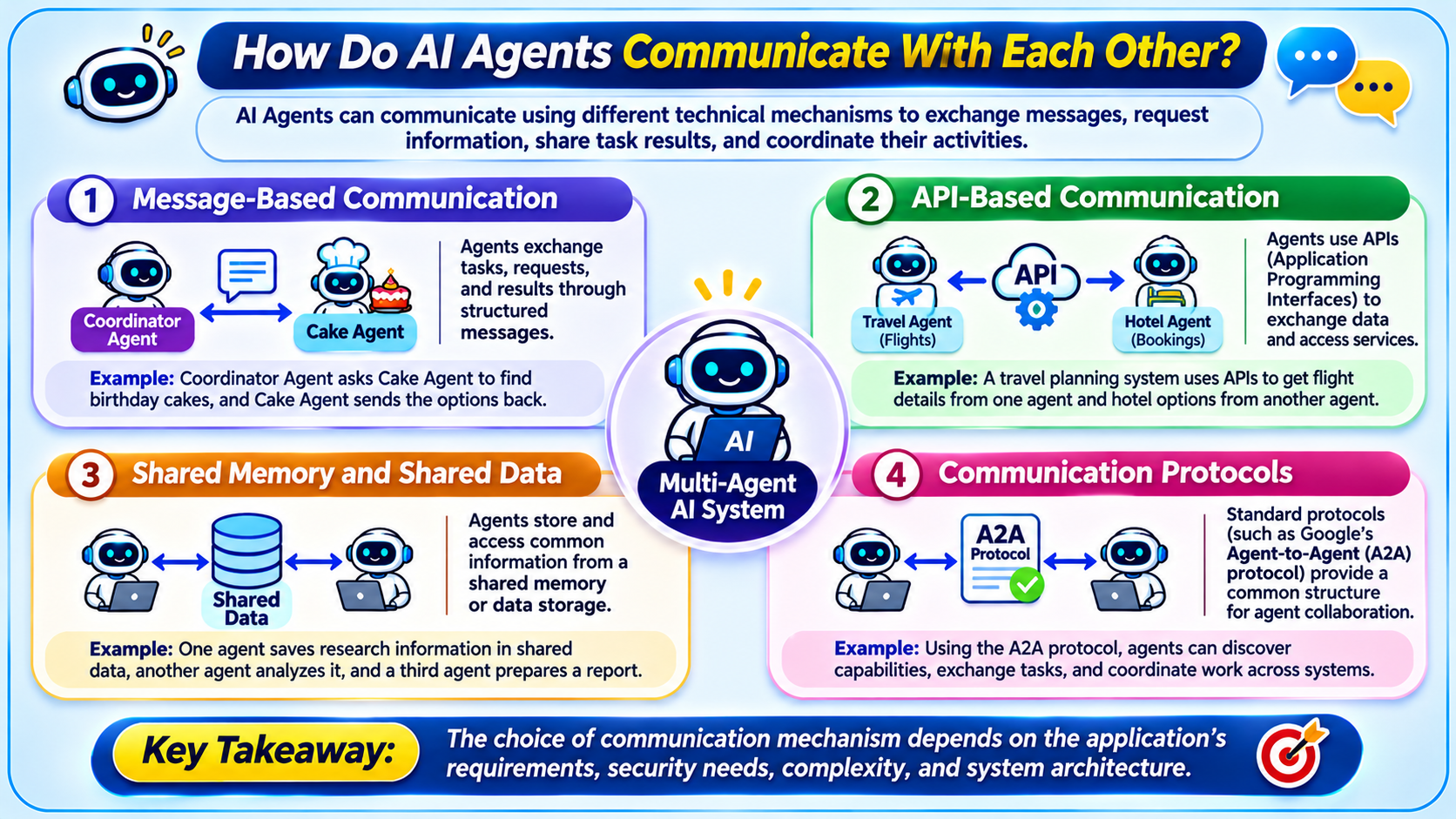
AI Agents can communicate using different technical mechanisms depending on the architecture of the application. These mechanisms help agents exchange messages, request information, share task results, and coordinate their activities.
1. Message-Based Communication
Message-based communication is one of the common approaches used in Multi-Agent Systems. In this approach, one AI Agent sends a message to another agent containing information about a task, a request, or a result.
For example, a Coordinator Agent responsible for organizing a birthday party may send a message to the Cake Agent asking it to find suitable birthday cakes. The Cake Agent processes the request, searches for relevant options, and sends the results back to the Coordinator Agent.
The Coordinator Agent can then use this information along with the results received from other agents to prepare the final plan.
Messages can contain structured information such as the task description, required inputs, agent identification, status, and expected output. This makes it easier for different agents to understand and process requests.
2. API-Based Communication
Application Programming Interfaces, commonly known as APIs, allow different software applications and services to communicate with each other. AI Agents can use APIs to exchange information, request services, and access the capabilities of other agents.
For example, imagine a Travel Planning AI System. One agent handles flight information, another handles hotel bookings, and another searches for tourist attractions. These agents may communicate through APIs to request information and share their results with the main application.
An API request can contain the required information, while the API response provides the result. Depending on the architecture, an agent may communicate with another agent directly through an API or communicate through a central application that manages the requests.
REST APIs are commonly used in these types of software integrations. They allow applications developed using different technologies to exchange information over HTTP.
3. Shared Memory and Shared Data
Some Multi-Agent Systems use shared memory or shared data storage to exchange information between agents. Instead of sending every piece of information directly to another agent, an agent can store its findings in a common location that authorized agents can access.
For example, imagine a research application where one AI Agent collects information about a particular topic and stores the findings in a shared data store. Another AI Agent can access that information and analyze it further. A third agent can use the analysis to prepare a final report.
Shared memory helps agents maintain common information and avoid repeating the same work. However, the system must manage data access, synchronization, and updates carefully to ensure that agents work with accurate and relevant information.
4. Communication Protocols
When different AI Agents need to communicate across different applications, platforms, or environments, communication protocols can provide a common structure for exchanging information.
For example, Google’s Agent-to-Agent (A2A) protocol is designed to support communication and collaboration between AI agents. It provides a standardized approach for agents to discover capabilities, exchange task information, and coordinate work across different systems.
Protocols help reduce communication complexity, especially when agents are developed using different technologies or frameworks.
The choice of communication mechanism depends on the application’s requirements, security needs, complexity, and system architecture.
What Is the Role of a Coordinator Agent?
In many Multi-Agent Systems, a Coordinator Agent or Orchestrator manages the overall workflow. Its responsibility is to understand the user’s request, divide a complex task into smaller activities, assign those activities to suitable agents, collect their responses, and combine the results.
For example, imagine a user asks an AI system to organize a birthday party within a specific budget. The Coordinator Agent first understands the user’s requirements, such as the date, number of guests, location, and budget. It then assigns the cake search to the Cake Agent, decoration planning to the Decoration Agent, and food selection to the Food Agent.
Each specialized agent completes its assigned activity and sends the results back to the Coordinator Agent. The Coordinator Agent checks the available information, combines the results, identifies any missing details, and prepares a complete birthday party plan for the user.
The Coordinator Agent acts as the central decision-making and workflow management component in this architecture. However, not every Multi-Agent System requires a central coordinator. Some systems use decentralized communication, where agents communicate and coordinate directly with one another.
Read also: What Is Task Decomposition in Agentic AI? How AI Agents Break Complex Tasks into Smaller Steps
Real-Time Example: AI Agents Organizing a Birthday Party
Let’s understand Multi-Agent Communication through a practical example.
Imagine you ask an AI application to organize your birthday party. You provide details such as the event date, number of guests, preferred food, decoration style, and budget.
The application uses multiple AI Agents, each responsible for a particular activity. The Coordinator Agent receives your request and divides the work into smaller tasks. It sends the cake requirements to the Cake Agent, decoration details to the Decoration Agent, and food preferences to the Food Agent.
The Cake Agent searches for suitable cake options and shares the available choices, prices, and other relevant details. The Decoration Agent identifies decoration materials and estimates the cost. Meanwhile, the Food Agent searches for suitable food options based on the number of guests and the available budget.
All these agents communicate their results to the Coordinator Agent through messages, APIs, or other configured communication mechanisms. The Coordinator Agent combines the information, checks whether the suggestions fit the budget, and prepares a final birthday party plan.
This example demonstrates how multiple specialized AI Agents can collaborate to complete a complex task that would otherwise require several individual activities.
How Does Information Flow Between Multiple AI Agents?
The communication process generally begins when a user provides a request to the AI application. The main system interprets the request and identifies the tasks that need to be completed.
The Coordinator Agent then assigns each task to the appropriate specialized agent. Every agent receives its instructions, performs its assigned activity, and returns the result through the configured communication mechanism.
The Coordinator Agent collects these responses and determines whether additional information or actions are required. If all the required tasks are completed, it combines the results and provides the final output to the user.
For example, a simple communication flow can look like this:
User Request → Coordinator Agent → Specialized AI Agents → Task Results → Coordinator Agent → Final Response.
This process allows multiple agents to work together while keeping their individual responsibilities organized.
Benefits of Communication Between AI Agents
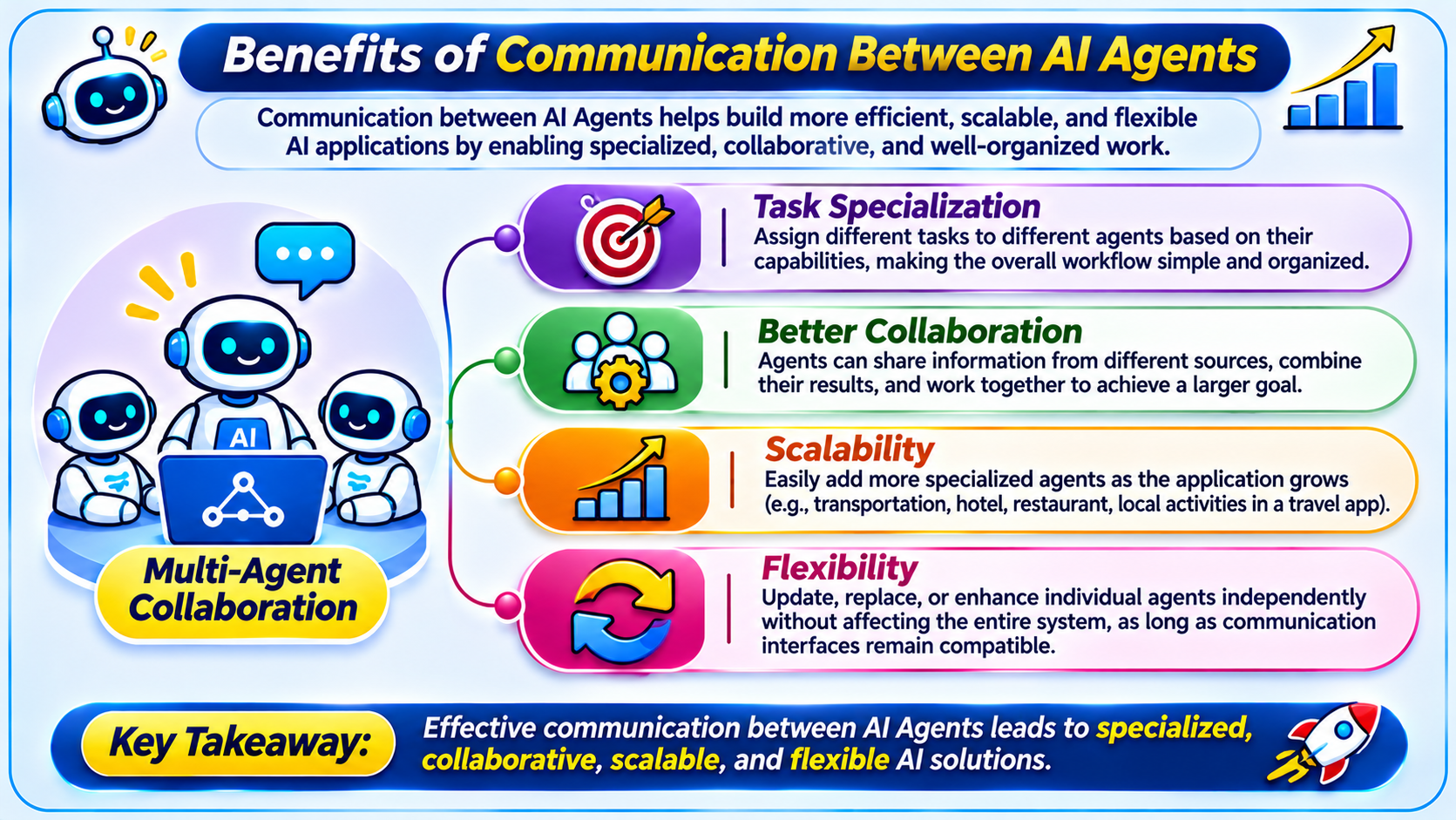
Communication between AI Agents provides several advantages when building complex AI applications. One important benefit is task specialization. Instead of making one agent handle every responsibility, developers can assign different tasks to agents with specific capabilities. This can make the overall workflow easier to organize and maintain.
Another benefit is collaboration. Multiple agents can contribute information from different sources and combine their results to complete a larger objective. This is particularly useful in research applications, customer support systems, business automation, and data analysis workflows.
Multi-Agent Communication can also support scalability. As application requirements grow, developers can introduce additional specialized agents without redesigning every part of the system. For example, a travel planning application can introduce separate agents for transportation, hotel selection, restaurant recommendations, and local activities.
It can also improve flexibility because different agents can be updated or replaced independently, provided that their communication interfaces and responsibilities remain compatible with the overall system.
Challenges in Multi-Agent Communication
Although communication between AI Agents provides several advantages, it also introduces technical challenges.
One major challenge is communication complexity. When multiple agents exchange information, developers must ensure that every agent understands the messages it receives. If agents use different data formats or interpret instructions differently, the overall workflow may produce incorrect results.
Another important challenge is security. AI Agents may access customer information, business applications, databases, and external services. Therefore, communication channels must be protected through appropriate authentication, authorization, and access controls.
Data consistency is another concern. If multiple agents update shared information simultaneously, the system must ensure that agents do not work with conflicting or outdated data.
Performance and scalability also need attention. When many agents communicate with each other, the number of messages and API requests can increase. Developers must manage response times, communication failures, resource usage, and unnecessary repeated requests.
Finally, reliability is important. If one agent fails to complete its task or returns incorrect information, the Coordinator Agent should be able to identify the problem and decide whether to retry the task, request another agent’s help, or ask for human intervention.
Where Are Multi-Agent Systems Used?
Multi-Agent Systems can be useful in several industries because many business activities involve multiple tasks and information sources.
In customer support, one agent can understand a customer’s query, another can retrieve relevant knowledge base information, and another can check order details. A coordinating component can combine the information and prepare a response.
In healthcare research, specialized agents can help organize medical literature, analyze research information, and prepare summaries for qualified professionals to review.
In finance, different agents can support document processing, transaction analysis, risk assessment, and report preparation. Appropriate security controls and human review are particularly important in these applications.
In e-commerce, agents can help with product discovery, inventory checking, order status, and customer assistance. In travel applications, agents can work together to organize flights, hotels, transportation, and sightseeing plans.
These examples demonstrate how Multi-Agent Systems can coordinate different activities within a larger business process.
Conclusion
AI Agents do not always need to work independently. They can communicate with other agents, exchange information, share task results, and collaborate to complete complex objectives.
Message-based communication, APIs, shared memory, and specialized communication protocols help agents coordinate their activities. A Coordinator Agent or Orchestrator can manage the workflow by assigning tasks, collecting results, and preparing the final response.
As AI technology continues to evolve, Multi-Agent Systems are becoming an important approach for developing advanced AI applications. Understanding how AI Agents communicate with each other is a valuable step toward learning Agentic AI and building intelligent, collaborative systems.
The future of AI is not just about building smarter individual agents. It is also about enabling multiple AI Agents to communicate, collaborate, and work together effectively.
Read Also: What Is a Feedback Loop in AI Agents?

