
What Is Agentic AI? Understanding AI That Can Plan and Take Action
Introduction to Agentic AI
Artificial Intelligence is evolving beyond systems that simply answer questions or generate content. A new approach called Agentic AI enables AI systems to work toward specific goals by planning tasks, making decisions, using tools, and taking actions with varying levels of human supervision. Instead of responding to every instruction as an isolated request, an Agentic AI system can understand a broader objective, identify the steps required to achieve it, and coordinate those steps to produce a useful result.
Agentic AI is becoming an important concept in the development of intelligent assistants and automated business processes. It combines capabilities such as reasoning, planning, memory, and tool usage to help AI systems handle tasks that involve multiple stages. This makes it useful in situations where achieving a goal requires more than providing a single answer.
What Is Agentic AI?
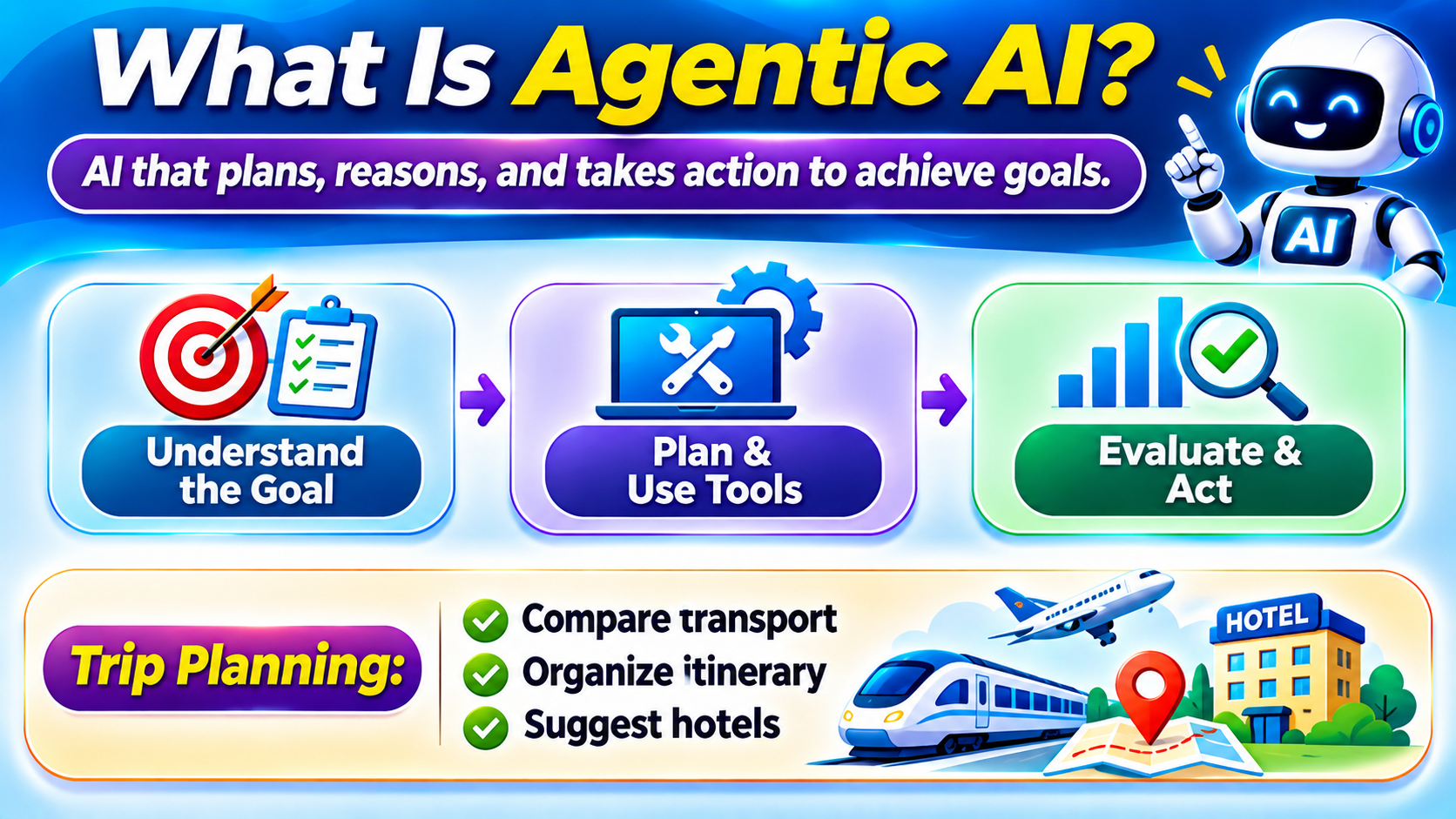
Agentic AI refers to AI systems designed to pursue a goal by determining what needs to be done and taking appropriate actions toward that goal. These systems can break complex requests into smaller tasks, decide which actions are appropriate, use connected tools or applications, and evaluate the results of their actions.
For example, when a user asks an AI system to plan a trip within a specific budget, a traditional AI assistant might provide general travel information. An Agentic AI system can go further by identifying transportation options, comparing prices and schedules, organizing an itinerary, and suggesting suitable accommodation. If connected to appropriate services and granted permission, it may also attempt to complete actions such as booking tickets or reserving a hotel.
The key distinction is that Agentic AI focuses not only on generating information but also on progressing toward a defined objective through a sequence of decisions and actions.
Ready to build your future in Artificial Intelligence? Explore our comprehensive AI Training Program, designed to help you understand key AI concepts, gain practical skills, and work on real-world projects. Click here to learn more about the course, curriculum, and training details.
How Does Agentic AI Work?
Agentic AI typically begins by interpreting the user’s request and identifying the intended outcome. It then determines which tasks are necessary to achieve that outcome. A complex goal may be divided into smaller, manageable steps, each of which contributes to the overall objective.
After creating a plan, the system selects suitable actions and tools. These tools may include web search, APIs, databases, business applications, or other software services. The agent uses the available information to perform each task and checks the results to determine whether the plan is working as expected. If circumstances change or an action fails, it may revise the plan and try an alternative approach.
This process can involve repeated cycles of planning, acting, and evaluating. The agent continues until it reaches the goal, encounters a limitation, or needs additional information or approval from the user. The exact capabilities depend on the model, tools, permissions, and safeguards configured for the system.
A Real-World Example: Planning a Trip from Hyderabad to Tirupati
Imagine asking an AI assistant, “I want to travel from Hyderabad to Tirupati. My budget is ₹5,000. Create a good trip plan for me.” This request involves several related tasks, including transportation, budgeting, accommodation, and deciding which places to visit.
A traditional AI assistant might respond with general information about trains, travel costs, and popular destinations in Tirupati. An Agentic AI system, when equipped with suitable tools, can approach the request as a multi-step goal. It can search for trains that fit the budget, compare departure times and ticket prices, and organize the most suitable options into a travel plan. It can also look for accommodation and suggest places to visit based on the available time and budget.
If the user authorizes the necessary actions and the system has access to booking tools, it may attempt to book a ticket or reserve a hotel. Before carrying out consequential actions such as making a payment or confirming a reservation, the system should follow the required permission and approval process. This example demonstrates how Agentic AI can coordinate multiple tasks instead of requiring the user to provide a separate instruction for every step.
Agentic AI vs. Traditional AI
Traditional AI systems are often designed to perform a specific task, such as answering a question, classifying an image, summarizing text, or generating content. They generally respond to the input they receive and provide an output for that request.
Agentic AI is designed to work toward a broader goal that may require several steps. It can plan a sequence of tasks, use tools to gather information or perform actions, and adapt its approach based on the results. While traditional AI is often focused on producing an answer, Agentic AI can focus on completing a workflow.
However, Agentic AI does not mean that every system can act independently or complete every task automatically. Its level of autonomy depends on the tools it can access, the permissions it has been granted, and the safeguards in place.
Key Capabilities of Agentic AI
One important capability of Agentic AI is task planning. It can transform a broad request into smaller tasks and determine an order in which to complete them. This helps the system manage requests that involve multiple activities and dependencies.
Another capability is reasoning and decision-making. The agent can evaluate available information, compare alternatives, and select an action that aligns with the user’s goal and constraints. For example, when planning a trip, it may compare travel time, cost, and convenience before recommending an option.
Tool usage allows Agentic AI to interact with external systems. Depending on its configuration, it may retrieve information from websites, query databases, call APIs, or work with business applications. Memory can also help an agent use relevant information from previous interactions, such as a user’s preferences, when that information is available and appropriate to retain.
Finally, Agentic AI may evaluate the outcomes of its actions and adjust its plan when necessary. This ability to respond to new information makes it more flexible than a fixed sequence of instructions, although it does not guarantee that every decision or action will be correct.
Applications of Agentic AI
Agentic AI can support many real-world workflows. In customer service, an agent may understand a customer’s request, retrieve relevant account information, and help resolve an issue through connected systems. In travel planning, it can compare transportation and accommodation options and organize an itinerary. In business operations, it may coordinate tasks across applications, retrieve records, prepare reports, or assist with routine administrative processes.
In education, an agent could help organize learning activities, recommend resources, or assist teachers with administrative tasks. In software development, it may help investigate errors, suggest code changes, or coordinate steps in a development workflow. These applications depend on the quality of the underlying AI system, the data it can access, and the tools and permissions provided to it.
Challenges and Responsible Use
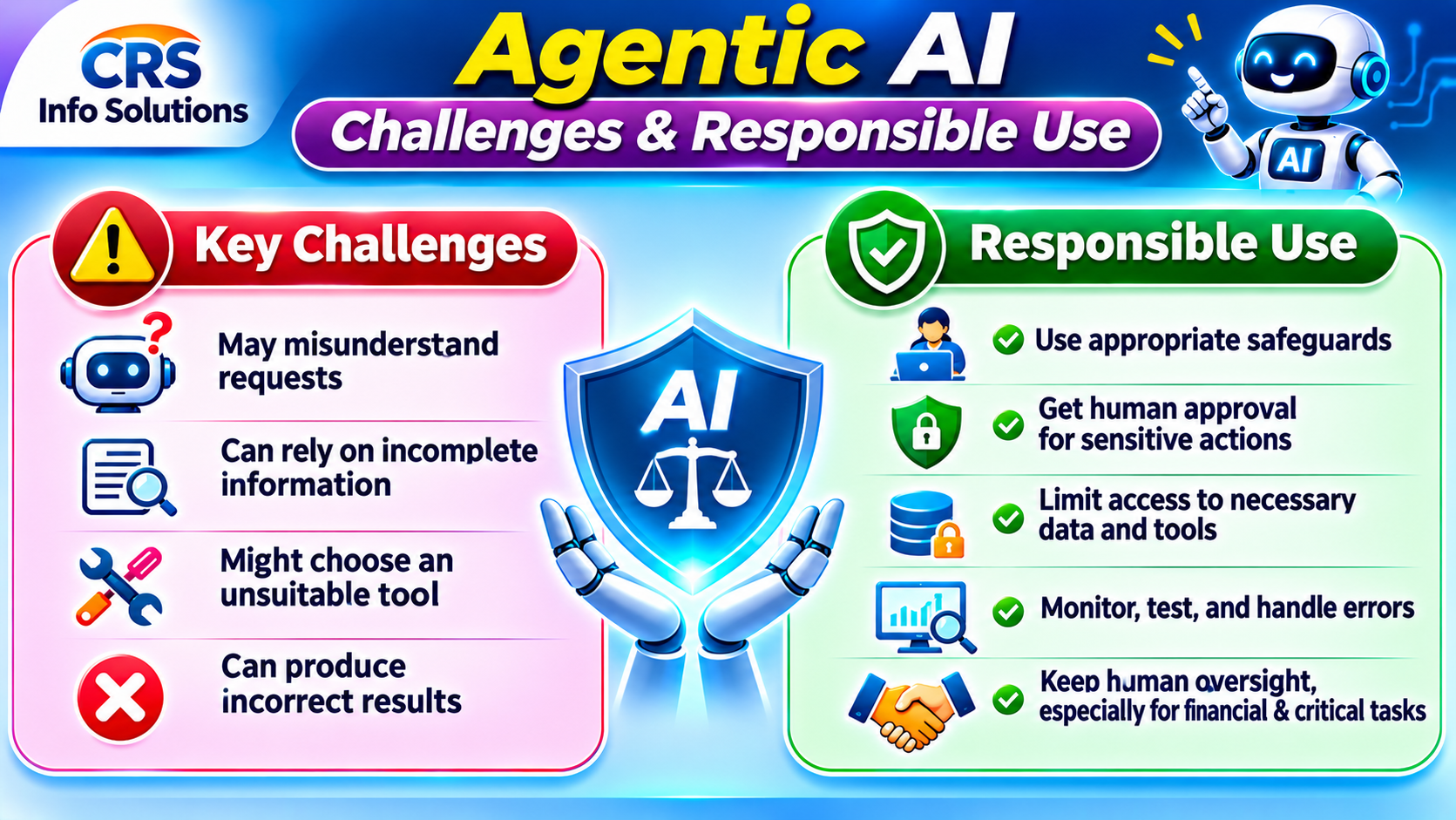
Although Agentic AI offers useful capabilities, it also introduces challenges. An agent may misunderstand a request, rely on incomplete information, select an unsuitable tool, or produce an incorrect result. When connected to external systems, an incorrect action may have consequences beyond the conversation.
For this reason, Agentic AI systems should be designed with appropriate safeguards. Sensitive actions may require human approval, and access to data and tools should be limited to what is necessary. Developers should also monitor system behavior, test important workflows, handle errors carefully, and make it clear when the agent is uncertain or unable to complete a task.
Human oversight remains important, especially for actions involving money, personal information, business-critical records, or other consequential decisions. Agentic AI is most effective when its capabilities are matched with clear permissions, reliable tools, and responsible supervision.
Conclusion
Agentic AI represents an important development in Artificial Intelligence by enabling systems to work toward goals through planning, reasoning, tool usage, and action. Rather than simply responding to individual questions, an agent can coordinate multiple tasks, evaluate results, and adapt its approach when needed.
The trip-planning example illustrates this difference: an Agentic AI system can help compare transportation, organize an itinerary, and potentially assist with bookings when appropriate tools and permissions are available. As these systems continue to develop, they are likely to play an increasingly important role in personal assistants, business automation, and intelligent applications.
Understanding Agentic AI provides a foundation for exploring how AI systems can move from generating answers to helping accomplish real-world tasks.
Read Our More Articles:
What Is AI Model Serving? How Do You Make a Trained Model Available to Users?
Which One Is Better: Loop with SOQL or Create a List Then Loop?

