
What Is the Attention Mechanism in AI? A Complete Guide with Real-World Examples
The Attention Mechanism is one of the most important concepts in modern Artificial Intelligence (AI), particularly in Natural Language Processing (NLP), Transformer architectures, and Large Language Models (LLMs) such as ChatGPT. It enables an AI model to identify relationships between different parts of an input and determine how much information from each part should contribute to its current computation. When a model processes a sentence, paragraph, or document, every word does not provide the same amount of useful information for understanding every other word. Some words provide essential context, while others may be less relevant to a particular interpretation. The Attention Mechanism helps the model learn these relationships by calculating attention scores and using them to combine information from relevant tokens. This capability has made attention a foundational technology behind many modern AI systems, including language generation, machine translation, text summarization, question answering, and several computer vision applications. To understand why attention is important, it helps to begin with a simple example from everyday language and then explore how the mechanism works inside a Transformer model.
Understanding the Attention Mechanism with a Simple Example
Imagine reading the sentence, “Ramu is playing cricket because he loves it.” As a human reader, you can usually understand that the word “he” refers to Ramu and the word “it” refers to cricket because you recognize the relationships between the words and use the surrounding context to interpret their meanings. An AI language model must learn similar contextual relationships when processing text. When the model encounters “he,” information about “Ramu” may help it construct a useful representation of the pronoun, while information about “cricket” may help it interpret “it.” The Attention Mechanism provides a mathematical way for the model to calculate how information from different tokens can contribute to the representation of a particular token. Instead of relying only on the immediately preceding word, the model can consider relationships with other words in the sentence, including words that appear farther away. The exact attention weights depend on the model’s learned parameters and the input, so attention does not simply follow a fixed rule that pronouns always refer to the nearest noun. Rather, it learns patterns from training data that help the model represent context and relationships more effectively.
What Is the Attention Mechanism in Artificial Intelligence?
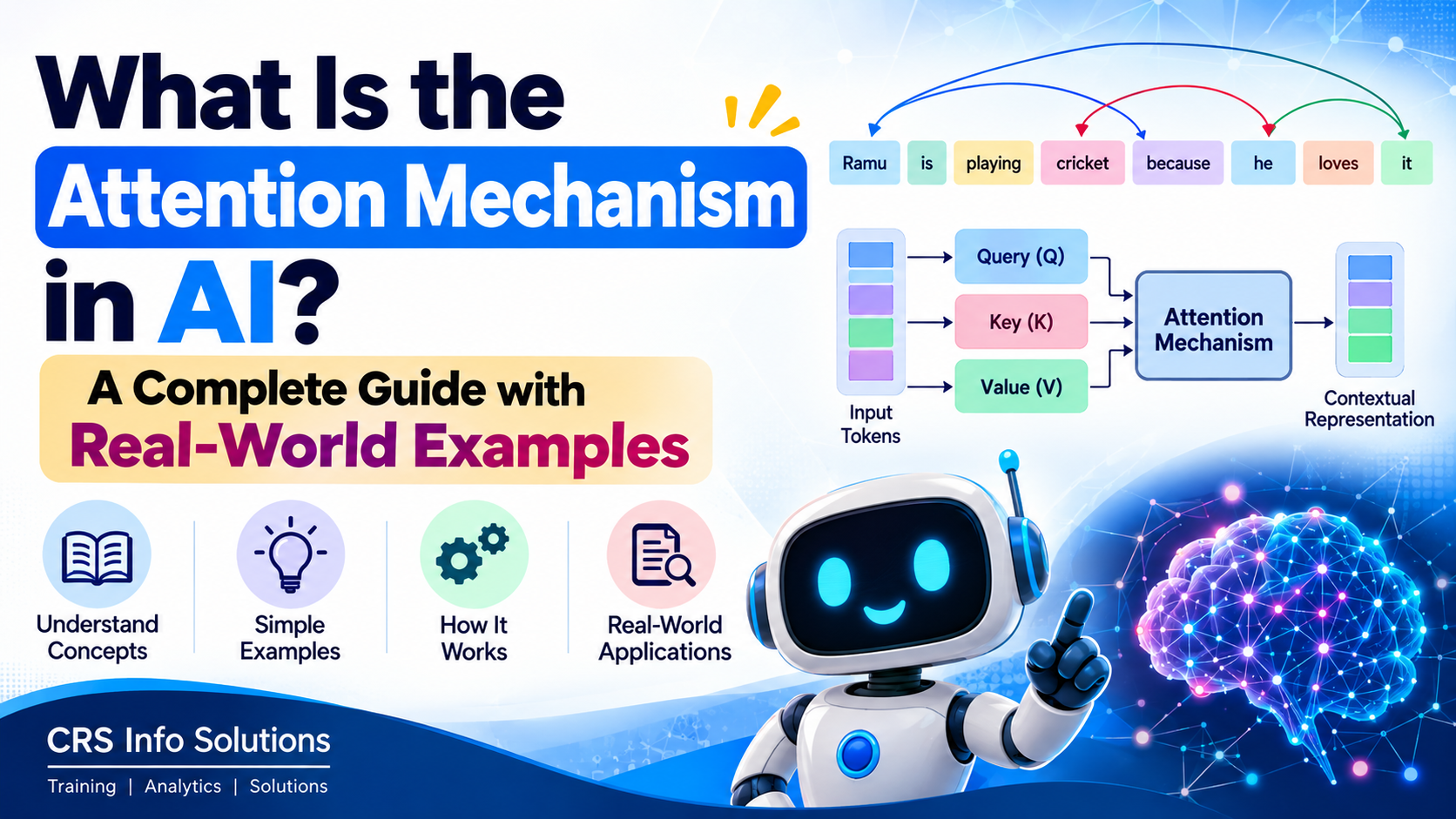
In Artificial Intelligence, the Attention Mechanism is a technique used in neural networks to assign different weights to information from different parts of an input when producing a representation or output. It is especially important in sequence-processing tasks, where the meaning of one element can depend on other elements in the sequence. For example, when an AI system processes the sentence “I deposited money in the bank,” the words “deposited” and “money” provide useful contextual information for interpreting “bank” as a financial institution. In another sentence, such as “We sat on the bank of the river,” the surrounding words provide a different context and suggest a geographical meaning. Attention helps a model calculate relationships between tokens and combine their representations so that the resulting representation can reflect the context in which a word appears. The mechanism typically uses Query, Key, and Value vectors to calculate relevance scores, convert those scores into normalized weights, and produce a weighted combination of information. Although attention is often described as a way for AI to “focus” on important words, this is a simplified explanation of a mathematical operation rather than human-like conscious attention. Its practical value comes from helping neural networks learn contextual relationships that are useful for predicting, classifying, translating, or generating information.
Want to Learn Artificial Intelligence (AI)?
Join Our Complete AI Training Program!
Why Is the Attention Mechanism Important in AI?
The Attention Mechanism is important because language and many other forms of data contain relationships that cannot always be understood by examining individual elements in isolation. In a long sentence, a pronoun may refer to a person or object mentioned several words earlier, and the meaning of a particular word may depend on the topic being discussed. Traditional sequence-processing approaches can have difficulty preserving useful information across long sequences, depending on the architecture and task. Attention offers a flexible way to calculate relationships between different positions in an input, allowing information from relevant tokens to contribute to the representation being constructed. This is particularly valuable in Transformer models, where self-attention helps process contextual relationships across a sequence and can be computed in parallel during training. Attention also supports the development of contextual representations, meaning that the representation of a word can change depending on the sentence in which it appears. These capabilities help modern AI models perform complex tasks such as answering questions about documents, summarizing articles, translating languages, and generating coherent text. However, attention alone does not guarantee that a model will understand every sentence correctly; the quality of the result also depends on training data, model architecture, learned parameters, and the task being performed.
Read also :What Is Clustering in Machine Learning? A Complete Guide with Real-World Examples
What Is the Role of Attention in Transformer Models?
The Transformer architecture uses attention as a central mechanism for processing relationships between tokens. Introduced in the influential research paper “Attention Is All You Need,” the Transformer design made attention the primary mechanism for connecting information across sequence positions, rather than relying on recurrent processing as in traditional recurrent neural networks. A Transformer first converts input tokens into numerical representations, often called embeddings, and then processes those representations through layers that include attention and feed-forward computations. In self-attention, the model calculates how the representation of one token relates to the representations of other tokens in the same sequence, subject to any masking rules required by the architecture. The resulting attention weights determine how information from other tokens contributes to each token’s updated representation. Multiple attention heads can operate with different learned projections, allowing the model to represent several kinds of relationships within a layer. In autoregressive language models, causal masking prevents a token from accessing future tokens during next-token prediction, while encoder-style models may allow tokens to attend to other positions throughout the input. This flexible design is one reason Transformers have become widely used in large language models, machine translation, document understanding, and other AI applications.
How Does the Attention Mechanism Work?
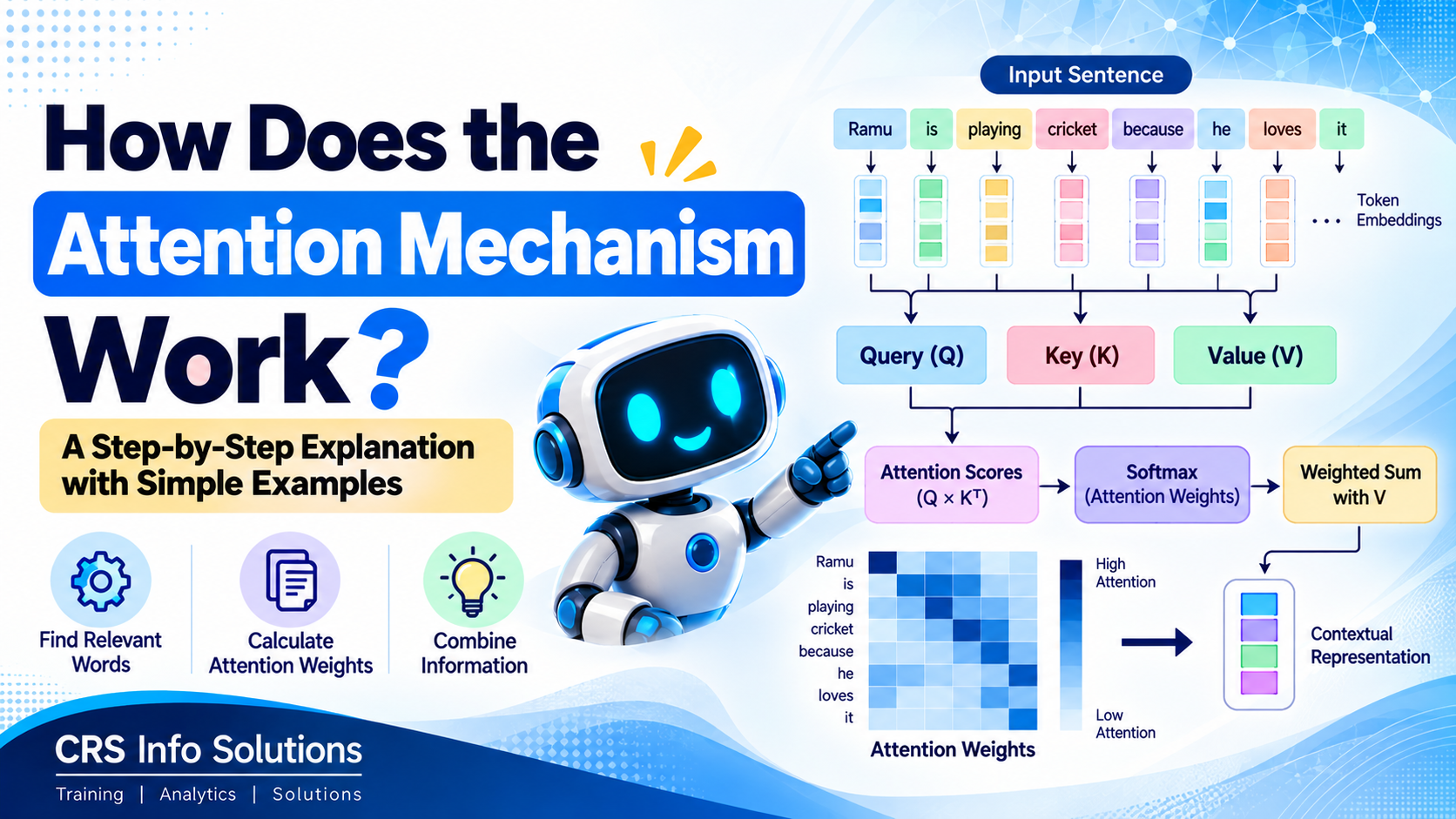
The Attention Mechanism works by transforming input representations into three components known as Query, Key, and Value, commonly abbreviated as Q, K, and V. The Query represents the information a token uses to determine what may be relevant to it, while each Key provides information used to calculate how relevant a token is to a given Query. The Value contains the information that can be combined after the relevance scores have been calculated. The model compares Queries with Keys, often using dot products, to produce attention scores. These scores are scaled and passed through a softmax function, which converts them into normalized weights. The model then multiplies the weights by the corresponding Value vectors and combines the results to produce an updated representation. For example, when processing the word “bank” in a sentence about depositing money, the attention calculations may allow information from words such as “deposited” and “money” to contribute to the contextual representation of “bank.” The model learns the projections and relationships during training rather than following a manually programmed dictionary of word relationships. The same mathematical process can be applied across many tokens and repeated in multiple layers, helping the network build increasingly contextual representations of the input.
Understanding Query, Key, and Value
Query, Key, and Value are the three central components of the standard scaled dot-product attention operation, and a simple comparison with a search system can help explain their roles. A Query is similar to the information used to express what a token is looking for, a Key is similar to a representation used to determine whether a token is relevant to that Query, and a Value is the information that can be retrieved and combined once relevance has been calculated. For example, if a model is processing the pronoun “it” in the sentence about Ramu playing cricket, its Query vector is compared with Key vectors associated with the available tokens. These comparisons produce attention scores that determine how strongly the corresponding Value vectors contribute to the resulting representation. The Query, Key, and Value vectors are generated through learned transformations of the input representations, so they are not literal questions, labels, or database records. Their purpose is mathematical: Queries and Keys determine the attention weights, while Values supply the information combined using those weights. This separation allows a Transformer to learn which relationships are useful for its training objective and downstream tasks.
See also: What Is Learning Rate in Machine Learning? Definition, Examples, and Importance
The Scaled Dot-Product Attention Formula
The standard scaled dot-product attention operation is represented by the formula Attention(Q, K, V) = softmax(QKᵀ / √dₖ)V. In this formula, Q represents the Query matrix, K represents the Key matrix, and V represents the Value matrix. The expression Kᵀ is the transpose of the Key matrix, and dₖ is the dimension of the Key vectors. The product QKᵀ calculates similarity scores between Queries and Keys, while division by the square root of dₖ scales those scores to help control their magnitude. The softmax function converts the scaled scores into normalized attention weights, and those weights are applied to the Value matrix to calculate the final output. In practical terms, the formula enables a model to calculate which tokens should contribute more information to a particular representation. This computation is performed using numerical vectors and matrices rather than by directly comparing the written meanings of words. The model learns useful relationships through training, and the attention operation applies those learned representations to the input sequence.
What Is Self-Attention in AI?
Self-attention is a specific form of attention in which the Queries, Keys, and Values are derived from the same sequence of input representations. It enables each token to gather contextual information from other tokens in that sequence, making it useful for representing relationships between words and phrases. Consider the sentence, “The student submitted the assignment after completing it.” To interpret “it,” the model may need information about “the assignment,” which appears earlier in the sentence. Self-attention calculates relationships between tokens so that information from the relevant parts of the sentence can contribute to the representation of “it.” The model does not need to restrict its calculations to neighboring words; depending on the architecture and masking rules, it can calculate relationships across many positions in the sequence. In an encoder-style Transformer, tokens can generally attend to other tokens in the input, whereas a causal language model prevents a token from attending to future positions during next-token prediction. Self-attention is therefore a key part of how Transformers learn contextual representations and process language efficiently.
What Is Multi-Head Attention?
Multi-Head Attention extends self-attention by running several attention operations in parallel, with each head using its own learned Query, Key, and Value projections. Each head can learn different patterns of relationships from the same input, and the resulting outputs are combined to create a richer representation. For example, while processing a sentence, different heads may learn patterns that help represent relationships between pronouns and nouns, connections between nearby words, or dependencies between words that appear farther apart. These examples illustrate possible learned patterns rather than fixed responsibilities assigned to particular heads. One head does not necessarily correspond to one grammatical rule, and interpreting the behavior of individual heads can require additional analysis. By combining the outputs of multiple heads, the model can represent different aspects of the input within the same Transformer layer. This provides greater flexibility than using only a single attention operation and contributes to the ability of Transformer architectures to learn complex relationships in text and other types of data.
What Is the Difference Between Attention, Self-Attention, and Cross-Attention?
Attention is the general mechanism used to calculate weighted combinations of information according to learned relevance scores. Self-attention is a particular form in which the Queries, Keys, and Values come from the same sequence of representations, allowing tokens to exchange contextual information with other tokens in that sequence. Cross-attention, in contrast, allows Queries from one sequence or representation set to attend to Keys and Values from another representation set. This is especially useful in encoder-decoder architectures, where an encoder processes the source input and a decoder uses cross-attention to access the encoder’s representations while producing an output. For example, in a machine translation system, the encoder may process an English sentence and the decoder may generate a Telugu translation while using cross-attention to access relevant information from the English input. Self-attention helps build contextual representations within a sequence, while cross-attention helps one representation set incorporate information from another. Both mechanisms are important in different Transformer designs, and their use depends on the architecture and task.
Real-World Applications of the Attention Mechanism
Large Language Models
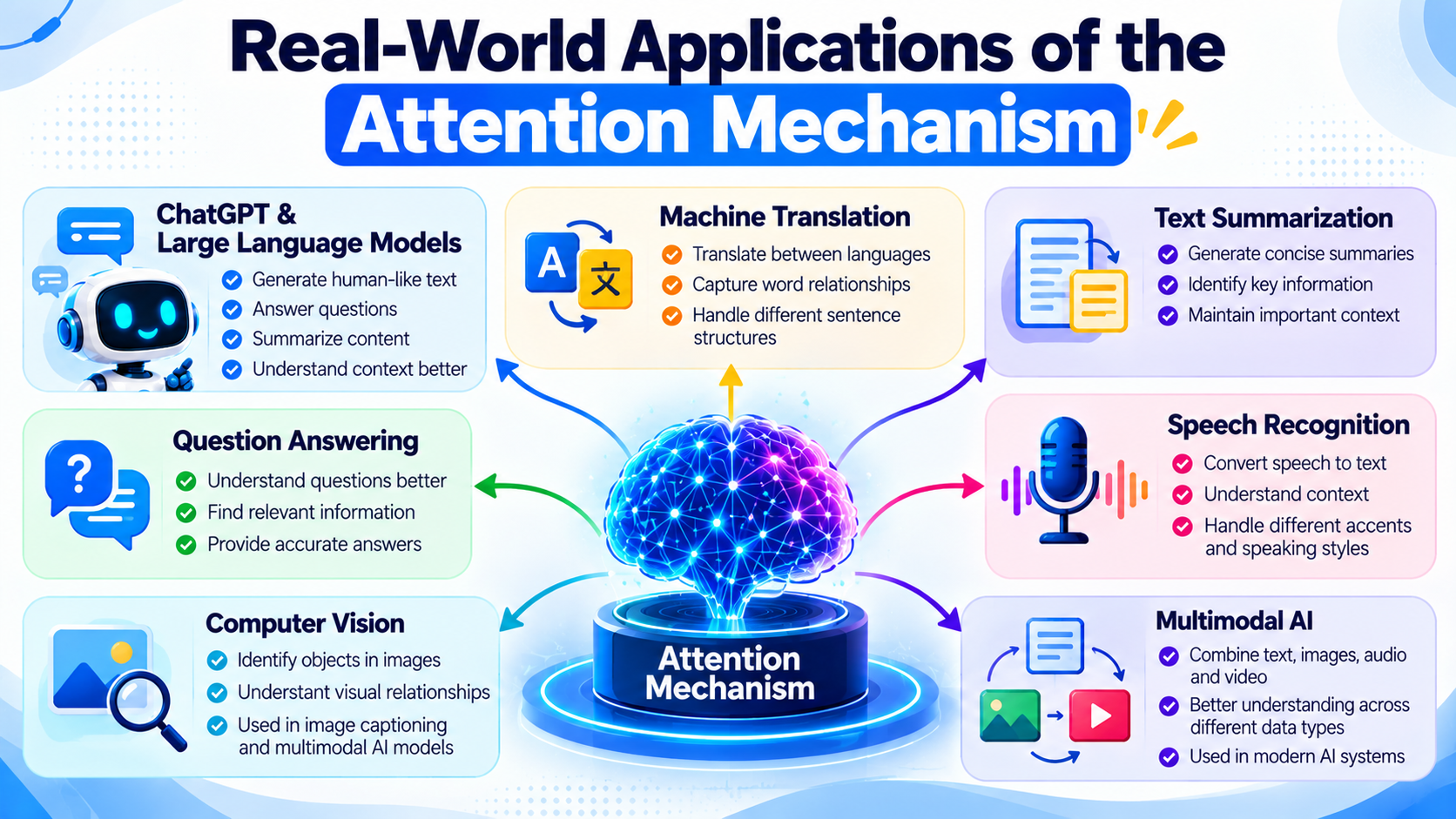
Large Language Models use Transformer-based architectures to process text and generate responses. Attention allows these models to calculate relationships between tokens and combine relevant contextual information when constructing representations used for next-token prediction. For example, when a user asks a question about a paragraph, the model processes the words in the question and the supplied context, and attention helps connect information across the input. During text generation, causal self-attention allows the model to use previously available tokens when calculating the representation used to predict the next token. This supports applications such as conversational assistants, text generation, summarization, explanation, and question answering. However, attention is only one part of a language model, and it does not guarantee that every generated answer is correct or that the model always uses evidence appropriately. Training data, model design, instruction tuning, and other components also influence how the model behaves.
Machine Translation
Machine translation systems convert text from one language into another, and attention can help them represent relationships between words and phrases across languages. A sentence may have different word orders, grammatical structures, or expressions in the source and target languages, so translating each word independently is often insufficient. In an encoder-decoder Transformer, the encoder represents the source sentence, while the decoder generates the translation and can use cross-attention to access the source representations. For example, when translating an English sentence into Telugu, the model may need to consider the meaning of a phrase as a whole rather than translating each English word in isolation. Attention helps the decoder incorporate relevant information from the source sentence while producing target-language tokens. Translation quality still depends on the model’s training data, linguistic coverage, architecture, and ability to handle ambiguity and cultural context.
Text Summarization
Text summarization involves producing a shorter version of a document while preserving its most important information. Attention helps a summarization model represent relationships between different parts of the input and combine contextual information while generating a summary. For example, when summarizing a long article about climate change, a model may need to connect information about causes, effects, evidence, and proposed solutions rather than simply selecting isolated words. Attention supports the representation of those relationships, while the model’s training objective and learned parameters influence the content of the generated summary. Depending on the summarization method, the model may generate new wording or select important portions of the source. Attention does not guarantee that every important fact will be retained, so summaries still need to be checked for missing context, factual errors, and misleading simplifications.
Question Answering
Question-answering systems use AI to respond to questions based on general knowledge or supplied information. Attention helps a model represent relationships between the question and the relevant parts of the context. For example, if a passage explains a company’s annual revenue, location, and founding year, a user may ask specifically about its revenue. A model can use contextual relationships to process the question and the relevant information in the passage when constructing an answer. In retrieval-augmented systems, a retrieval component may first locate relevant documents, and the language model can then process the question together with the retrieved content. Attention helps with contextual processing, but it does not independently verify whether a statement is true or whether the retrieved passage is reliable. The quality of the final answer depends on retrieval quality, the model’s capabilities, the input context, and the overall system design.
Speech Recognition
Speech recognition converts spoken language into text, and attention-based architectures can help model relationships between acoustic input and linguistic output. Depending on the system, the input may be represented as audio frames or learned acoustic features, while the output is a sequence of text tokens. Attention can help the model align relevant portions of the audio representation with the text it generates or predicts. This is useful because speech varies with accent, speaking speed, pronunciation, background noise, and sentence structure. For example, when a person speaks a long sentence, the model must use information from the audio signal and the linguistic context to determine which words were spoken. Attention can support this process, although real-world speech recognition systems may combine attention with other architectures and techniques. Accuracy also depends on training data, acoustic conditions, language coverage, and the design of the speech-processing system.
Computer Vision
Attention mechanisms are also used in computer vision, where models process images rather than only text. Vision Transformers commonly divide an image into smaller patches, convert those patches into numerical representations, and apply attention to learn relationships between different regions. For example, identifying an animal in an image may require considering several visual regions together rather than examining one small patch in isolation. Attention allows the model to combine information across patches, helping it learn representations that support image classification and other visual tasks. Attention-based approaches can also be used in systems that process both images and text, such as models that answer questions about an image. Their performance depends on the architecture, training data, image resolution, and task. Attention is one useful design component, but it does not by itself guarantee accurate object recognition or visual reasoning.
See also: Supervised Learning vs Unsupervised Learning: Key Differences, Examples, and Applications
Advantages of the Attention Mechanism
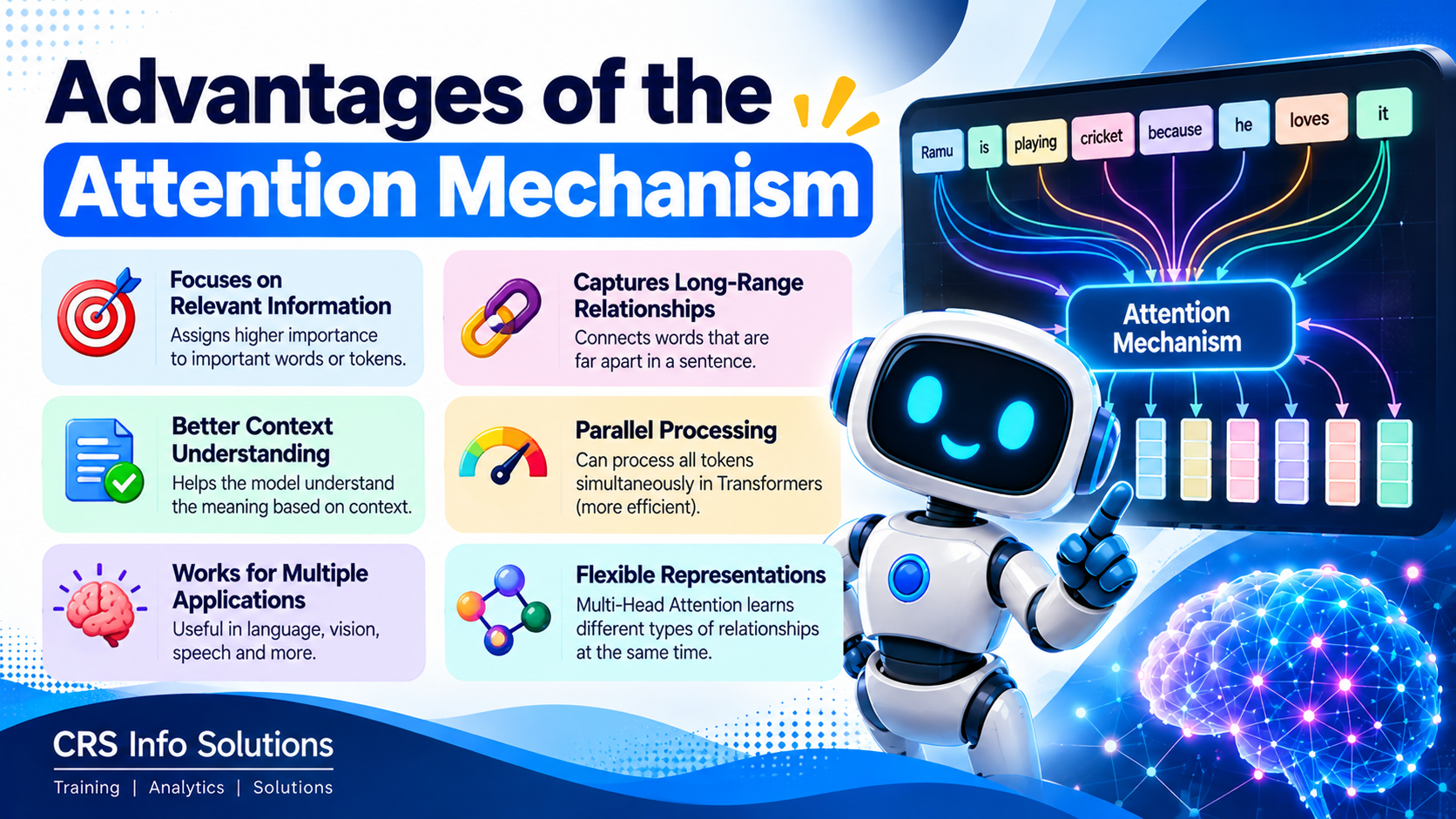
The Attention Mechanism offers several advantages that have contributed to its widespread use in modern AI. It helps neural networks learn contextual relationships between tokens and combine information from different parts of an input according to learned weights. Unlike architectures that rely exclusively on step-by-step recurrent processing, Transformer attention can calculate relationships across multiple sequence positions in parallel during training, subject to the model’s masking and implementation requirements. Multi-Head Attention provides additional flexibility by allowing multiple learned projections to represent different patterns of relationships within a layer. Attention can also be applied across different forms of data, including text, images, and audio representations, making it useful for a broad range of applications. These advantages help explain why attention is central to many language models and multimodal AI systems. Nevertheless, its effectiveness depends on the model architecture, available data, training process, and computational resources, and attention should not be treated as a complete solution to every AI problem.
Limitations of the Attention Mechanism
Although attention is powerful, it also introduces important limitations. Standard full self-attention calculates relationships across pairs of tokens, so its computational and memory requirements generally grow quadratically with sequence length. This can make processing very long documents or large inputs expensive, especially when the model must handle many tokens at once. Researchers have developed more efficient attention methods and alternative approaches to reduce these costs, but the best choice depends on the model and application. Another limitation is that attention weights should not automatically be interpreted as a complete explanation of a model’s reasoning. They show how information is weighted within a particular computation, but they do not necessarily reveal every factor responsible for the model’s final prediction. Attention also depends on learned representations, training data, and model parameters, so it cannot guarantee correct interpretations when the input is ambiguous or the model has learned misleading patterns. In practical AI development, attention must be considered alongside model evaluation, data quality, computational efficiency, and the requirements of the intended application.
Difference Between Traditional Sequence Processing and Attention
Traditional recurrent neural networks process sequence elements step by step, using hidden states to carry information from earlier positions to later positions. This approach can be useful for sequential tasks, but it may become difficult to preserve information over long distances, depending on the architecture and training conditions. Attention provides a different approach by calculating relationships between sequence positions and allowing information from relevant tokens to contribute directly to a representation. In Transformer architectures, these calculations can be performed in parallel during training, which can improve computational efficiency compared with strictly sequential processing. For example, when processing a long sentence, self-attention can calculate a relationship between two words even when several other words appear between them. However, standard full attention has significant memory and computation costs for long sequences, while some recurrent or other specialized architectures may be more suitable for particular applications. Therefore, the choice between attention-based Transformers and other sequence-processing methods depends on the task, input length, available hardware, latency requirements, and desired performance.
See also: Classification vs Regression in Machine Learning: A Complete Guide for Beginners
Conclusion: Why Is the Attention Mechanism Important in AI?
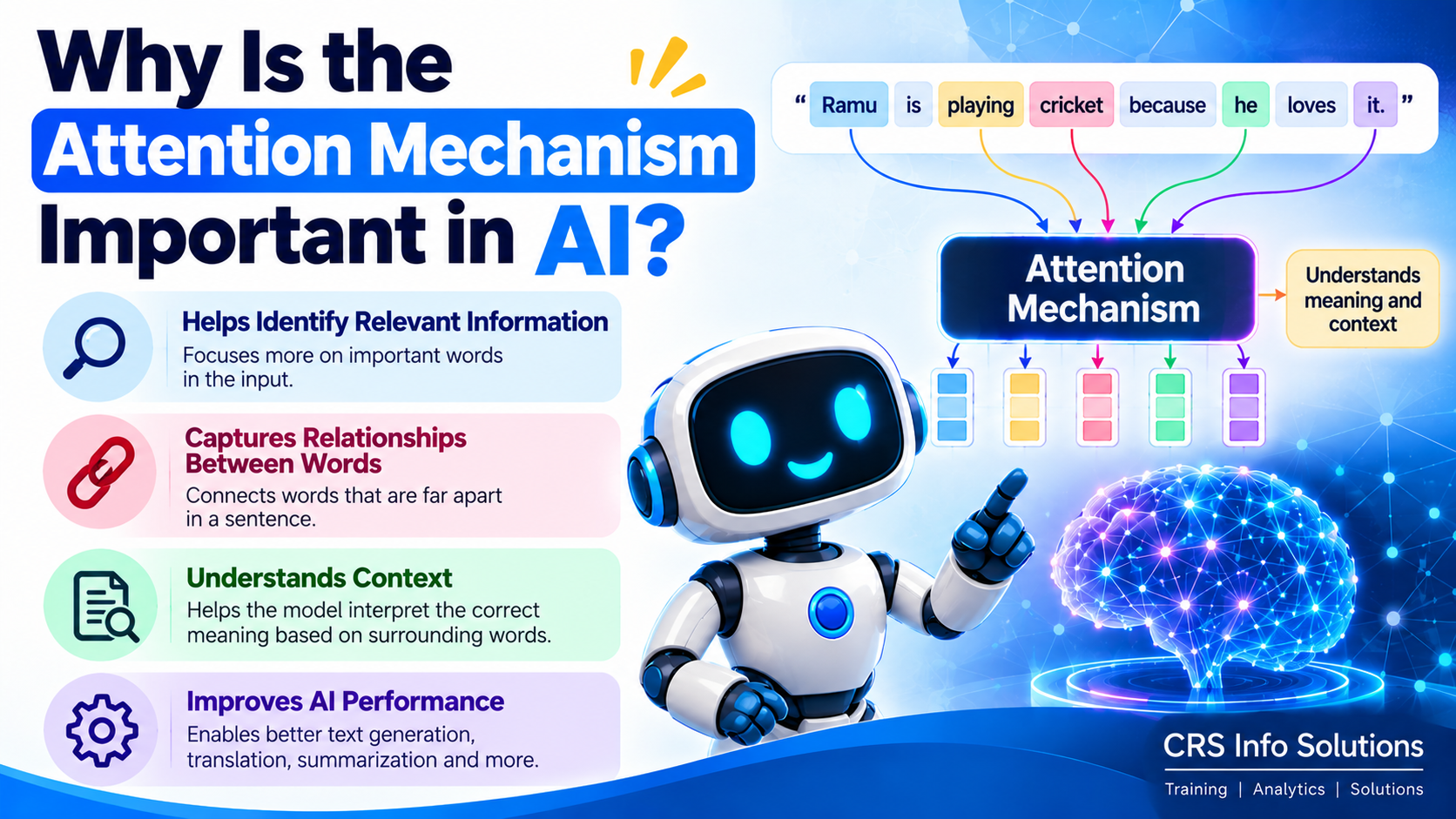
The Attention Mechanism is a foundational concept in modern Artificial Intelligence because it provides a flexible way for neural networks to calculate relationships between different parts of an input and combine relevant information into contextual representations. By using Query, Key, and Value vectors, self-attention calculates attention scores and produces weighted combinations of token representations, while Multi-Head Attention enables several learned attention operations to work together. These mechanisms support the Transformer architectures used in many Large Language Models and other AI applications, including ChatGPT, machine translation, text summarization, question answering, speech recognition, and computer vision. Although attention has limitations related to computational cost, interpretation, and model accuracy, it remains one of the most influential techniques in current AI development. Understanding how attention works provides a strong foundation for learning Transformers, Large Language Models, Generative AI, and advanced neural network architectures. In simple terms, the Attention Mechanism helps an AI model calculate which parts of its input are relevant to one another and combine that information to build a context-aware representation.

