
How Do We Evaluate AI Agent Performance?
Introduction
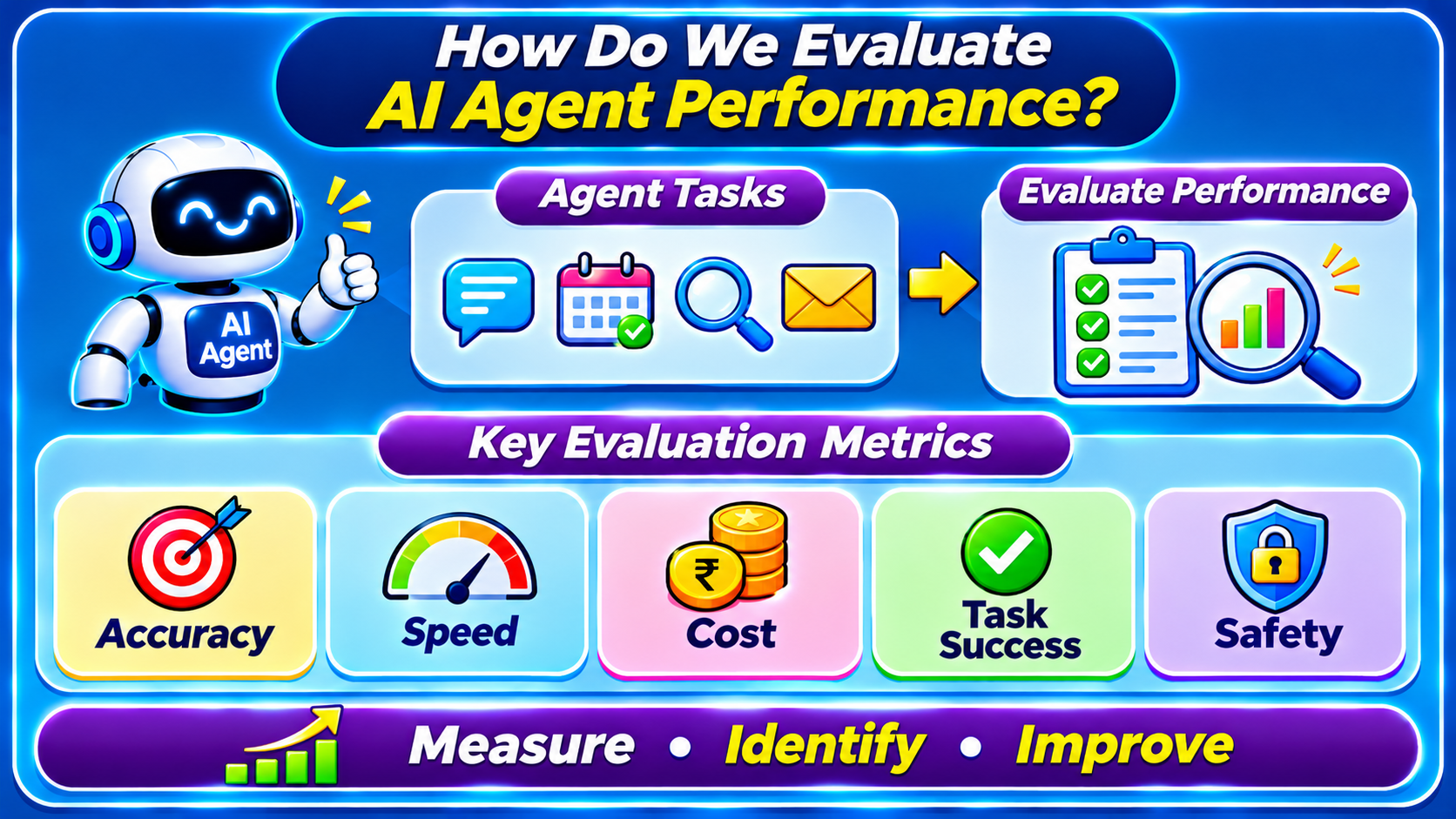
Artificial Intelligence is evolving rapidly, and AI Agents are becoming an important part of modern applications and businesses. Today, AI Agents can perform different tasks such as answering customer questions, searching for information, booking appointments, analyzing data, sending emails, and interacting with external applications through APIs. However, developing an AI Agent is not enough. We also need to understand whether it is performing its assigned tasks correctly, efficiently, safely, and consistently. This is where AI Agent Performance Evaluation becomes important.
Imagine that you have developed an AI Agent and assigned it a task. The Agent completes the task and provides a result. But how do you know whether the result is correct? Did it understand your instructions properly? Did it complete the task within the expected time? Did it use unnecessary resources? Did it follow all the rules and restrictions? These questions help us understand why evaluating AI Agent performance is essential.
AI Agent Evaluation is the process of measuring how effectively an AI Agent performs its assigned tasks by analyzing different performance metrics such as accuracy, speed, cost, task success rate, and safety. These metrics help developers identify the strengths and weaknesses of an AI Agent and improve its overall performance.
Kickstart your career in Artificial Intelligence with CRS Info Solutions’ AI Training Program. Our industry-oriented training is designed for students, freshers, IT professionals, and non-IT learners who want to build practical AI skills.
Understanding AI Agent Performance Evaluation with a Real-Life Example
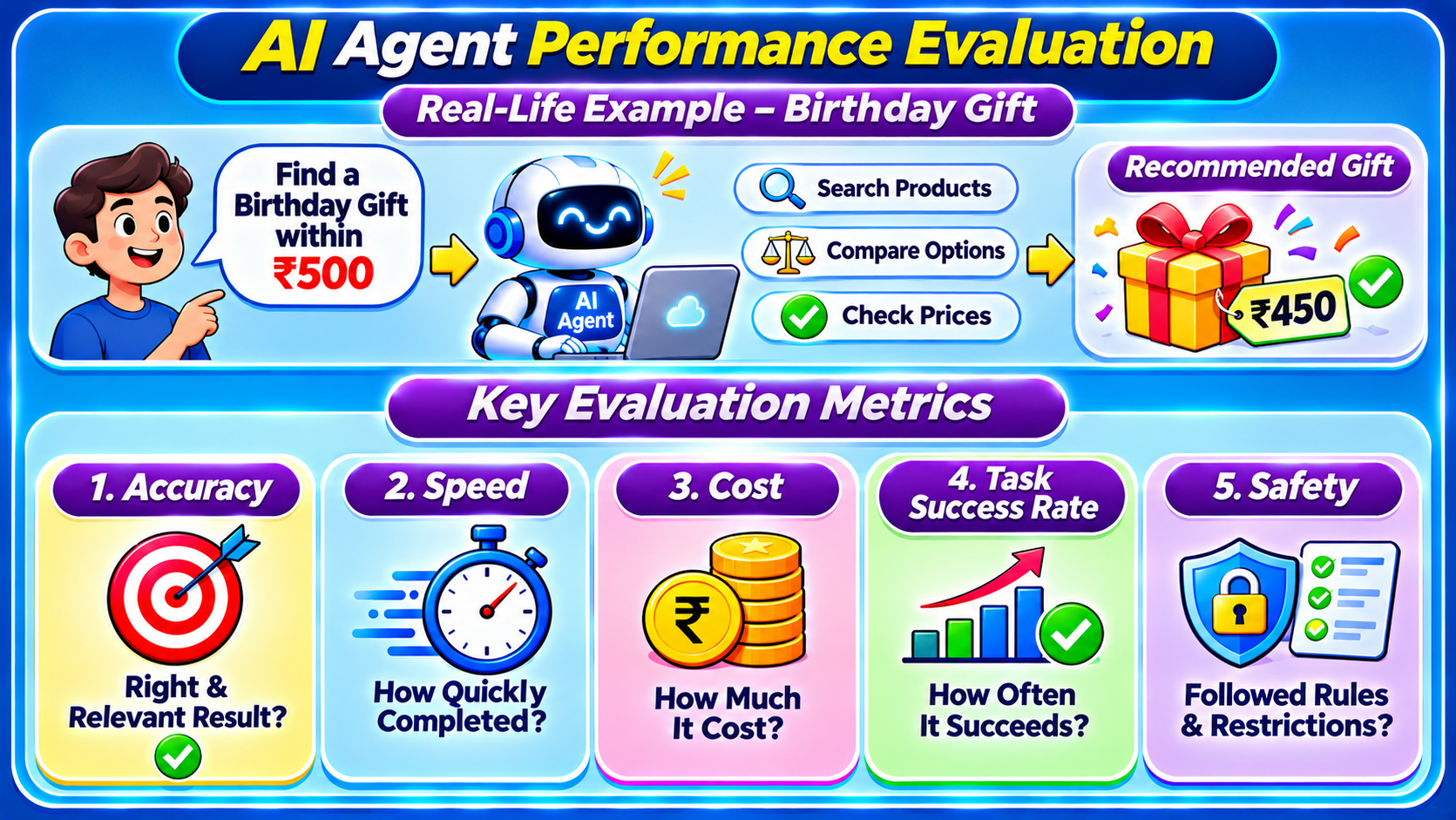
Let’s understand this concept with a simple real-life example.
Imagine that you ask an AI Agent to find a birthday gift for your friend within a budget of ₹500. The Agent needs to understand your requirement, search for suitable products, compare available options, check their prices, and recommend the best gift without exceeding your budget.
Now, suppose the AI Agent recommends a birthday gift worth ₹450. At first glance, the task looks successful. However, simply recommending a product does not mean the Agent has performed perfectly. We need to evaluate different aspects of its performance.
Did it recommend a suitable birthday gift? How quickly did it find the product? How much did it cost to complete the task? Did it stay within the ₹500 budget? Did it provide accurate product information?
To answer these questions, we use different performance evaluation metrics.
1. Accuracy – Did the AI Agent Provide the Correct Result?
Accuracy is one of the most important metrics used to evaluate AI Agent performance. It measures whether the AI Agent understands the given instructions and provides correct, relevant, and useful results.
An AI Agent may complete a task, but the output it generates must match the user’s actual requirement. If the Agent misunderstands the instructions or provides incorrect information, its performance cannot be considered successful.
For example, imagine that you ask an AI Agent to find a birthday gift within ₹500. The Agent recommends a product worth ₹450, but the product is not suitable for a birthday gift. Even though the price is within the budget, the recommendation does not satisfy the actual requirement.
This means the Agent has failed to provide an accurate recommendation.
To improve accuracy, developers evaluate the Agent’s responses using predefined test cases, expected outputs, human feedback, and automated evaluation methods. They can also check whether the Agent correctly understands user instructions, selects appropriate tools, retrieves relevant information, and produces reliable results.
In simple words, accuracy tells us whether the AI Agent is giving the right answer or performing the right action.
2. Speed – How Much Time Did the AI Agent Take?
Speed is another important metric used to evaluate AI Agent performance. It measures how much time an AI Agent takes to understand a task, process information, interact with tools, and deliver the final result.
In real-world applications, users expect AI Agents to complete their tasks within a reasonable amount of time. Even if an AI Agent provides accurate results, taking too much time to complete a simple task can negatively affect the user experience.
For example, imagine that you ask an AI Agent to find a birthday gift under ₹500. One Agent finds three suitable products within 10 seconds, while another Agent takes two minutes to provide similar recommendations.
Both Agents may provide correct results, but the first Agent offers a faster experience.
However, speed does not always mean better performance. Some tasks require more time because they involve multiple steps, external API calls, database searches, or complex reasoning. Therefore, developers need to balance response time with accuracy and reliability.
Common performance measurements include response time, task completion time, and latency. Developers may also measure the average time taken across multiple requests to understand how consistently the Agent performs.
In simple words, speed tells us how quickly an AI Agent completes its assigned task.
3. Cost – How Much Does It Cost to Complete the Task?
Cost is an important metric, especially when AI Agents are deployed in production environments and handle hundreds or thousands of user requests.
Running an AI Agent may involve several expenses, including Large Language Model API usage, token consumption, cloud infrastructure, database operations, external API calls, and other supporting services.
For example, imagine that you ask an AI Agent to find a birthday gift within ₹500. The Agent searches multiple websites, compares product details, and generates recommendations.
While completing this task, the Agent may use an LLM API, perform several searches, and make multiple external API requests. Each of these operations may contribute to the overall execution cost.
Suppose one AI Agent completes the task at a cost of ₹2, while another Agent requires ₹15 to complete the same task with similar accuracy and quality. In this situation, the first Agent may be more cost-efficient.
However, reducing cost should not affect the quality of the output. If an Agent uses fewer resources but provides inaccurate recommendations, it is not necessarily a better solution.
Developers evaluate token usage, API expenses, infrastructure costs, and the total cost per completed task. They also look for opportunities to optimize prompts, reduce unnecessary tool calls, select suitable models, and improve the Agent’s workflow.
In simple words, cost tells us how much money and computational resources are required for an AI Agent to complete a task.
4. Task Success Rate – Did the AI Agent Achieve the Assigned Goal?
Task Success Rate measures how often an AI Agent successfully completes the objectives assigned by users.
This metric is especially important because AI Agents are designed to perform tasks, not just generate text-based responses.
An Agent may provide a good explanation about a task, but that does not necessarily mean it has completed the task successfully.
For example, imagine that you ask an AI Agent to find a birthday gift under ₹500. The Agent needs to identify suitable products, verify their prices, and provide a recommendation that satisfies your requirements.
If the Agent successfully finds an appropriate product within the budget, the task can be considered successful.
But if it recommends an unsuitable product, provides an incorrect price, or fails to complete the search, the task may be considered unsuccessful.
Developers evaluate task success by defining clear completion criteria before testing the Agent.
For example, if an AI Agent receives 100 tasks and successfully completes 90 of them, its Task Success Rate is 90%.
Task Success Rate can be calculated using the following formula:
Task Success Rate = (Number of Successfully Completed Tasks / Total Number of Tasks) × 100
For example:
Total Tasks = 100
Successfully Completed Tasks = 90
Task Success Rate = (90 / 100) × 100 = 90%
This metric helps developers understand how reliably an AI Agent achieves its assigned goals.
In simple words, Task Success Rate tells us how often an AI Agent successfully completes the tasks given to it.
5. Safety – Did the AI Agent Follow the Rules and Restrictions?
Safety is one of the most critical aspects of AI Agent performance evaluation. An AI Agent should not only complete tasks correctly but also operate within predefined rules, permissions, and safety guidelines.
AI Agents may interact with sensitive information, external applications, financial systems, customer databases, and business tools. Therefore, developers must ensure that Agents do not perform unauthorized actions or violate user requirements.
Let’s understand this with our birthday gift example.
Imagine that you ask an AI Agent to find a birthday gift within ₹500. The Agent recommends a product worth ₹700 because it believes that the product is better.
Although the product may be useful, the Agent has violated your budget restriction.
Similarly, imagine that an AI Agent is asked to find a gift but attempts to make a purchase without receiving your approval. This could create an unwanted financial transaction.
These situations show why safety evaluation is important.
Developers evaluate whether an AI Agent follows user instructions, respects access permissions, protects sensitive information, avoids unauthorized actions, and requests human approval when necessary.
They also test whether the Agent can resist malicious instructions, prompt injection attacks, and attempts to access restricted information.
For important operations such as payments, deleting records, sending sensitive emails, or modifying business data, human approval can provide an additional layer of protection.
In simple words, safety tells us whether an AI Agent performs its tasks responsibly while following all the required rules and restrictions.
Read Also: What Is Task Decomposition in Agentic AI? How AI Agents Break Complex Tasks into Smaller Steps
Additional Metrics Used to Evaluate AI Agents
Apart from accuracy, speed, cost, task success rate, and safety, developers may evaluate AI Agents using several additional metrics.
Reliability
Reliability measures how consistently an AI Agent performs across repeated executions of similar tasks. An Agent that produces correct results only occasionally cannot be considered reliable.
Tool Usage Efficiency
Tool Usage Efficiency measures how effectively an AI Agent uses external tools, APIs, databases, and other resources. For example, if an Agent needs to search for a product, it should use the appropriate search tool instead of making unnecessary API calls.
Response Quality
Response Quality evaluates whether the Agent’s responses are relevant, clear, complete, and useful to users. A technically correct response may still be difficult to understand if it is poorly structured.
Robustness
Robustness measures how well an AI Agent handles unexpected situations, incomplete instructions, incorrect inputs, API failures, and changing conditions.
Consistency
Consistency measures whether the Agent provides similar levels of quality and accuracy when performing the same type of task multiple times.
These additional metrics help developers understand the overall quality of an AI Agent beyond its basic task completion capabilities.
How Do Developers Evaluate AI Agent Performance in Real-World Applications?
In real-world projects, developers do not evaluate an AI Agent using only one test or one successful execution. They create multiple test scenarios to understand how the Agent behaves under different conditions.
First, developers define the expected goals and outcomes of the AI Agent. Then, they prepare test datasets containing different user instructions and scenarios. The Agent is tested against these scenarios, and its responses and actions are evaluated.
For example, an AI Agent designed for customer support may receive different questions related to order tracking, product returns, payment issues, and delivery status.
Developers check whether the Agent understands each question, retrieves the correct information, selects the appropriate tools, and provides a useful response.
They also evaluate its execution time, token consumption, API usage, safety, and overall task success rate.
After testing, developers analyze the results to identify performance issues. If the Agent frequently provides incorrect answers, they may improve the prompts, update the knowledge base, change the model, or modify the workflow.
If the Agent takes too much time, developers may optimize tool calls or reduce unnecessary processing steps.
This evaluation process continues even after the AI Agent is deployed into production because real-world user behavior and application requirements can change over time.
Why Is AI Agent Performance Evaluation Important?
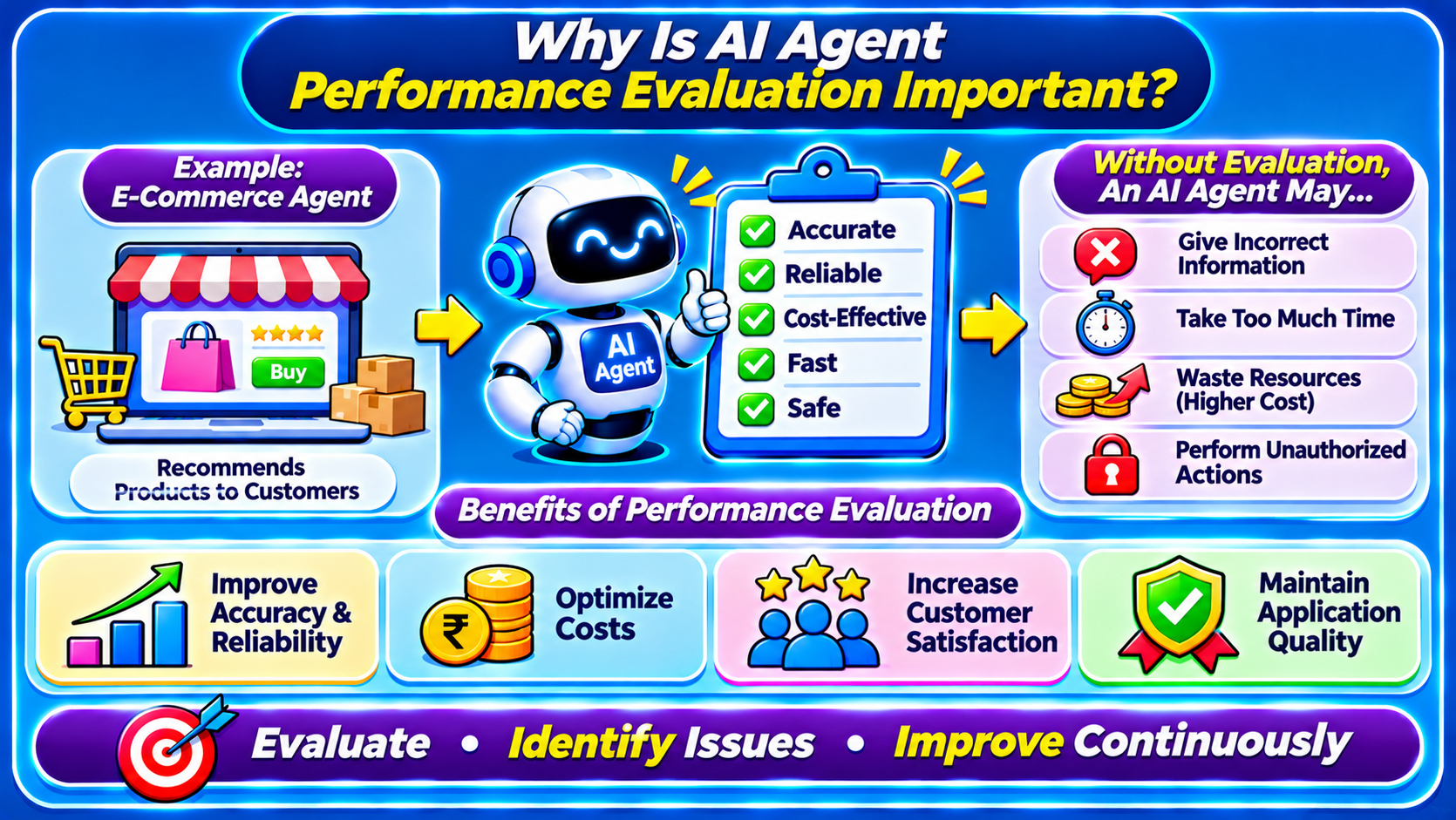
AI Agent Performance Evaluation is important because businesses need AI systems that are accurate, reliable, cost-effective, fast, and safe.
Without proper evaluation, an AI Agent may provide incorrect information, waste computational resources, take too much time, or perform actions that violate business rules.
For example, consider an AI Agent used in an e-commerce application. If it recommends incorrect products, customers may lose trust in the application. If it takes too long to respond, customers may stop using it. If it exceeds the customer’s budget, it may provide a poor experience. If it performs unauthorized transactions, it may create serious business risks.
By evaluating different performance metrics, developers can identify these problems early and continuously improve the Agent.
Performance evaluation also helps organizations compare different AI models, optimize operational costs, improve customer satisfaction, and maintain the quality of AI-powered applications.
Conclusion
AI Agent development does not end when an Agent successfully completes its first task. We must continuously evaluate its performance to understand whether it is delivering the expected results.
Accuracy helps us understand whether the Agent provides correct results. Speed measures how quickly it completes tasks. Cost tells us how many resources are required. Task Success Rate measures how often it achieves the assigned goals. Safety ensures that it follows the required rules and restrictions.
All these metrics work together to help developers build better AI Agents.
In simple terms:
Accuracy + Speed + Cost + Task Success Rate + Safety = AI Agent Performance Evaluation.
The ultimate goal is not just to build an intelligent AI Agent, but to build an AI Agent that performs tasks correctly, efficiently, consistently, and safely in real-world applications.
As AI technology continues to evolve, evaluating AI Agent performance will become an essential part of developing reliable and production-ready AI applications.
Read Also: What Is a Feedback Loop in AI Agents?
What Is Generative AI? A Simple Guide to AI That Creates New Content

