
What Is the AI Model Lifecycle? How Do You Take a Model from Development to Production?
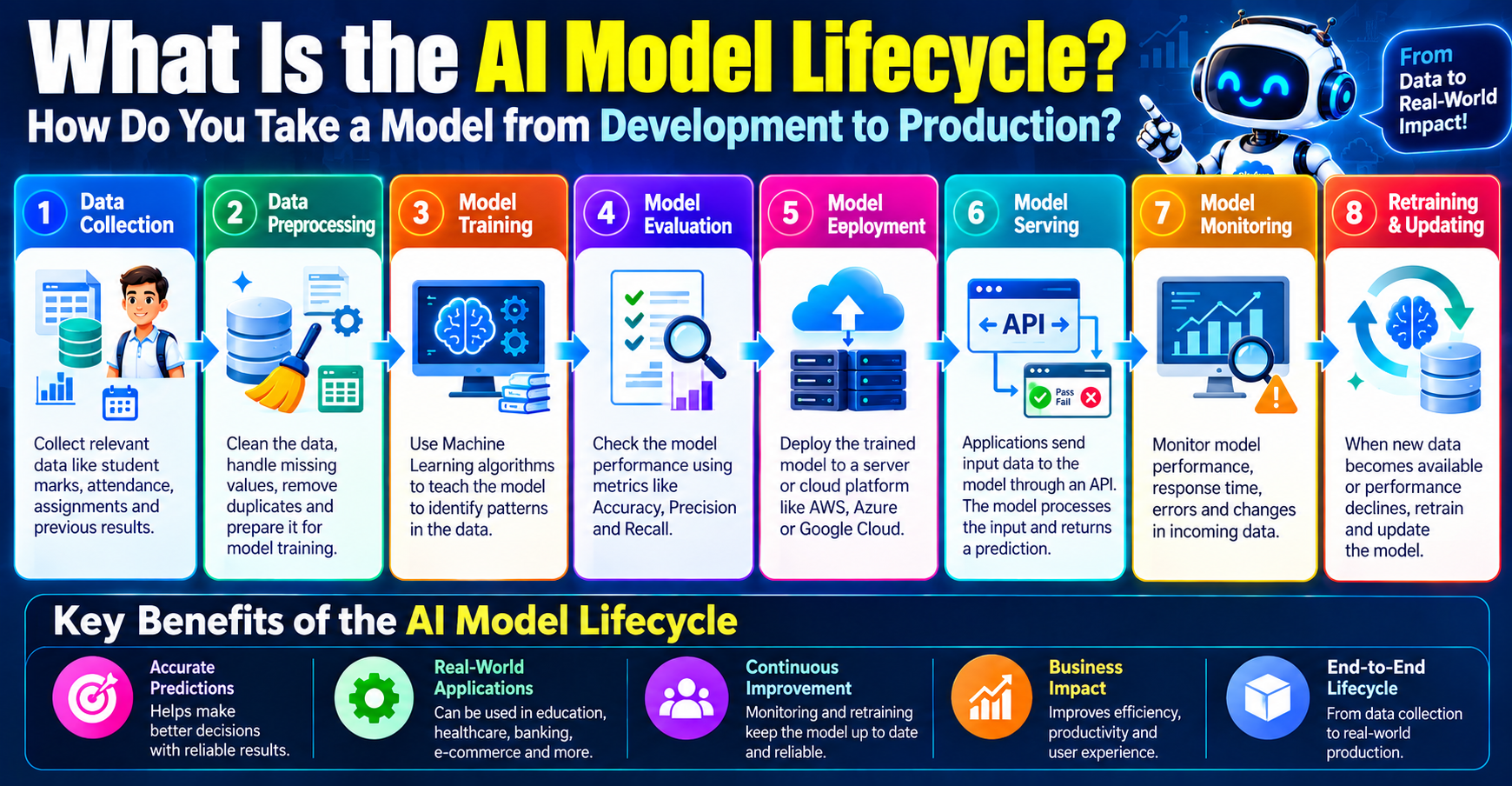
Artificial Intelligence and Machine Learning are transforming the way businesses operate, make decisions, and solve real-world problems. Today, AI models are being used in various industries, including healthcare, banking, education, e-commerce, manufacturing, and transportation. However, developing an AI model is only one part of the complete process. The real challenge is taking that model from development to production and making it available for real-world users.
This complete process is known as the AI Model Lifecycle. It includes several stages, starting from data collection and preprocessing to model training, evaluation, deployment, serving, monitoring, and retraining. Each stage plays an important role in ensuring that the AI model works accurately, efficiently, and reliably in real-world environments.
Understanding the AI Model Lifecycle with a Real-World Example
To understand the AI Model Lifecycle in a simple way, let’s consider a practical example. Imagine that we are developing a Machine Learning model to predict whether a student will pass or fail an examination based on their academic performance, attendance, assignment scores, and previous examination results. Our goal is to build an intelligent system that can analyse student information and predict their examination results.
Read Also: What Is the Attention Mechanism in AI? A Complete Guide with Real-World Examples
Data Collection: Gathering the Right Information
The first stage of the AI Model Lifecycle is Data Collection. Before developing any Machine Learning model, we need relevant and sufficient data. Data acts as the foundation for the entire AI system because the quality of the model’s predictions depends heavily on the quality of the data used during training. In our student performance prediction example, we collect information such as student marks, attendance percentage, assignment scores, classroom participation, and previous examination results. This information can be collected from school management systems, student databases, attendance applications, and academic records. The more relevant and representative the data is, the better the model can learn meaningful patterns.
Data Preprocessing: Cleaning and Preparing the Data
After collecting the data, the next stage is Data Preprocessing. In real-world applications, collected data is rarely perfect. It may contain missing values, duplicate records, incorrect entries, inconsistent formats, or unnecessary information. If we directly provide such data to a Machine Learning algorithm, it may negatively affect the model’s performance. Therefore, we need to clean and transform the data before training. For example, if a student’s attendance percentage is missing, we need to handle that missing value using an appropriate method. Similarly, duplicate student records must be removed, incorrect marks must be corrected, and categorical information must be converted into a format that the algorithm can understand. Data preprocessing makes the dataset more reliable and suitable for Machine Learning.
Model Training: Teaching the Machine Learning Algorithm
Once the data is prepared, we move to Model Training. This is the stage where the Machine Learning algorithm learns from historical data. We divide the available dataset into training and testing datasets so that we can train the model and later evaluate its performance on unseen data. In our example, the model analyses historical student records and identifies relationships between attendance, examination marks, assignment performance, and final results. For instance, it may learn that students with consistent attendance and higher assignment scores generally have a greater probability of passing examinations. The algorithm uses these patterns to build a predictive model. Depending on the problem, we can select suitable algorithms such as Logistic Regression, Decision Tree, Random Forest, or other classification algorithms.
Model Evaluation: Checking the Model’s Performance
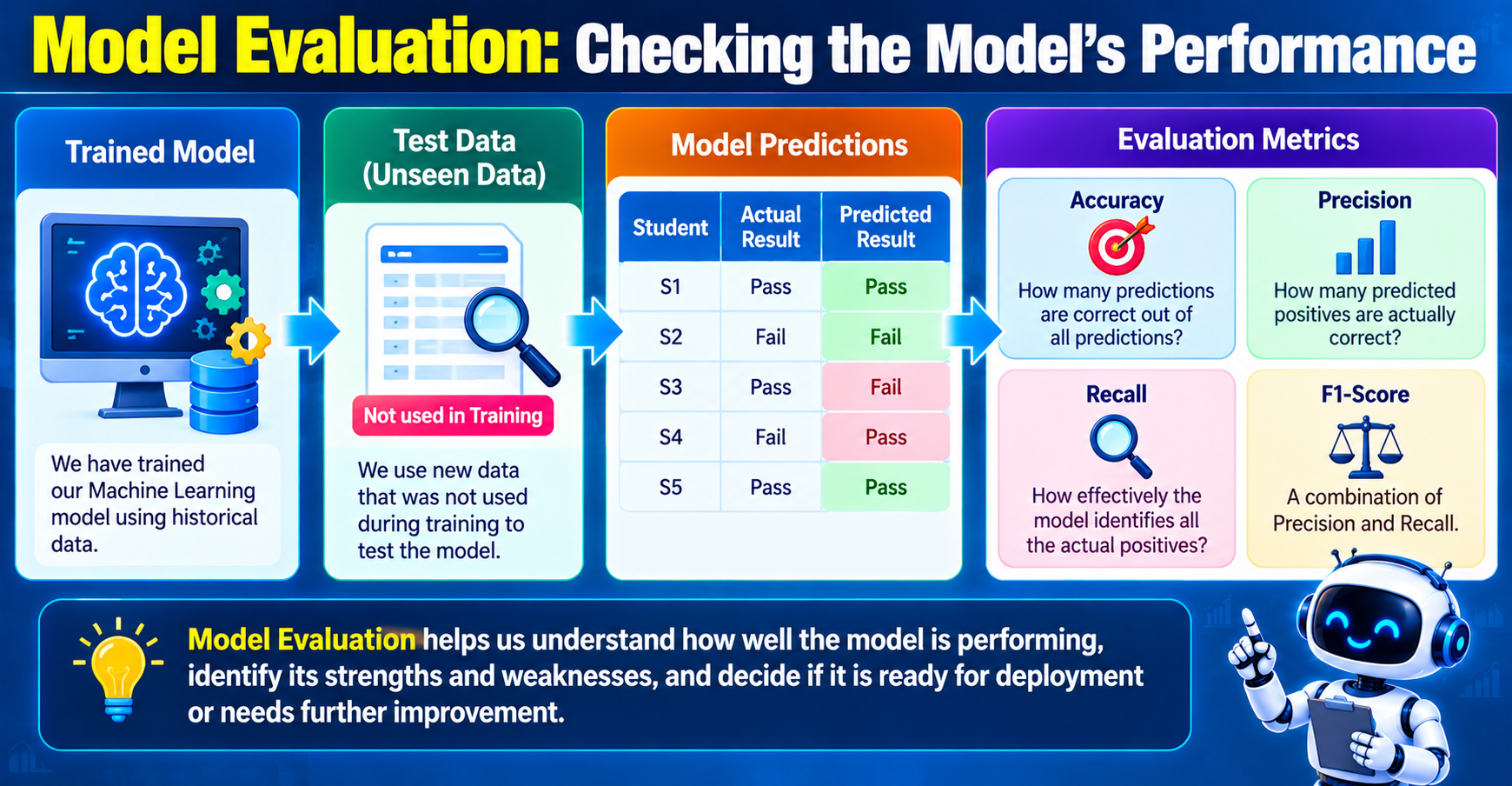
After training the model, we cannot immediately assume that it will produce accurate predictions. We must verify how well it performs. This stage is called Model Evaluation. During evaluation, we test the trained model using data that was not used during the training process. We measure its performance using different evaluation metrics such as Accuracy, Precision, Recall, and F1-Score. Accuracy tells us how many predictions are correct out of all predictions. Precision helps us understand how many predictions made for a particular category are actually correct. Recall measures how effectively the model identifies all the actual cases belonging to a particular category. These metrics help us understand the strengths and weaknesses of the model. If the model does not perform well, we may need to improve the dataset, select a different algorithm, adjust model parameters, or perform additional feature engineering.
Read Also: What Is Clustering in Machine Learning? A Complete Guide with Real-World Examples
Model Deployment: Moving the Model into Production
Once the model achieves acceptable performance, the next important stage is Model Deployment. Developing a model in a local development environment is different from making it available to real-world users. Deployment means moving the trained model from the development environment to a production environment, such as a cloud platform or server. For example, imagine that a school wants to integrate our student performance prediction model into its existing student management application. We deploy the trained model to a suitable server or cloud environment so that the application can access it whenever a prediction is required. Depending on the project requirements, we may use cloud platforms such as AWS, Microsoft Azure, or Google Cloud Platform. Deployment makes the trained model accessible to other applications and systems.
Model Serving: Making Predictions Available to Applications
After deployment, we have another important stage called Model Serving. Model serving is the process of making the deployed model available to applications so that they can request predictions. In simple terms, an application sends input data to the model, the model processes that information, and the prediction is returned to the application. This communication commonly happens through an API. For example, imagine that a teacher opens the student management application and enters a student’s attendance percentage, assignment scores, and previous examination marks. The application sends this information to the deployed Machine Learning model through an API. The model analyses the input and returns a prediction such as Pass or Fail. The application then displays the prediction to the teacher. This entire process happens without requiring the teacher to understand how the Machine Learning algorithm works internally.
Model Monitoring: Keeping the Model Healthy in Production
However, deploying a model does not mean that our work is complete. A model that performs well during development may not always perform equally well in a real-world production environment. This is why Model Monitoring is an essential part of the AI Model Lifecycle. Once the model is being used by real users, we continuously monitor its performance, prediction accuracy, response time, system errors, and incoming data patterns. For example, imagine that our student prediction model was trained using previous academic year data. Over time, the examination pattern, teaching methods, syllabus, or student performance trends may change. As a result, the model’s predictions may become less reliable. Monitoring helps us identify these changes and understand when the model needs improvement. We may also monitor data drift, which occurs when the characteristics of incoming data change compared with the data used during model training.
Model Retraining and Updating: Improving the Model Continuously
The final stage is Model Retraining and Updating. Machine Learning models are not necessarily permanent solutions. They may require updates when new data becomes available, prediction accuracy decreases, or real-world conditions change. In our student performance prediction example, after every academic year, the school collects new information about student attendance, assignments, examination marks, and final results. We can use this newly collected data to retrain the model so that it learns from recent student performance patterns. After retraining, we evaluate the updated model before deploying it into production. If the new model performs better and satisfies the required quality standards, we can replace the previous version with the updated version. This continuous improvement process helps the AI system remain useful and reliable over time.
What Is the Role of MLOps in the AI Model Lifecycle?
Another important aspect of production-level AI systems is automation. Instead of manually performing every stage, organizations can use Machine Learning Operations, commonly known as MLOps, to automate model training, testing, deployment, monitoring, and retraining workflows. MLOps combines Machine Learning, software engineering, and operational practices to manage Machine Learning models throughout their lifecycle. It helps development teams maintain consistency, improve collaboration, manage model versions, and deploy updates more efficiently.
For example, whenever new student performance data becomes available, an automated MLOps pipeline can help process the data, train a new model, evaluate its performance, and prepare it for deployment. This reduces manual effort and makes managing Machine Learning models easier and more efficient.
Real-World Applications of the AI Model Lifecycle
The AI Model Lifecycle is important because building an accurate Machine Learning model is not enough to solve a real-world business problem. An AI model must be properly tested, deployed, integrated with applications, monitored, and maintained. Without proper deployment, users cannot access the model’s predictions. Without monitoring, we may not identify performance problems. Without retraining, the model may become outdated as real-world data changes.
For example, in healthcare, an AI model may help doctors identify potential diseases based on medical information. In banking, Machine Learning models can help detect fraudulent transactions. In e-commerce, recommendation models suggest products based on customer preferences. In education, predictive models can help identify students who may need additional academic support. In every one of these applications, the complete AI Model Lifecycle plays an important role in delivering reliable results.
Conclusion: From Model Development to Real-World Production
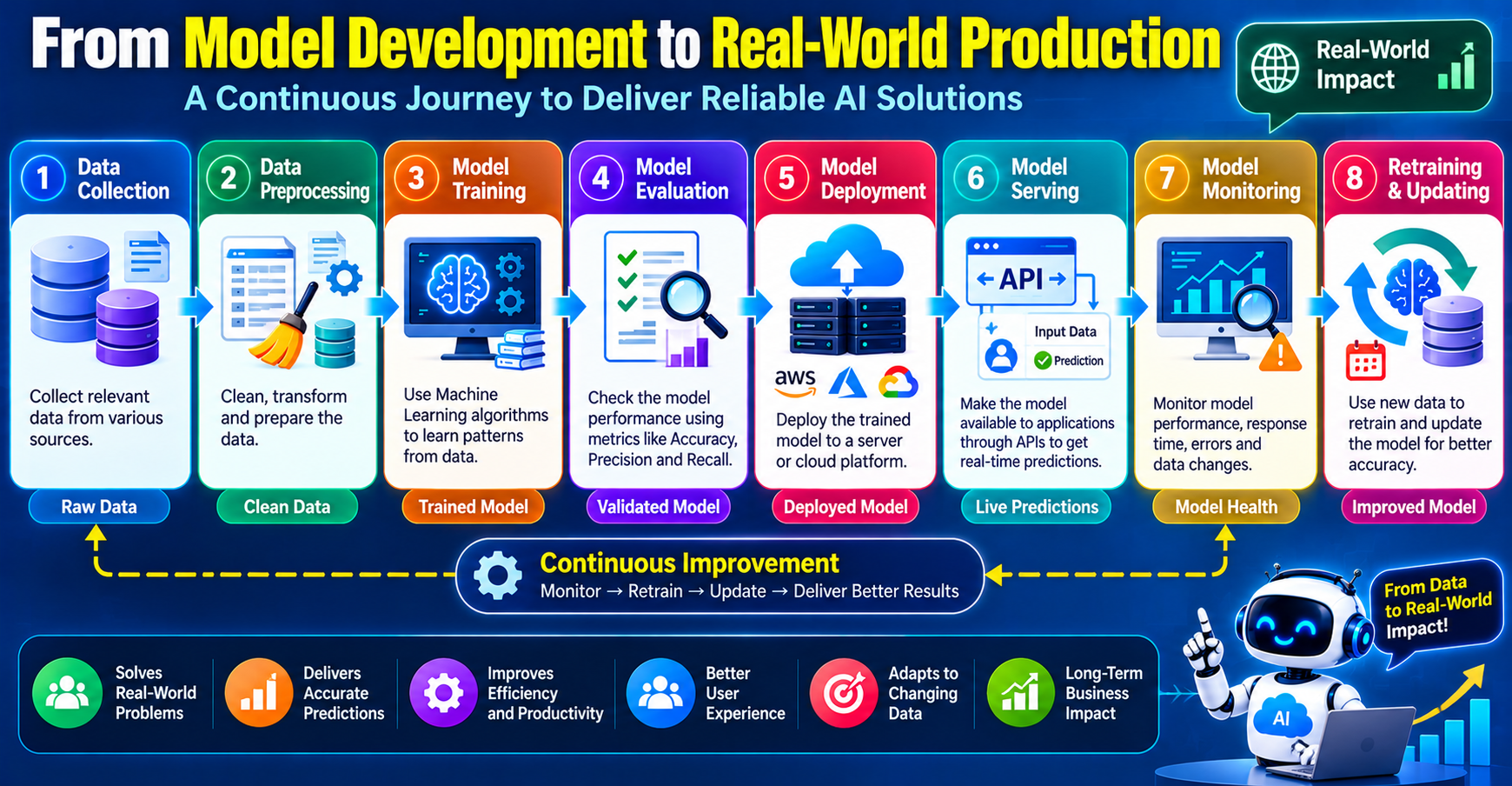
The AI Model Lifecycle is a continuous process that takes a Machine Learning model from initial development to real-world production. It starts with collecting relevant data, preparing that data, training the model, and evaluating its performance. Once the model meets the required standards, it is deployed to a production environment and made accessible through model-serving mechanisms such as APIs. After deployment, continuous monitoring helps identify performance issues and changes in incoming data. Finally, retraining and updating ensure that the model continues to deliver reliable predictions as new information becomes available.
Remember, Artificial Intelligence is not just about developing a Machine Learning model. It is about building a complete system that can solve real-world problems, deliver predictions to users, and continuously improve over time. Understanding the AI Model Lifecycle is an essential step for anyone who wants to build, deploy, and manage real-world AI and Machine Learning applications.
Read Also: What Is Learning Rate in Machine Learning? Definition, Examples, and Importance

