
Top 5 Metrics to Measure AI Agent Performance
Introduction
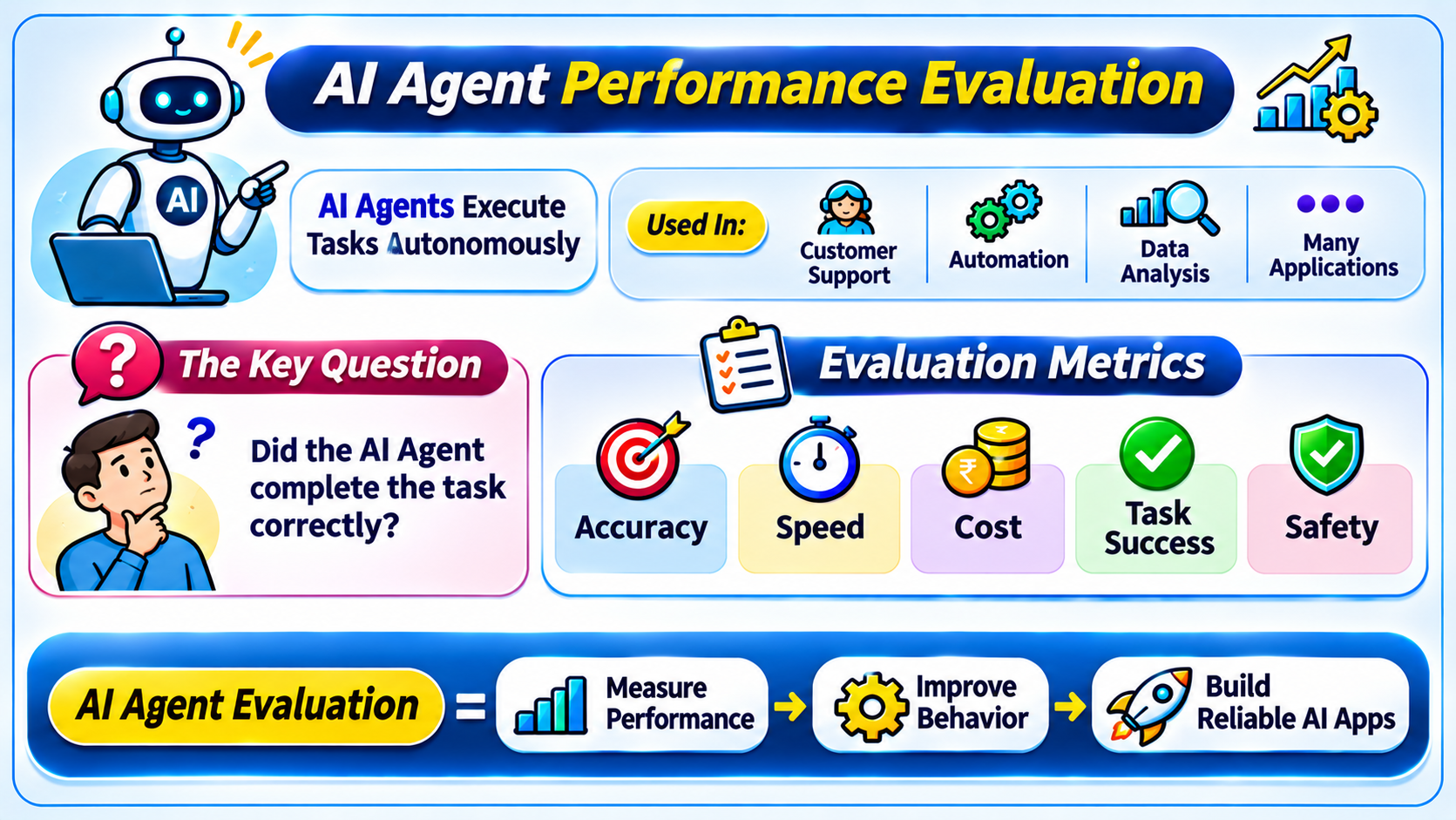
Artificial Intelligence is evolving rapidly, and AI Agents are becoming an important part of modern business applications. Unlike traditional software programs that follow predefined instructions, AI Agents can understand objectives, make decisions, interact with tools, perform actions, and complete tasks with a certain level of autonomy. They are being used in customer support, business automation, research, data analysis, personal assistance, and many other applications.
However, building an AI Agent is only one part of the process. An equally important question is how to determine whether the agent is actually performing its tasks correctly. How do we know whether it has understood the user’s instructions? Did it complete the assigned task successfully? Did it provide accurate information? How much time and money did it consume? Did it follow the required rules and safety guidelines?
To answer these questions, organizations use AI Agent Performance Evaluation. It is the process of measuring how effectively an AI Agent understands instructions, performs actions, achieves assigned goals, and follows safety requirements. By evaluating different performance metrics, developers can identify weaknesses, improve agent behavior, and build more reliable AI applications.
What Is AI Agent Performance Evaluation?
AI Agent Performance Evaluation refers to the process of measuring and analyzing the performance of an AI Agent based on its ability to complete assigned tasks. It involves checking whether the agent produces accurate results, completes tasks within an acceptable time, uses resources efficiently, and follows the instructions provided by the user.
For example, imagine you ask an AI Agent to find a birthday gift within a budget of ₹500. The agent needs to understand your budget, search for suitable products, compare available options, and recommend an appropriate gift. Simply returning a product suggestion does not necessarily mean the task was completed successfully. The recommendation must be relevant, fit within the budget, and satisfy your requirements.
Therefore, evaluating the agent requires more than checking its final response. We also need to examine the actions it performed, the decisions it made, the resources it consumed, and whether it followed the expected rules throughout the process.
Enroll for free demo today: AI Training in Hyderbad
Why Is Evaluating AI Agent Performance Important?
Evaluating AI Agent performance is important because an agent may sometimes generate incorrect information, misunderstand instructions, use inappropriate tools, or fail to complete a task. Without proper evaluation, developers may not identify these problems before deploying the agent into real-world applications.
For businesses, an unreliable AI Agent can affect customer experience, increase operational costs, and create security or compliance risks. For example, an AI customer support agent may provide incorrect information about an order, while a financial assistant may misunderstand a transaction-related request. These situations demonstrate why AI Agents must be tested and evaluated before they are trusted with important business activities.
Performance evaluation also helps developers compare different AI models, improve system instructions, optimize tool usage, and monitor the agent after deployment. It provides measurable information that helps organizations understand whether their AI systems are delivering the expected results.
Read Also: How Do We Evaluate AI Agent Performance?
Key Metrics Used to Evaluate AI Agent Performance
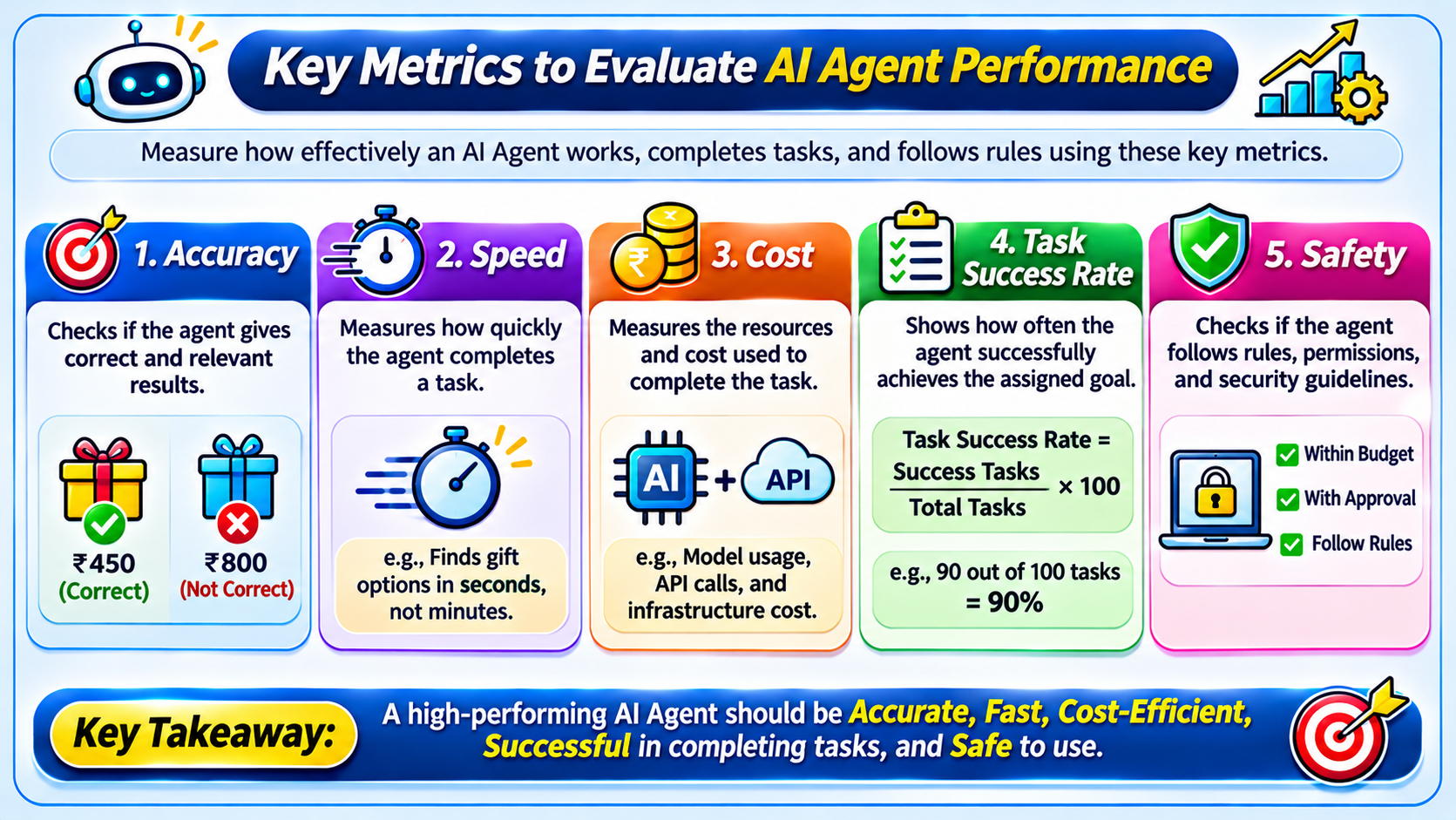
There are several metrics used to measure AI Agent performance. The most important metrics include accuracy, speed, cost, task success rate, and safety. Each metric evaluates a different aspect of the agent’s behavior, and together they provide a broader understanding of its overall performance.
1. Accuracy
Accuracy measures whether an AI Agent provides correct and relevant information while performing an assigned task. An agent must understand the user’s request, interpret the available information correctly, and produce results that match the expected requirements.
For example, imagine asking an AI Agent to find a birthday gift within a budget of ₹500. If the agent recommends a suitable gift priced at ₹450 that matches your preferences, it has produced a relevant result. However, if it recommends an item priced at ₹800, the result does not satisfy the budget requirement.
Accuracy is particularly important in applications such as customer support, healthcare assistance, financial analysis, research, and business automation. Developers can evaluate accuracy by comparing the agent’s responses and actions against expected results, verified information, or predefined evaluation criteria.
2. Speed
Speed measures how much time an AI Agent takes to understand a request and complete the assigned task. In many applications, users expect AI Agents to provide responses and complete activities within a reasonable amount of time.
For example, imagine asking an AI Agent to search for five birthday gift options within a budget of ₹500. If the agent completes the search and provides suitable recommendations within a few seconds, it offers a faster user experience. However, if it takes several minutes to complete a simple task, its performance may not meet user expectations.
Speed becomes especially important in customer support systems, real-time applications, automated business workflows, and applications where multiple AI Agents communicate with each other. Developers can measure response time, task completion time, and the time taken by individual steps to identify performance bottlenecks.
3. Cost
Cost measures the resources required by an AI Agent to complete a task. Running AI applications may involve expenses related to model usage, API calls, cloud infrastructure, computing resources, and external tools.
For example, imagine an AI Agent that uses a language model to search for birthday gifts, compare products, and prepare recommendations. Every interaction with the AI model may consume tokens, while external product search APIs may also involve usage costs. If the agent makes unnecessary API calls or repeatedly performs the same operation, the overall cost can increase.
Therefore, developers need to evaluate how efficiently an AI Agent uses available resources. They can monitor token consumption, API usage, infrastructure expenses, and the average cost per completed task. Cost evaluation helps organizations build AI applications that are not only effective but also economically practical.
4. Task Success Rate
Task Success Rate measures how often an AI Agent successfully completes the objectives assigned to it. This is one of the most important metrics because an agent may provide a well-written response but still fail to achieve the actual goal.
For example, suppose you ask an AI Agent to find a birthday gift within ₹500. The agent must identify suitable products, verify that the selected option fits the budget, and provide the required recommendation. If it completes all these requirements, the task can be considered successful.
If the agent recommends an unsuitable product or fails to provide the required information, the task may be considered unsuccessful.
Task Success Rate can be measured by comparing the number of successfully completed tasks with the total number of tasks attempted.
Task Success Rate = (Successfully Completed Tasks / Total Tasks Attempted) × 100
For example, if an AI Agent successfully completes 90 out of 100 assigned tasks, its task success rate is 90%. This metric helps developers understand how consistently an agent achieves its objectives.
5. Safety
Safety evaluation checks whether an AI Agent follows the required rules, permissions, restrictions, and security guidelines while completing a task. Even if an agent produces accurate results quickly, it should not violate user instructions, access unauthorized information, or perform actions beyond its permitted responsibilities.
For example, imagine asking an AI Agent to find a birthday gift within ₹500. The agent should respect the specified budget and should not purchase an item without the required user approval. If the agent has access to payment tools, it must follow the configured authorization rules before taking any financial action.
Safety is especially important when AI Agents interact with business systems, customer records, financial applications, or sensitive information. Developers evaluate whether agents follow access controls, respect permissions, avoid unsafe actions, and request human approval when necessary.
A reliable AI Agent should not focus only on completing a task. It must also complete the task responsibly and within the boundaries defined by the system.
Real-Time Example: Evaluating an AI Agent for Birthday Gift Selection
Let’s understand all five evaluation metrics through one practical example.
Imagine you ask an AI Agent to find a birthday gift within a budget of ₹500. The agent needs to understand your requirement, search for suitable gifts, compare prices, and recommend the best available option.
First, accuracy is evaluated by checking whether the recommended gift is relevant and whether its price is within ₹500. Next, speed is measured by checking how long the agent takes to complete the search and provide its recommendation. Cost is evaluated by calculating the resources, model usage, and API calls required to complete the task.
Task Success Rate checks whether the agent actually achieves the assigned objective by providing a suitable recommendation within the specified budget. Finally, safety evaluation checks whether the agent respects the budget, follows the configured rules, and avoids making any purchase without proper authorization.
By evaluating all these aspects, developers can determine whether the AI Agent is performing effectively and identify areas that need improvement.
How Do Developers Improve AI Agent Performance?
After evaluating an AI Agent, developers analyze the results to identify areas where the system needs improvement. If the agent provides incorrect answers, developers may improve its instructions, use better data sources, or modify the model configuration. If the agent takes too much time, they may optimize tool calls, reduce unnecessary processing, or improve the application’s architecture.
If the operational cost is too high, developers can examine token consumption, API usage, and model selection to identify opportunities for optimization. If the agent fails to complete assigned tasks, developers can review its planning process, tool selection, task execution, and error-handling mechanisms.
Safety improvements may include strengthening authentication, restricting unnecessary permissions, adding validation steps, and introducing human approval for sensitive actions.
Continuous evaluation is important because AI Agents may behave differently when they encounter new user requests, changing data, or unexpected situations. Therefore, developers should evaluate agents during development, before deployment, and throughout their production lifecycle.
AI Agent Evaluation in Enterprise Applications
In enterprise environments, AI Agent evaluation becomes even more important because agents may interact with multiple business applications, databases, APIs, and external services. A single AI Agent may handle customer requests, retrieve information from CRM systems, update records, and trigger business workflows.
Organizations need to ensure that these agents perform their assigned tasks accurately, efficiently, securely, and consistently. For example, an enterprise customer support agent may need to understand a customer complaint, retrieve the relevant order details, check the refund policy, and provide an appropriate response.
Evaluating only the final response is not sufficient in such scenarios. Organizations may also need to examine whether the agent accessed the correct records, followed the configured permissions, used the appropriate tools, and completed the workflow successfully.
This is why enterprise AI evaluation often considers task-level performance, operational reliability, security, cost efficiency, and user satisfaction.
Conclusion
AI Agent Performance Evaluation is an essential part of building reliable and effective AI applications. It helps developers understand whether an AI Agent can complete assigned tasks correctly, efficiently, and safely.
Accuracy measures the correctness of results, speed measures task completion time, cost measures resource consumption, task success rate measures goal achievement, and safety checks whether the agent follows the required rules and permissions.
These metrics provide a practical way to understand and improve AI Agent performance. As AI Agents become more capable of handling complex tasks and interacting with external systems, continuous evaluation will play an important role in making them more reliable and useful.
Remember, building an AI Agent is only the beginning. Measuring its performance, identifying weaknesses, and continuously improving its behavior are what make it truly effective.
Read Also: How Do AI Agents Communicate with Each Other? Understanding Multi-Agent Communication

