
Skills, Career Opportunities, and the Future of Salesforce Development in AI Era
The software development industry is experiencing a major transformation with the rapid growth of Artificial Intelligence. Generative AI tools, AI-powered coding assistants, and intelligent automation platforms are changing how developers design, develop, test, and maintain applications. Technologies such as ChatGPT, GitHub Copilot, Cursor, and other AI development tools can generate code, explain programming concepts, identify errors, and assist with repetitive development tasks. However, this transformation does not mean that programming knowledge is becoming unnecessary. Instead, developers who understand application architecture, business requirements, programming fundamentals, and AI-powered development tools will be better prepared for the future. Salesforce is one of the leading cloud-based CRM platforms embracing this transformation by combining customer relationship management, automation, data intelligence, and AI-powered capabilities.
A Salesforce Developer is a technology professional who builds customized applications and business solutions on the Salesforce Platform. Salesforce provides several development technologies that help organizations customize their CRM systems according to their business requirements. Developers work with Apex, Lightning Web Components, SOQL, Salesforce APIs, integrations, and automation tools to create applications that improve business operations. For example, an organization may need a customized sales application that automatically calculates discounts, validates customer information, generates approval requests, and displays real-time business reports. A Salesforce Developer understands these requirements and converts them into practical technical solutions.
Looking for the best Salesforce Training in Hyderabad? Learn Salesforce Administration, Apex, LWC, SOQL, Triggers, Integrations, and Agentforce with hands-on practice and real-time projects.
Why Is Salesforce Development Important for Businesses?
Businesses across different industries use Salesforce to manage customer information, sales activities, customer service operations, marketing campaigns, and business processes. However, every organization has different requirements, workflows, approval processes, and reporting needs. Standard Salesforce functionality may not always satisfy every business requirement. This is where Salesforce Developers play an important role. They customize the platform, create new functionalities, integrate external applications, and develop solutions that help organizations work more efficiently.
Consider an educational institution that wants to manage student admissions, fee payments, attendance, examination results, and parent communication through Salesforce. Standard CRM functionality may provide a starting point, but the institution might require customized student records, automated fee reminders, admission approval workflows, and a dedicated student information interface. A Salesforce Developer can create these features using custom objects, Apex classes, Lightning Web Components, Flows, and integrations. In this way, Salesforce Development helps businesses transform their requirements into scalable digital solutions.
Important Skills Every Salesforce Developer Should Learn
Salesforce Development involves a combination of programming knowledge, platform understanding, problem-solving abilities, and business analysis skills. Developers should begin by understanding Salesforce fundamentals, including CRM concepts, standard objects, custom objects, fields, records, relationships, and the Salesforce data model. Understanding how Salesforce stores and manages information is essential before developing complex applications. For example, in a sales application, Accounts represent companies, Contacts represent individuals associated with those companies, and Opportunities represent potential business deals. A developer must understand these relationships before writing code that processes customer information.
Apex is one of the most important programming languages for Salesforce Developers. It is a strongly typed, object-oriented programming language designed specifically for the Salesforce Platform. Developers use Apex to implement business logic, process records, perform database operations, execute complex calculations, and handle requirements that cannot be implemented easily using declarative automation alone. Apex classes, triggers, methods, collections, exception handling, asynchronous Apex, and test classes are important concepts to understand. Developers should also learn Salesforce Governor Limits because Salesforce operates in a multi-tenant environment where platform resources are shared. Writing efficient, bulkified code is essential for building reliable applications that can handle large volumes of records.
Lightning Web Components, commonly known as LWC, are another essential technology in modern Salesforce Development. LWC is a component-based framework that allows developers to create interactive and reusable user interfaces using JavaScript, HTML, and CSS. Developers can build custom forms, dashboards, search interfaces, data tables, and application components that provide a better user experience. For example, a sales manager may need a dashboard that displays customer details, opportunity information, sales performance, and follow-up activities in one place. A Salesforce Developer can create a customized Lightning Web Component that displays this information and interacts with Salesforce data. Learning JavaScript fundamentals, component communication, events, wire services, and Apex integration is important for developing effective LWC applications.
Salesforce Developers should also understand SOQL and SOSL for retrieving information from Salesforce databases. SOQL is used to query records from Salesforce objects, while SOSL is useful for searching text across multiple objects. Developers use these query languages when building applications that need to retrieve customer records, sales opportunities, service requests, or other business information. In addition, knowledge of REST APIs, SOAP APIs, authentication, JSON, and external system integration is valuable because modern businesses frequently connect Salesforce with websites, payment gateways, ERP systems, marketing platforms, and other enterprise applications.
How Is Artificial Intelligence Changing Salesforce Development?
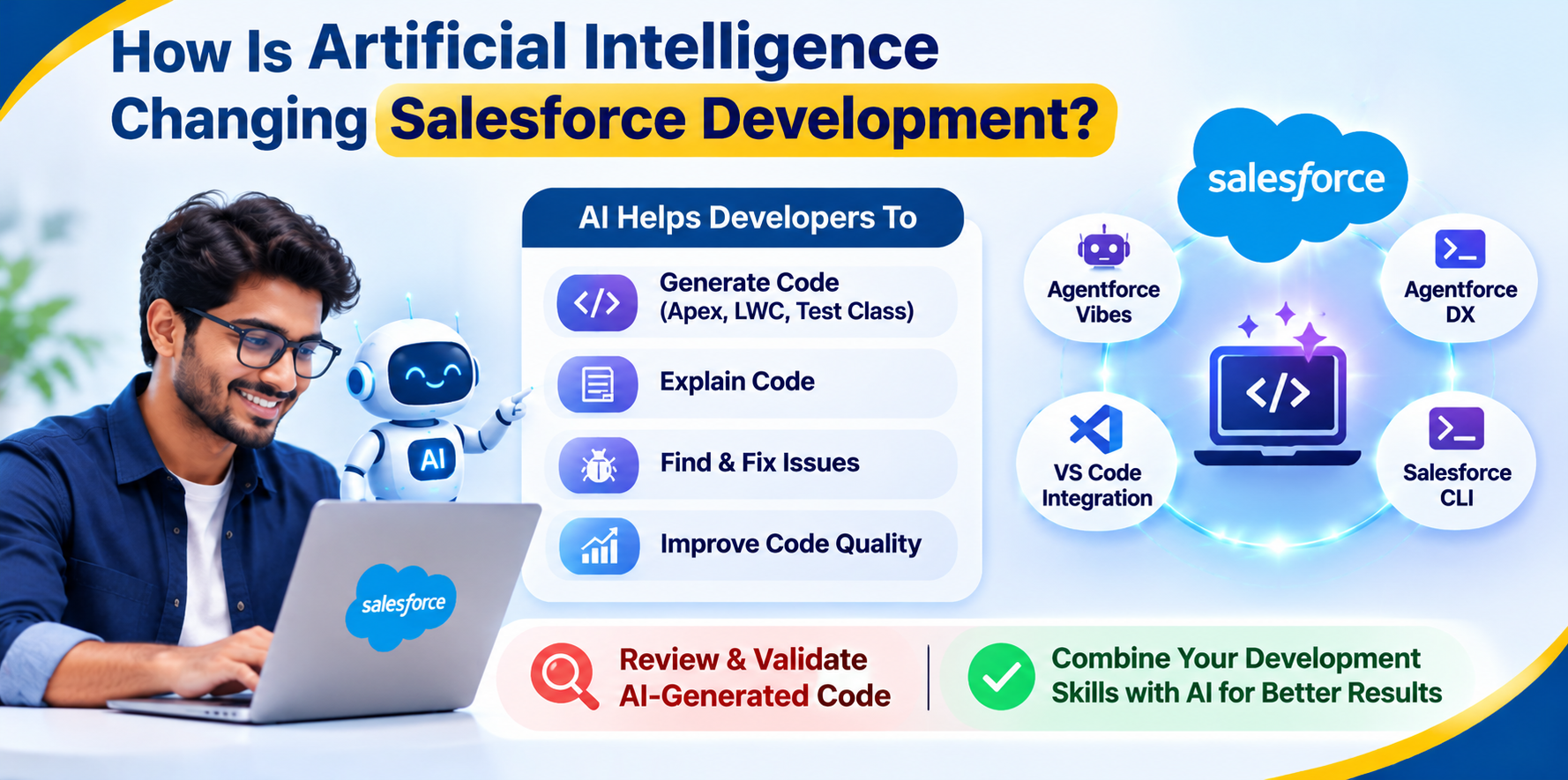
Artificial Intelligence is changing the way developers approach software development. Earlier, developers had to manually write most of the code, search documentation, identify syntax errors, and create test cases. Today, AI-powered development assistants can help with many of these activities. Developers can describe a requirement in natural language and use AI tools to generate an initial version of an Apex class, Lightning Web Component, test class, or documentation. AI can also help explain unfamiliar code, suggest improvements, and identify possible issues. This can reduce repetitive work and allow developers to focus more on application design, business logic, security, and overall solution quality.
However, AI-generated code should never be accepted without proper review. A generated Apex class may contain incorrect object names, missing field-level security checks, inefficient database queries, or logic that does not match the actual business requirement. Similarly, an AI-generated Lightning Web Component may need changes to follow the application’s existing design and coding standards. Salesforce Developers must understand the code, validate it against the organization’s data model, test different scenarios, and ensure that it follows platform best practices. The real advantage comes from combining development knowledge with AI assistance rather than depending completely on AI-generated solutions.
Salesforce is also introducing platform-specific AI development experiences. Agentforce Vibes, for example, supports AI-assisted Salesforce development by helping developers work with Apex, Lightning Web Components, metadata, and debugging tasks using Salesforce-aware context. Salesforce’s developer ecosystem is also expanding through Agentforce DX, Salesforce CLI, VS Code integrations, and AI development workflows. These tools help developers work more efficiently while maintaining control over the code and deployment process.
Understanding Agentforce: The New AI Opportunity for Salesforce Developers
Agentforce is an important development in the Salesforce ecosystem because it brings AI agents into business applications and workflows. Traditional software applications generally follow predefined instructions and business rules. AI agents can go further by understanding user requests, using available business context, selecting appropriate actions, and helping complete tasks. Within Salesforce, Agentforce can support business processes across areas such as sales, customer service, and other enterprise operations.
Consider a customer who contacts a company to ask about an order status. A traditional chatbot may respond with predefined answers or direct the customer to a particular page. An AI agent, when properly configured and authorized, can understand the customer’s request, retrieve relevant order information, and initiate an appropriate action through available tools. Depending on the business configuration, it may also escalate the request to a human employee when necessary. This creates opportunities for Salesforce Developers to build and customize the actions, integrations, and business logic that support AI-powered workflows.
Salesforce Developers can contribute to Agentforce projects by creating custom Apex actions, integrating external services, connecting business data, configuring APIs, and implementing application-specific logic. They should understand how AI agents interact with Salesforce records, how permissions control access to information, and how business actions are tested and monitored. Knowledge of Prompt Builder, Agentforce, Agent Script, Agent APIs, and the Salesforce development environment can help developers work on modern AI-powered Salesforce applications.
Join our Salesforce Training in Bangalore to gain practical knowledge of Salesforce Admin and Development. Learn Apex Programming, Lightning Web Components, Automation, and Integrations through real-time project experience.
Role of Apex, LWC, and APIs in AI-Powered Salesforce Applications
Even as AI becomes more powerful, core Salesforce development technologies remain important. Apex provides the business logic required to process records, validate transactions, perform calculations, and execute custom operations. Lightning Web Components provide the user interface through which employees interact with applications and AI-powered features. APIs allow Salesforce to communicate with external applications, services, and AI systems. These technologies work together to create complete enterprise solutions.
For example, imagine a company building an AI-powered customer support application. A customer submits a support request through a web interface. A Lightning Web Component can collect the request details and display the relevant information. Apex can validate the request, retrieve customer records, and execute the required business logic. An external AI service or Agentforce agent can assist with understanding the request and suggesting an appropriate response. APIs can connect the application with external order management or payment systems. Finally, Salesforce automation can update the case status and notify the appropriate support team. This example demonstrates why developers need a strong understanding of Salesforce fundamentals even when working with advanced AI technologies.
Salesforce Developer Tools in the Modern AI Era
Modern Salesforce development involves more than writing code in an editor. Developers use a collection of tools to build, test, manage, and deploy applications. Visual Studio Code with Salesforce Extensions provides a development environment for Apex, Lightning Web Components, and Salesforce metadata. Salesforce CLI helps developers create projects, connect to Salesforce organizations, retrieve metadata, run tests, and deploy changes. Git supports version control and collaboration, while sandboxes and scratch orgs provide environments for development and testing.
AI-assisted development tools are becoming an additional part of this workflow. Tools such as Agentforce Vibes and other coding assistants can help generate code, explain errors, suggest improvements, and support development tasks. Salesforce’s evolving developer ecosystem also includes Agentforce DX and Model Context Protocol integrations that help compatible AI tools work with Salesforce development projects and organizational context. Developers should learn how to use these tools responsibly, review suggested changes, and validate their work before deploying it to production.
Why Coding Knowledge Is Still Important When AI Can Generate Code
One of the common questions among aspiring developers is: If AI tools can write code, why should we learn programming? The answer is simple: generating code and building a reliable business application are two different things. AI can produce code based on the instructions it receives, but developers must understand whether that code correctly solves the actual problem. They must evaluate application security, data access, performance, scalability, error handling, and business requirements.
Imagine asking an AI tool to create an Apex trigger that updates related records whenever an Opportunity is modified. The tool may generate code quickly, but the developer must check whether the trigger handles bulk record updates, avoids unnecessary database queries, follows Governor Limits, prevents recursion issues, and works correctly for different scenarios. The developer must also create appropriate test classes and verify the behavior in a suitable environment. Without programming and platform knowledge, it becomes difficult to identify problems in AI-generated code. Therefore, learning Apex, JavaScript, SOQL, LWC, and Salesforce architecture remains valuable even when AI coding tools are available.
Salesforce Development and the Future of Low-Code and Pro-Code Technologies
Salesforce offers both declarative and programmatic development approaches. Declarative tools such as Flow Builder allow administrators and developers to automate business processes with minimal code. Programmatic technologies such as Apex and LWC provide greater flexibility when applications require complex business logic, custom interfaces, or advanced integrations. In modern Salesforce projects, these approaches often work together.
For example, a company may use Salesforce Flow to automate an approval process, Apex to perform complex calculations, and LWC to display a customized user interface. Agentforce can then be introduced to help users interact with business processes through natural language. Developers who understand when to use declarative tools and when to write custom code can design more maintainable and efficient solutions. The future of Salesforce Development is not simply about writing more code; it is about choosing the right technology to solve the right business problem.
Career Opportunities for Salesforce Developers
Salesforce Developers can explore career opportunities across consulting companies, IT service organizations, product companies, and enterprises that use Salesforce for their business operations. Common roles include Salesforce Developer, Salesforce Platform Developer, Apex Developer, Lightning Web Component Developer, Salesforce Integration Developer, and Salesforce Technical Consultant. As organizations adopt AI-powered business applications, additional opportunities are emerging around Agentforce development, AI integration, and intelligent workflow automation.
Career growth depends on practical knowledge, project experience, problem-solving ability, and the capacity to understand business requirements. Freshers can begin by learning Salesforce fundamentals and building small applications. Professionals with programming experience can strengthen their knowledge of Apex, LWC, integrations, and application architecture. Experienced Salesforce Developers can expand into technical leadership, solution architecture, enterprise integration, and AI-powered application development. Building a portfolio of practical projects and understanding real business use cases can help candidates demonstrate their skills during interviews.
How to Start Learning Salesforce Development
Anyone interested in becoming a Salesforce Developer should follow a structured learning path. Start with CRM fundamentals, Salesforce navigation, standard objects, custom objects, fields, relationships, and security concepts. Once the platform basics are clear, learn Apex programming, object-oriented programming concepts, SOQL, SOSL, triggers, classes, collections, exception handling, and test classes. After developing a good understanding of Apex, move to JavaScript, HTML, CSS, and Lightning Web Components. Learning Salesforce APIs, integrations, Git, Salesforce CLI, and deployment practices will help you understand how real-time Salesforce projects are developed and delivered.
After learning the core technologies, begin building practical applications. Create a student management application, an employee onboarding system, a sales management application, or a customer support solution. These projects help you understand how Salesforce objects, relationships, automation, Apex, and LWC work together. You can then explore Agentforce, AI-assisted development, Prompt Builder, and AI integrations to understand how intelligent capabilities can be added to business applications. Learning through hands-on implementation is more effective than simply memorizing concepts because it helps you develop the confidence to solve real development challenges.
Why Choose Salesforce Developer Training at CRS Info Solutions?
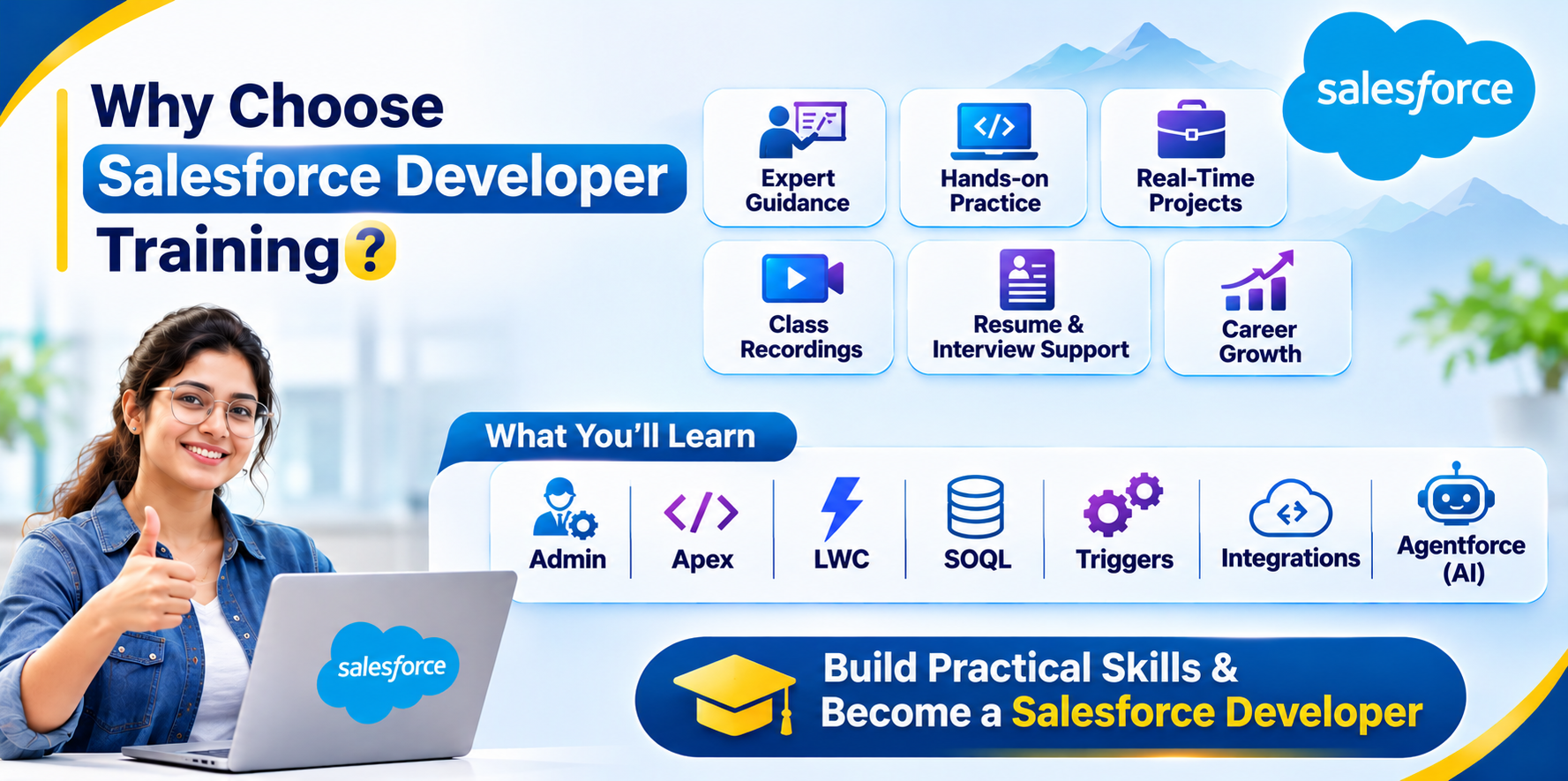
Learning Salesforce Development with proper guidance can help beginners understand the platform step by step and develop the practical skills required for real-world projects. CRS Info Solutions provides Salesforce training designed to cover important platform concepts, development technologies, and practical implementation scenarios. Learners can build their understanding of Salesforce Administration, Apex programming, Triggers, SOQL, Lightning Web Components, integrations, and modern AI-related capabilities such as Agentforce. A structured learning approach can help students understand how different Salesforce technologies work together to solve business problems.
Practical exercises and real-time project scenarios are important parts of becoming a confident Salesforce Developer. Instead of focusing only on theoretical explanations, learners should practice creating custom objects, writing Apex classes, developing triggers, building Lightning Web Components, implementing automation, and connecting external services. Understanding how to troubleshoot errors, write test classes, manage deployments, and follow coding standards is equally important. With expert guidance, hands-on practice, and continuous learning, aspiring developers can build a strong foundation and prepare themselves for Salesforce development opportunities.
Conclusion: Build Your Future as a Salesforce Developer in the AI Era
Artificial Intelligence is changing the way software applications are developed, and Salesforce is moving toward a future where CRM, automation, data, and intelligent agents work together. AI coding assistants can help developers write code faster, but they cannot eliminate the need for people who understand business requirements, application architecture, security, data management, and software quality. Salesforce Developers who combine strong programming fundamentals with modern AI technologies will be better positioned to build intelligent, scalable, and business-focused applications.
If you are planning to start a career in Salesforce Development, this is a valuable time to learn the platform and explore its growing AI ecosystem. Begin with Salesforce fundamentals, develop your Apex and LWC skills, gain experience through real-time projects, and gradually learn Agentforce and AI-assisted development tools. Remember that the future belongs not simply to developers who can write code, but to developers who can understand problems, design solutions, use AI responsibly, and deliver meaningful business value.
Start learning Salesforce Development today and prepare to build the next generation of intelligent business applications with CRS Info Solutions.
Choose our Salesforce Training in India to build your career in Salesforce Administration and Development. Get comprehensive training in Apex, LWC, SOQL, Automation, Integrations, and Agentforce with practical projects and expert guidance.

