
What Is Generative AI? A Simple Guide to AI That Creates New Content
Introduction to Generative AI
Artificial Intelligence is transforming how people work, learn, communicate, and create. One major development is Generative AI, which can create new content such as text, images, music, videos, and code based on user instructions.
AI writing assistants and image-generation tools make this technology accessible to everyone. Users can describe what they need in everyday language and generate content without advanced technical knowledge.
Generative AI is also being used in business, software development, education, customer service, and marketing. Understanding how it works and where it can be applied helps individuals and organizations make better use of this rapidly evolving technology.
What Is Generative AI?
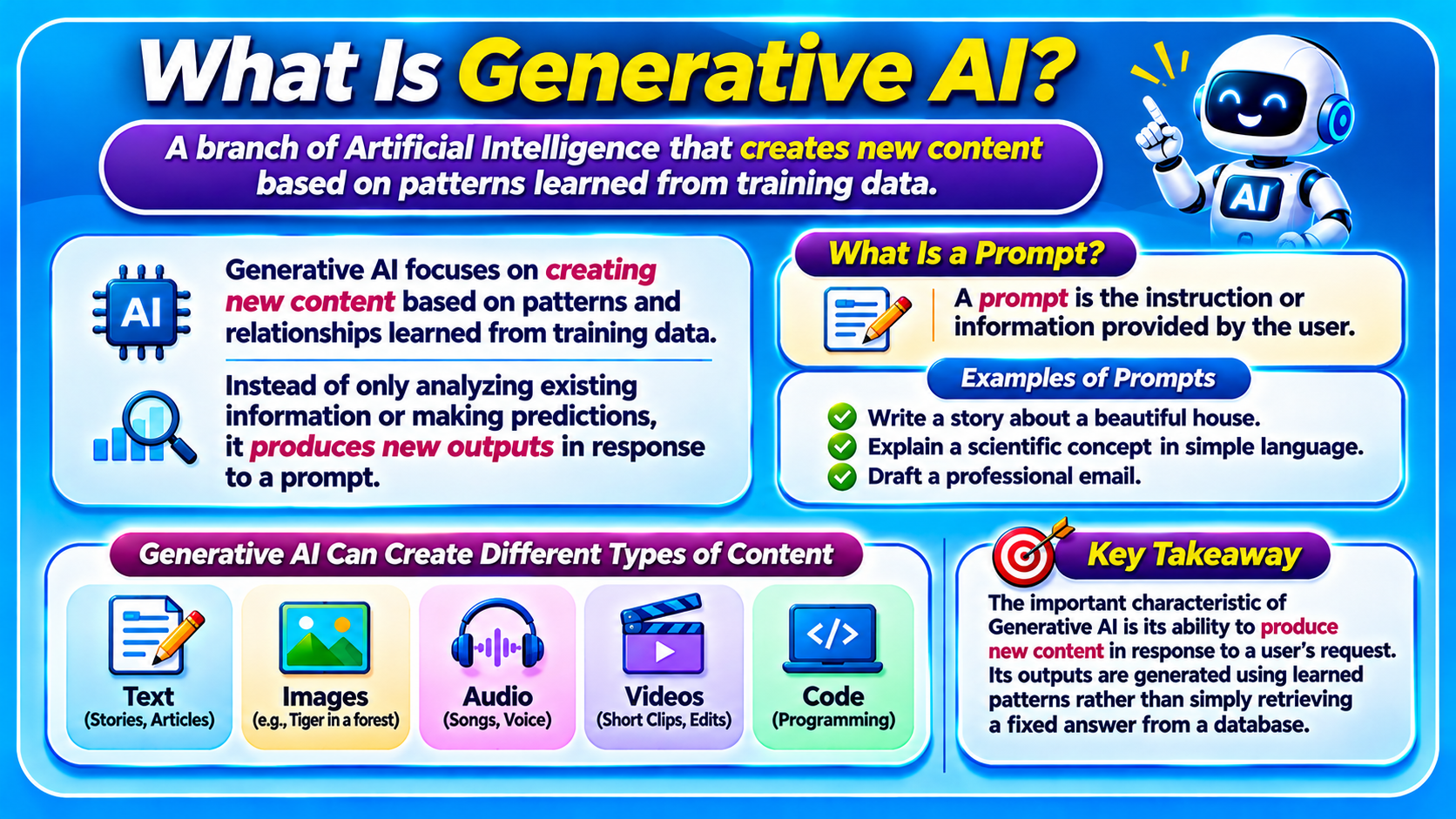
Generative AI is a branch of Artificial Intelligence that focuses on creating new content based on patterns and relationships learned from training data. The generated content may include text, images, audio, video, or code. Instead of only analyzing existing information or making predictions, Generative AI can produce new outputs in response to a prompt.
A prompt is the instruction or information provided by the user. For example, a user might ask AI tool to write a story about a beautiful house, explain a scientific concept in simple language, or draft a professional email. The AI interprets the instruction and generates a response based on the patterns it learned during training.
Similarly, an image-generation tool can create a picture from a written description. If a user requests an image of a tiger walking through a forest at sunset, the system can generate an image that reflects those details. Generative AI can also create music, assist with video production, and generate computer code from natural-language instructions.
The important characteristic of Generative AI is its ability to produce new content in response to a user’s request. Its outputs are generated using learned patterns rather than simply retrieving a fixed answer from a database.
Want to build a career in AI? Join our AI Training Program to learn Artificial Intelligence concepts, explore real-world applications, and gain hands-on experience through practical projects. Start your AI learning journey with expert guidance and prepare for exciting opportunities in the AI industry.
How Does Generative AI Work?
Generative AI systems learn from large amounts of data during a process called training. The type of data depends on the model being developed. Language models are trained on text, image-generation models learn from visual data and associated information, and audio models may learn from recordings and transcripts. Through training, the model identifies patterns, structures, and relationships within the data.
For example, a language model learns how words and sentences are commonly organized, how different concepts relate to one another, and how language is used in different contexts. An image-generation model learns relationships between visual features, objects, styles, and descriptions. These learned patterns help the models generate content when they receive new instructions.
When a user submits a prompt, the model processes the request and generates an output based on its learned parameters. A language model may generate text one token at a time, where a token can be a word or part of a word. An image-generation model may progressively create an image by transforming an initial representation into a result that matches the prompt.
The generated content depends on the model’s training, its design, and the details included in the prompt. A clear and specific prompt can help guide the system toward a more relevant result, although it does not guarantee accuracy or quality.
Understanding Prompts in Generative AI
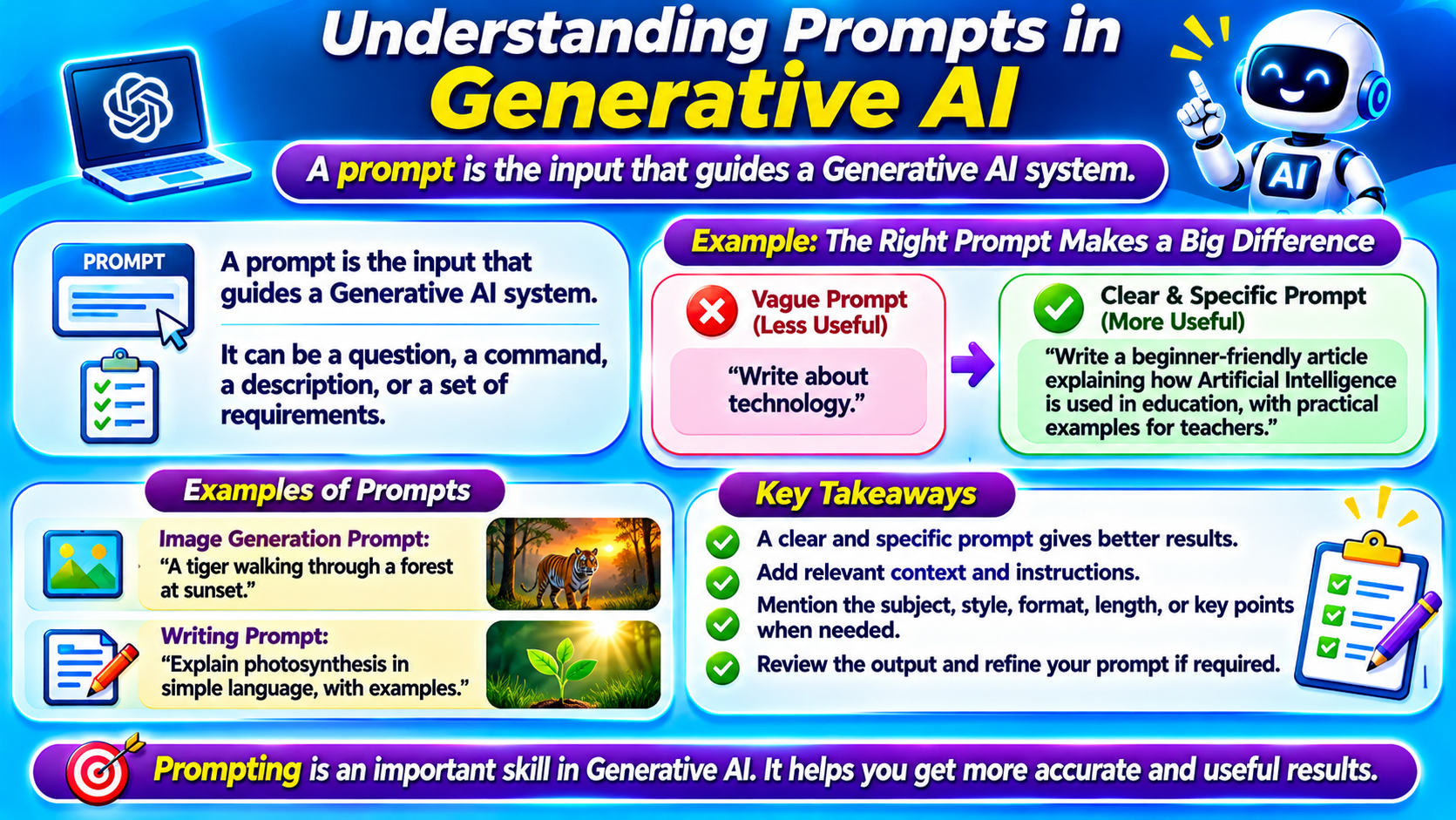
A prompt is the input that guides a Generative AI system. It can be a question, a command, a description, or a set of requirements. The quality of the prompt often influences the usefulness of the generated output.
For example, asking an AI to “write about technology” provides very little direction. Asking it to “write a beginner-friendly article explaining how Artificial Intelligence is used in education, with practical examples for teachers” gives the model a clearer objective, audience, and topic.
For image generation, a prompt may specify the subject, setting, style, lighting, colors, and composition. For writing tasks, it may include the intended audience, tone, format, length, and key points. Providing relevant context and clear instructions can reduce ambiguity and make the output more useful.
Prompting is therefore an important skill when working with Generative AI. Users can improve results by describing the task clearly, reviewing the output, and refining their instructions when necessary.
Types of Generative AI
Generative AI includes different types of models designed to create different forms of content. Text-generation models produce written responses, articles, summaries, stories, and other language-based content. These models are commonly used in chatbots, writing assistants, research support, and conversational applications.
Image-generation models create visual content from text prompts or other images. They can be used to generate illustrations, concept art, product ideas, marketing visuals, and creative designs. Audio-generation models can produce music, speech, and sound effects, while speech-generation systems can convert written text into spoken audio.
Video-generation models can create or assist with video content, such as short clips, animations, and visual sequences. Code-generation models can produce programming code, explain existing code, suggest improvements, and help developers troubleshoot errors. Some modern systems combine multiple capabilities, allowing users to work with text, images, audio, and video in a single application.
Generative AI vs. Traditional AI
Traditional AI systems are often designed to analyze information, recognize patterns, classify data, or make predictions. For example, a spam detection model may classify an email as spam or not spam. A forecasting model may estimate future sales based on historical data, while an image classification model may identify objects in a photograph.
Generative AI focuses on creating new content. It can write a response to a question, generate an image from a description, compose music, or produce computer code. Although traditional AI and Generative AI both learn patterns from data, their typical objectives and outputs differ.
Traditional AI often answers questions such as “Which category does this belong to?” or “What is likely to happen?” Generative AI often addresses requests such as “Create a story,” “Generate an image,” or “Write a program.” In many real-world applications, generative and traditional AI techniques can also be combined.
Real-World Applications of Generative AI
Generative AI is being used in a wide range of industries and everyday activities. In education, it can help teachers prepare lesson plans, create practice questions, explain difficult concepts, and develop learning materials. Students can use it to explore topics, receive explanations, and practice problem-solving, while still verifying important information and completing their own learning tasks.
In marketing and communication, Generative AI can assist with drafting advertisements, social media posts, product descriptions, email campaigns, and promotional content. It can help teams explore different creative approaches and adapt messages for different audiences. Human review remains important to ensure that the content is accurate, appropriate, and aligned with the organization’s goals.
In software development, Generative AI can suggest code, explain programming concepts, create test cases, and assist with debugging. Developers can use it to accelerate routine coding tasks while reviewing the generated code for correctness, security, and maintainability.
In healthcare, Generative AI may assist with summarizing information, preparing documentation, and supporting research workflows. Such applications require careful validation, privacy protections, and professional oversight because inaccurate outputs can have serious consequences.
In entertainment and design, Generative AI can support story development, image creation, music composition, animation, and video production. It can help creators explore ideas and produce early drafts, while human creativity and judgment guide the final work.
Benefits of Generative AI
One of the major benefits of Generative AI is increased productivity. It can help users create first drafts, summarize lengthy material, brainstorm ideas, and automate repetitive content-related tasks. This can reduce the time spent on routine work and allow people to focus more on planning, analysis, and decision-making.
Generative AI can also make creative tools more accessible. People who do not have advanced drawing, writing, music, or programming skills can use natural-language instructions to explore ideas and create initial outputs. This does not eliminate the need for expertise, but it can lower the barrier to experimentation and learning.
Another benefit is its ability to support personalized experiences. AI systems can adapt explanations, examples, and learning materials to different levels of understanding. In business environments, they can help teams produce content for different audiences and support workflows that involve multiple types of information.
Limitations and Challenges of Generative AI
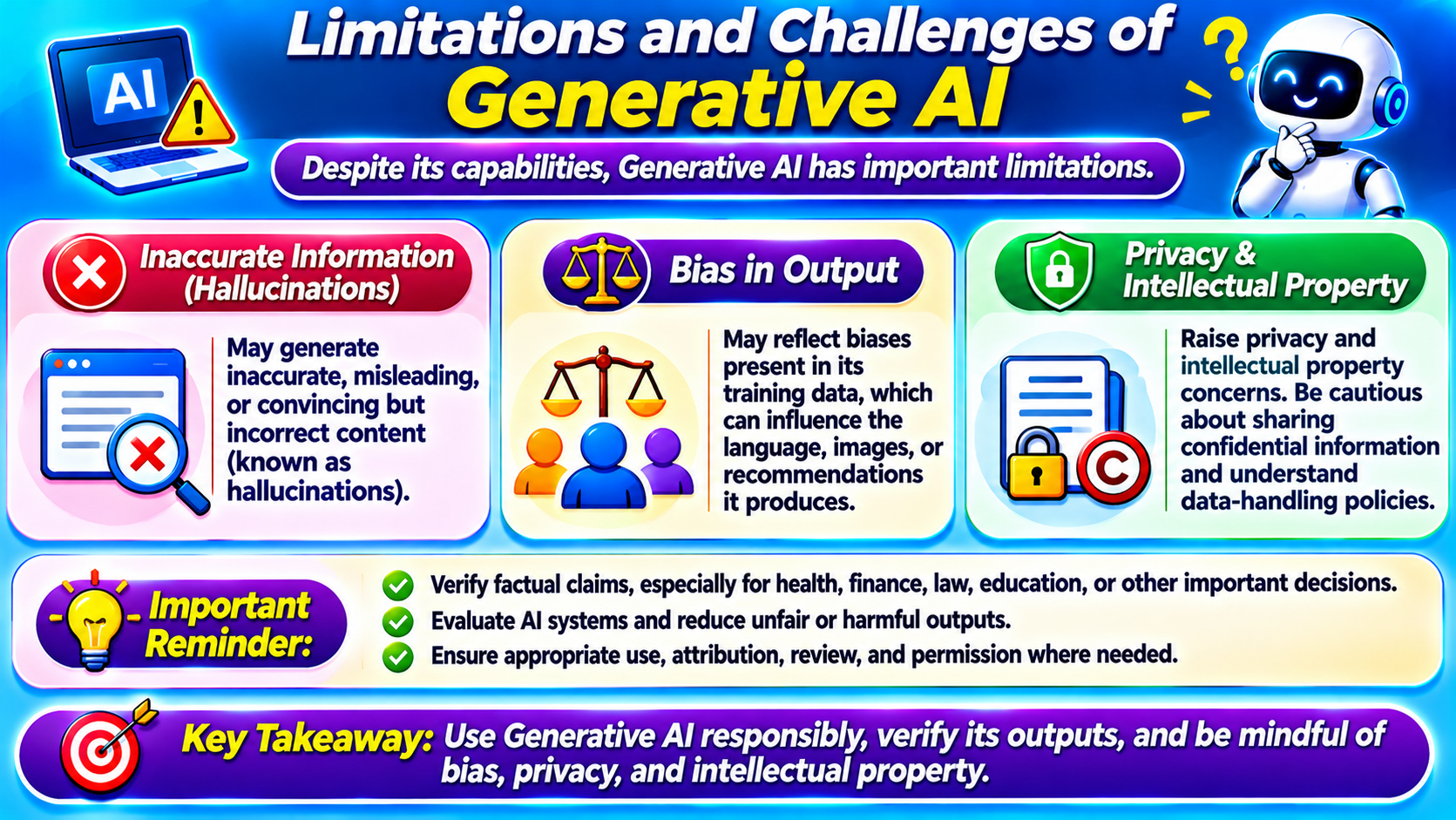
Despite its capabilities, Generative AI has important limitations. It may generate inaccurate information, misunderstand a prompt, or produce content that appears convincing but is incorrect. These errors are sometimes referred to as hallucinations. Therefore, users should verify factual claims, particularly when the information relates to health, finance, law, education, or other important decisions.
Generative AI may also reflect biases present in its training data. These biases can influence the language, images, or recommendations it produces. Developers and organizations need to evaluate their systems carefully and take steps to reduce unfair or harmful outputs.
Privacy and intellectual property are additional considerations. Users should be cautious about submitting confidential information to AI tools and should understand the relevant data-handling policies. Organizations should also consider whether generated content is appropriate for its intended use and whether it requires attribution, review, or permission.
Read also: What Is Agentic AI? Understanding AI That Can Plan and Take Action
Responsible Use of Generative AI
Responsible use means treating Generative AI as a tool that supports human work rather than assuming that every output is correct. Users should review generated content, verify important information, and apply their own judgment before sharing or acting on it.
Organizations should establish clear guidelines for using AI tools, particularly when sensitive data or important business decisions are involved. They should consider privacy, security, fairness, transparency, and accountability when developing or adopting AI systems.
Human oversight is especially important in high-impact situations. Generative AI can provide useful assistance, but people remain responsible for evaluating the output and deciding how it should be used.
The Future of Generative AI
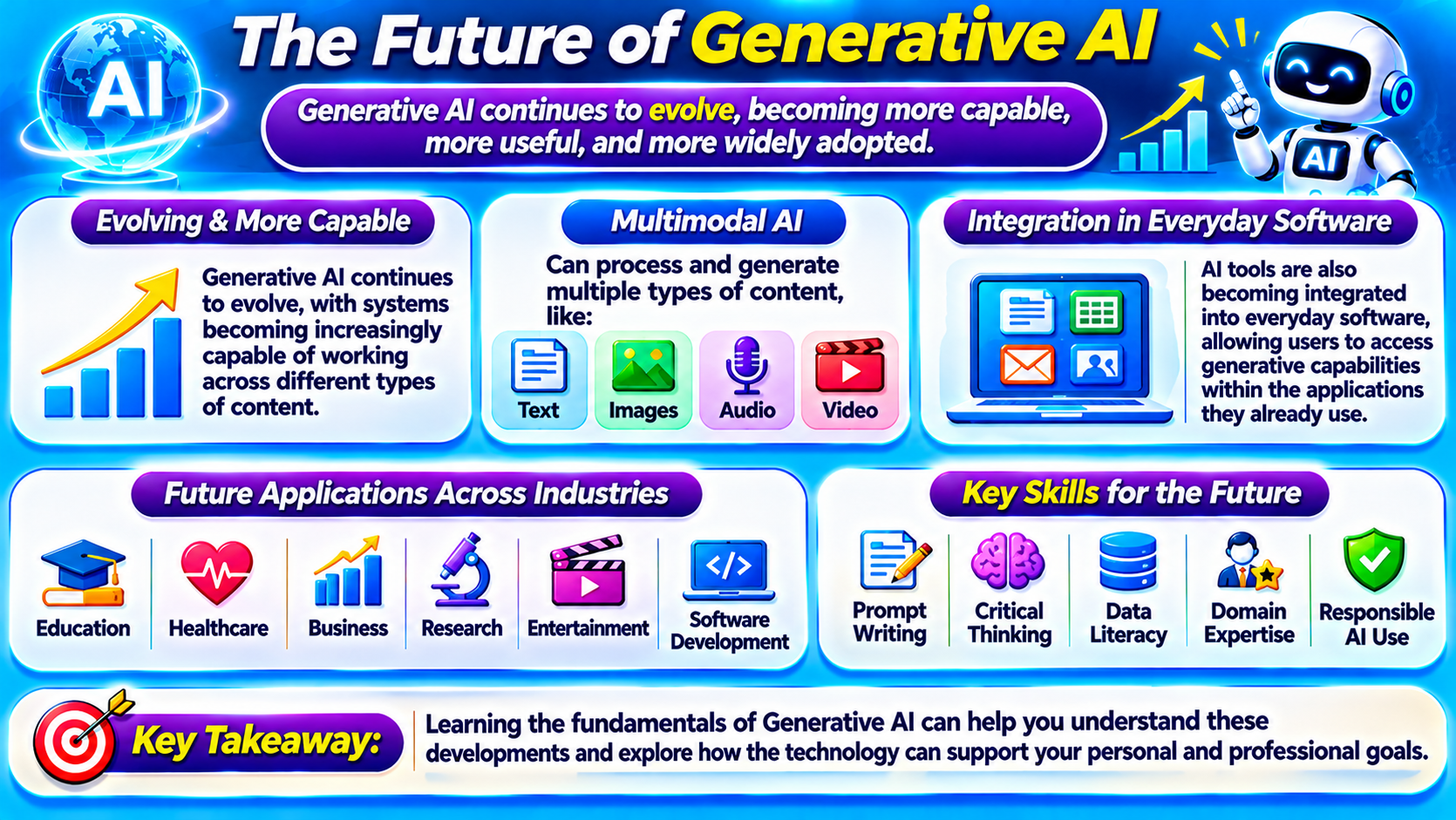
Generative AI continues to evolve, with systems becoming increasingly capable of working across different types of content. Multimodal AI can process and generate combinations of text, images, audio, and video, enabling more natural and flexible interactions. AI tools are also becoming integrated into everyday software, allowing users to access generative capabilities within the applications they already use.
In the future, Generative AI may support more complex workflows in education, healthcare, business, research, entertainment, and software development. As these capabilities expand, skills such as prompt writing, critical thinking, data literacy, domain expertise, and responsible AI use will become increasingly valuable.
Learning the fundamentals of Generative AI can help individuals understand these developments and explore how the technology may support their personal and professional goals.
Conclusion
Generative AI is a powerful branch of Artificial Intelligence that creates new content based on instructions and patterns learned from data. It can generate text, images, audio, video, and code, making it useful for creativity, learning, communication, and productivity
Read also: What Is AI Model Serving? How Do You Make a Trained Model Available to Users?

