
What Is a Feedback Loop in AI Agents?
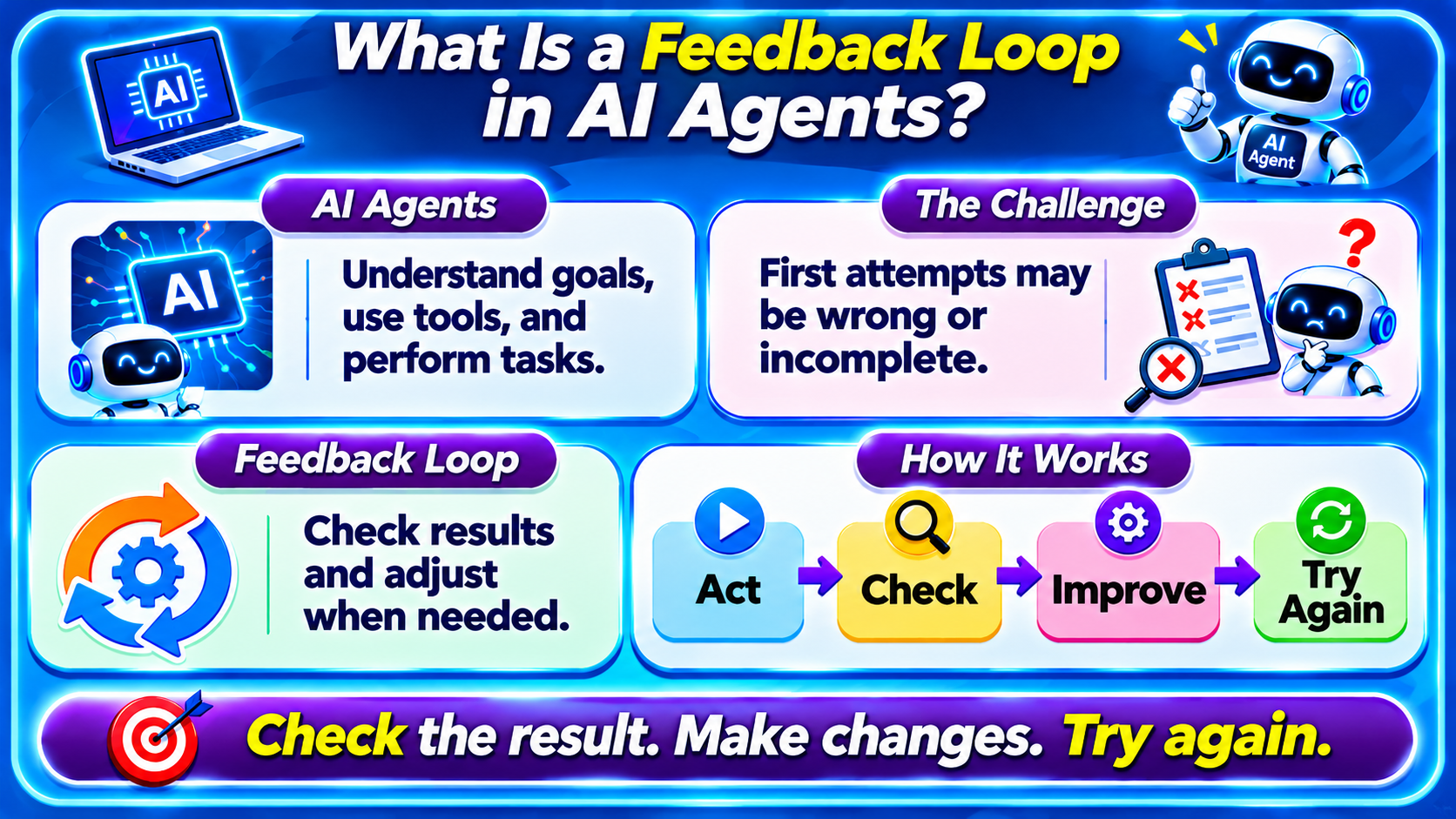
Artificial Intelligence is transforming the way people work, learn, communicate, and solve problems. Among the latest developments in this field, AI Agents are becoming increasingly useful because they can understand goals, perform actions, interact with tools, and complete multi-step tasks. However, an AI Agent may not always achieve the desired result on its first attempt. It might misunderstand an instruction, select an unsuitable option, or produce an incomplete answer. To handle these situations, AI Agents can use a mechanism called a Feedback Loop.
A Feedback Loop allows an AI Agent to evaluate the results of its actions and make adjustments when necessary. Instead of performing a task once and immediately stopping, the agent checks whether the result meets the user’s requirements. If it identifies a problem, it can use the feedback to change its approach and try again. This process helps the agent work toward a more suitable outcome and makes it better equipped to handle tasks that require multiple steps.
Kickstart your AI career with our comprehensive AI training program! Learn Artificial Intelligence, Machine Learning, Generative AI, and real-world AI tools through hands-on projects and expert guidance. Build practical skills, gain industry-ready knowledge, and prepare for exciting career opportunities in the world of AI.
Understanding Feedback Loops Through a Real-Life Example
Imagine you ask an AI Agent to find a good birthday gift within a budget of ₹500. You want something useful and interesting, but you do not want to spend more than your budget. The AI Agent begins by searching for suitable gifts and collecting information about their prices, features, and availability.
During its initial search, the agent finds a gift priced at ₹650. Although the product may be attractive, it does not satisfy your requirement because it exceeds your budget. At this stage, the agent needs to evaluate its result rather than simply presenting the product as the final recommendation. It compares the price with your original instruction and identifies that the selected gift is too expensive.
The agent then uses this feedback to improve its next attempt. It may narrow its search to products priced below ₹500, explore alternative gift categories, or look for similar products at lower prices. After searching again, it finds a suitable gift priced at ₹450. The agent checks the new result and confirms that the product is within the requested budget.
Finally, the agent presents the gift option to you. This example shows how an AI Agent can perform an action, evaluate the result, identify a mismatch, and take corrective action. The important point is that the agent does not simply accept its first result. It uses feedback to guide its next step.
The Four Main Stages of a Feedback Loop
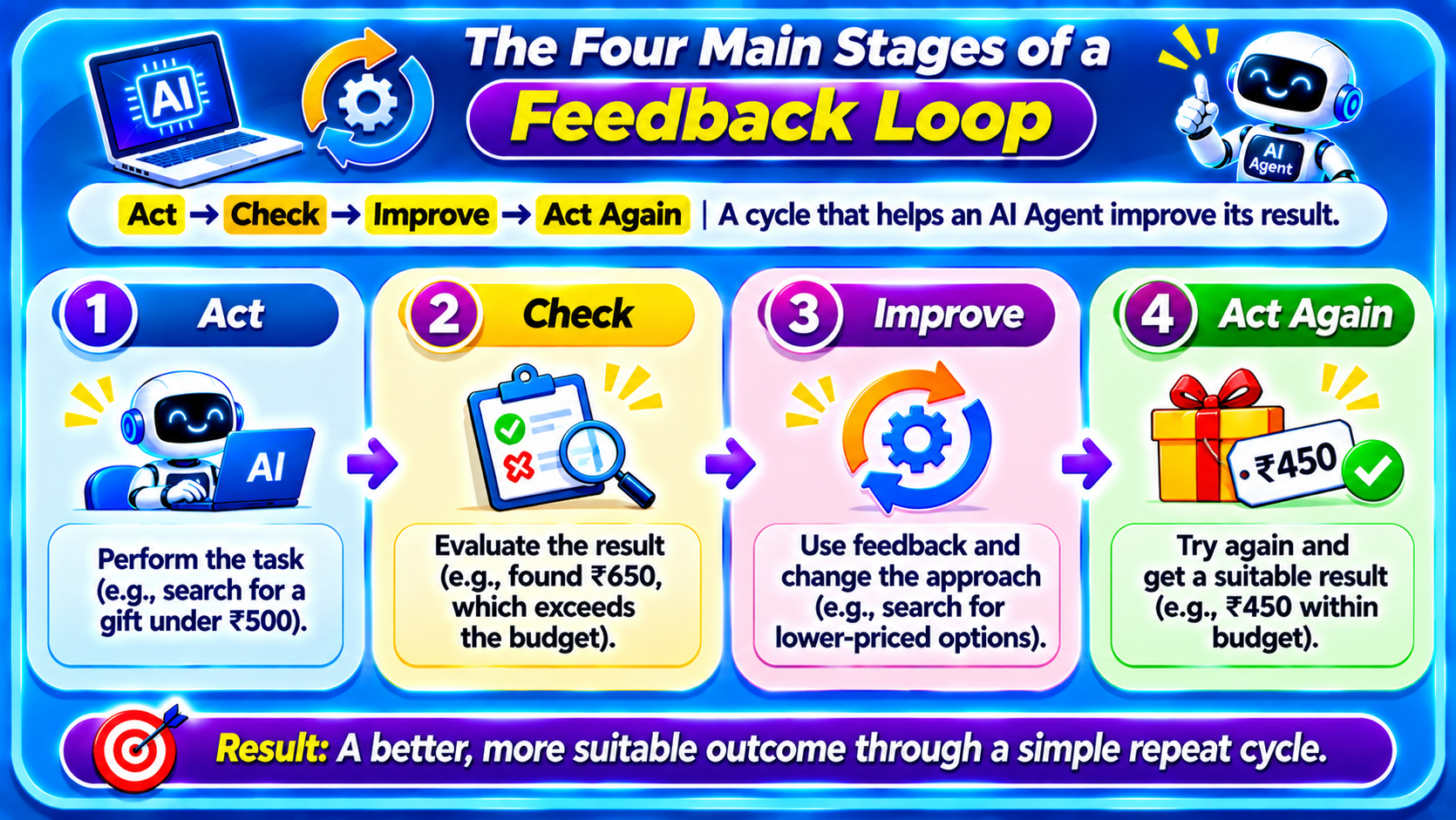
A Feedback Loop can be understood through four simple stages: Act, Check, Improve, and Act Again. These stages form a cycle that allows an AI Agent to evaluate its progress and adjust its behavior when required.
1. Act: Perform the Task
The first stage begins when the AI Agent receives a request and takes action toward achieving the user’s goal. Depending on the task, the agent may generate content, search for information, call an external tool, or process data.
For example, when asked to find a birthday gift under ₹500, the agent searches for gift options. This action produces an initial result that the agent can evaluate in the next stage.
2. Check: Evaluate the Result
After performing an action, the agent examines the result to determine whether it satisfies the user’s requirements. This evaluation may involve checking facts, comparing values, validating output, or examining the response received from a tool.
In the birthday gift example, the agent checks the price of the selected product against the ₹500 budget. Since the first option costs ₹650, the result does not meet the requirement. The agent identifies the difference between the expected outcome and the actual result.
3. Improve: Identify What Needs to Change
Once the agent identifies a problem, it uses the feedback to determine how to improve its next attempt. The adjustment depends on the type of task and the information available.
For the gift search, the agent may change its search criteria, focus on lower-priced products, or consider different categories of gifts. The purpose of this stage is to use the evaluation result to guide a better approach rather than repeating the same unsuccessful action.
4. Act Again: Try the Improved Approach
In the final stage, the agent performs another action using the changes identified during the improvement stage. It then checks the new result to see whether the task has been completed successfully.
In our example, the agent searches again and finds a gift priced at ₹450. It verifies that the price is within the budget and presents the result. If the new result still does not meet the requirements, the agent may repeat the cycle, subject to its retry limits and stopping conditions.
Read Also: What Is Generative AI? A Simple Guide to AI That Creates New Content
How Feedback Loops Work in Different AI Applications
Feedback Loops are useful in many AI applications because they allow systems to evaluate intermediate results and make adjustments before completing a task.
AI Writing Assistants
An AI writing assistant may be asked to write a professional email requesting a meeting. After generating the first draft, the system can check whether the email includes the requested purpose, meeting date, and professional tone. If important information is missing, it can revise the draft and produce a more complete version.
AI Customer Support Agents
A customer support agent may need to answer a question using information from a company knowledge base. After retrieving information, the agent can check whether the response addresses the customer’s question. If the retrieved information is incomplete, it may search for additional details or ask the customer a clarifying question.
AI Coding Assistants
An AI coding assistant may generate code for a specific task. The code can then be tested to identify errors or unexpected behavior. If a test fails, the system can use the error information to revise the code and run the test again. This process can help identify and resolve certain programming issues, although it does not guarantee that the final code is correct or secure.
AI Research and Search Agents
An AI research agent may collect information from multiple sources and prepare a summary. It can evaluate whether the collected information answers the original question and whether important details are missing. If necessary, it can perform additional searches and update its summary.
Feedback Loops and Tool Usage
Many AI Agents interact with external tools such as search engines, calendars, databases, APIs, and email services. Feedback Loops help these agents evaluate the results returned by those tools and decide what to do next.
For example, an AI Agent asked to schedule a meeting may check a calendar for available time slots. If the preferred time is unavailable, it can examine alternative slots and try again. After selecting a suitable time, it can verify the details before completing the scheduling process.
Tool responses can provide valuable feedback, such as whether an operation succeeded, whether required information was missing, or whether an error occurred. The agent can use this information to choose its next action. However, actions that affect real users or important systems may require explicit approval, depending on the application’s design.
Feedback Loops Versus Model Training
It is important to understand that a Feedback Loop does not necessarily mean the AI model is permanently learning or changing its internal parameters.
In many AI Agent applications, feedback is used to improve the current task. The agent may revise a response, adjust a search, or retry a tool call while continuing to use the same underlying model. This is often described as task-level feedback or iterative refinement.
Permanent model improvement is a different process. It may involve collecting examples, evaluating model performance, and using techniques such as fine-tuning or additional training. Therefore, when an AI Agent corrects an answer during a task, it does not automatically mean that the underlying model has learned that correction for future conversations.
Benefits of Feedback Loops in AI Agents
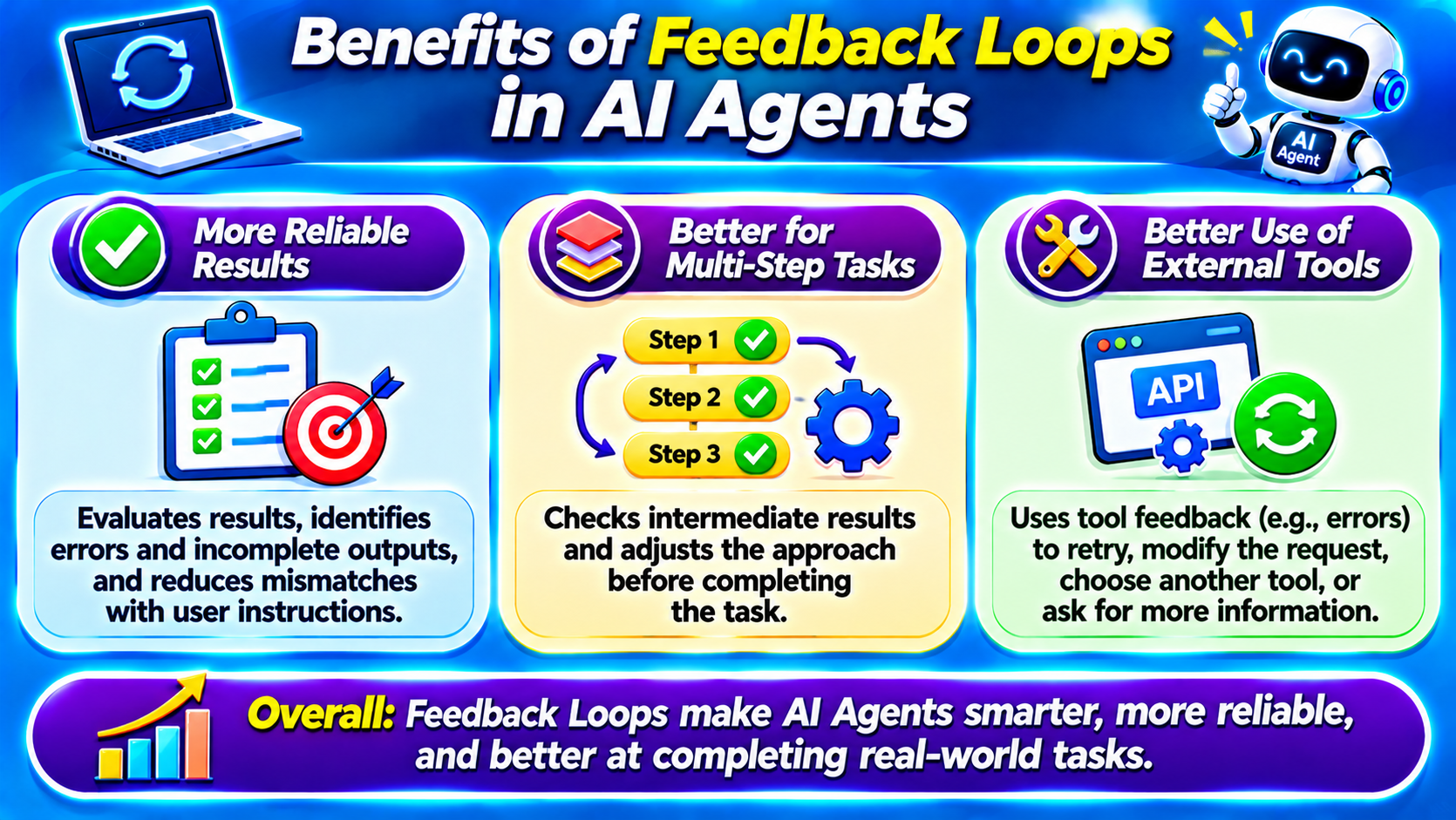
Feedback Loops can improve the reliability of AI Agent workflows by allowing the agent to evaluate whether its actions are producing the expected results. They can help identify errors, incomplete outputs, and mismatches between the user’s instructions and the agent’s current result.
They are especially useful for multi-step tasks in which an early action affects later decisions. By checking intermediate results, an agent can avoid continuing with an unsuitable result and can adjust its approach before completing the task.
Feedback Loops can also support better use of external tools. When a tool returns an error or an unexpected result, the agent can use that information to decide whether to retry, modify its request, choose another tool, or ask the user for additional information.
Challenges and Limitations of Feedback Loops
Although Feedback Loops are useful, they do not guarantee that an AI Agent will always correct its mistakes. The agent may fail to recognize an error, misunderstand the feedback, or make an incorrect adjustment. If the evaluation criteria are incomplete or inaccurate, the agent may also accept a result that does not truly satisfy the user’s needs.
Repeated attempts can consume additional time, API calls, and computing resources. For this reason, practical AI Agent systems often include retry limits, timeouts, validation rules, and clear stopping conditions. These safeguards help prevent an agent from repeating the same action indefinitely.
For tasks involving sensitive information, financial transactions, or important decisions, feedback mechanisms should be combined with appropriate permissions, security controls, and human oversight. The agent should not be allowed to take every possible corrective action without considering the consequences.
Conclusion
A Feedback Loop is an important mechanism that allows an AI Agent to evaluate its actions and improve its results within a task. By following the cycle of Act, Check, Improve, and Act Again, an agent can identify certain mistakes, adjust its approach, and work toward completing the user’s request more effectively.
From finding a birthday gift within a budget to generating emails, writing code, and using external tools, Feedback Loops help AI Agents handle tasks that may require more than one attempt. Understanding this concept provides a foundation for learning how intelligent agents evaluate their progress and make decisions throughout a workflow.
Read Also: What Is Agentic AI? Understanding AI That Can Plan and Take Action

