
What Is Task Decomposition in Agentic AI? How AI Agents Break Complex Tasks into Smaller Steps
Introduction
Artificial Intelligence is transforming the way people work, learn, and solve problems. With the development of Agentic AI, AI systems are becoming more capable of handling complex tasks, making decisions, using external tools, and working toward specific goals. However, completing a complex task is not always easy, even for an advanced AI Agent. A single task may involve several smaller activities, and each activity may require different information, decisions, and actions. To manage these activities effectively, AI Agents use a technique called Task Decomposition.
Task Decomposition is an important concept in Agentic AI that helps an AI Agent break down a large and complex task into smaller, manageable subtasks. Instead of trying to complete everything in one step, the agent divides the main goal into multiple activities and works on them in an organized manner. This approach makes complex tasks easier to understand, plan, execute, and manage.
What Is Task Decomposition?
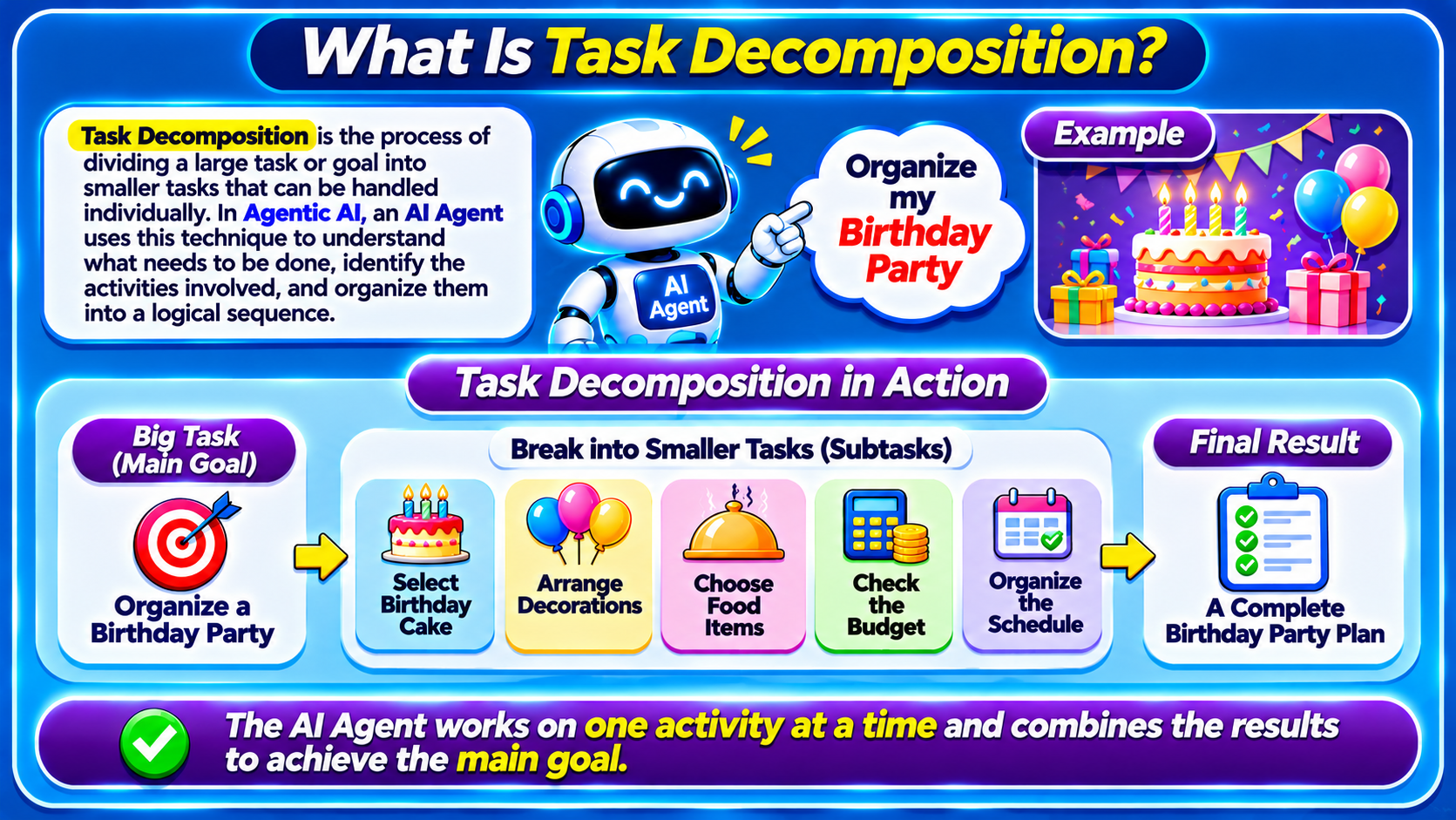
Task Decomposition is the process of dividing a large task or goal into smaller tasks that can be handled individually. In Agentic AI, an AI Agent uses this technique to understand what needs to be done, identify the activities involved, and organize them into a logical sequence.
For example, imagine asking an AI Agent to organize your birthday party. This request may sound simple, but completing it involves several activities, such as selecting a birthday cake, arranging decorations, choosing food items, checking the budget, and organizing the schedule. Instead of treating the entire birthday party arrangement as one single task, the AI Agent breaks it into smaller subtasks and works on each one.
This allows the agent to focus on one activity at a time while keeping the overall goal in mind. Once the individual subtasks are completed, their results can be combined to help achieve the main objective.
Want to build your career in Artificial Intelligence? Join our AI Training Program to learn Generative AI, Agentic AI, AI Agents, Python, and real-world applications through practical examples and hands-on projects. Start your AI learning journey with u
How Does Task Decomposition Work in AI Agents?
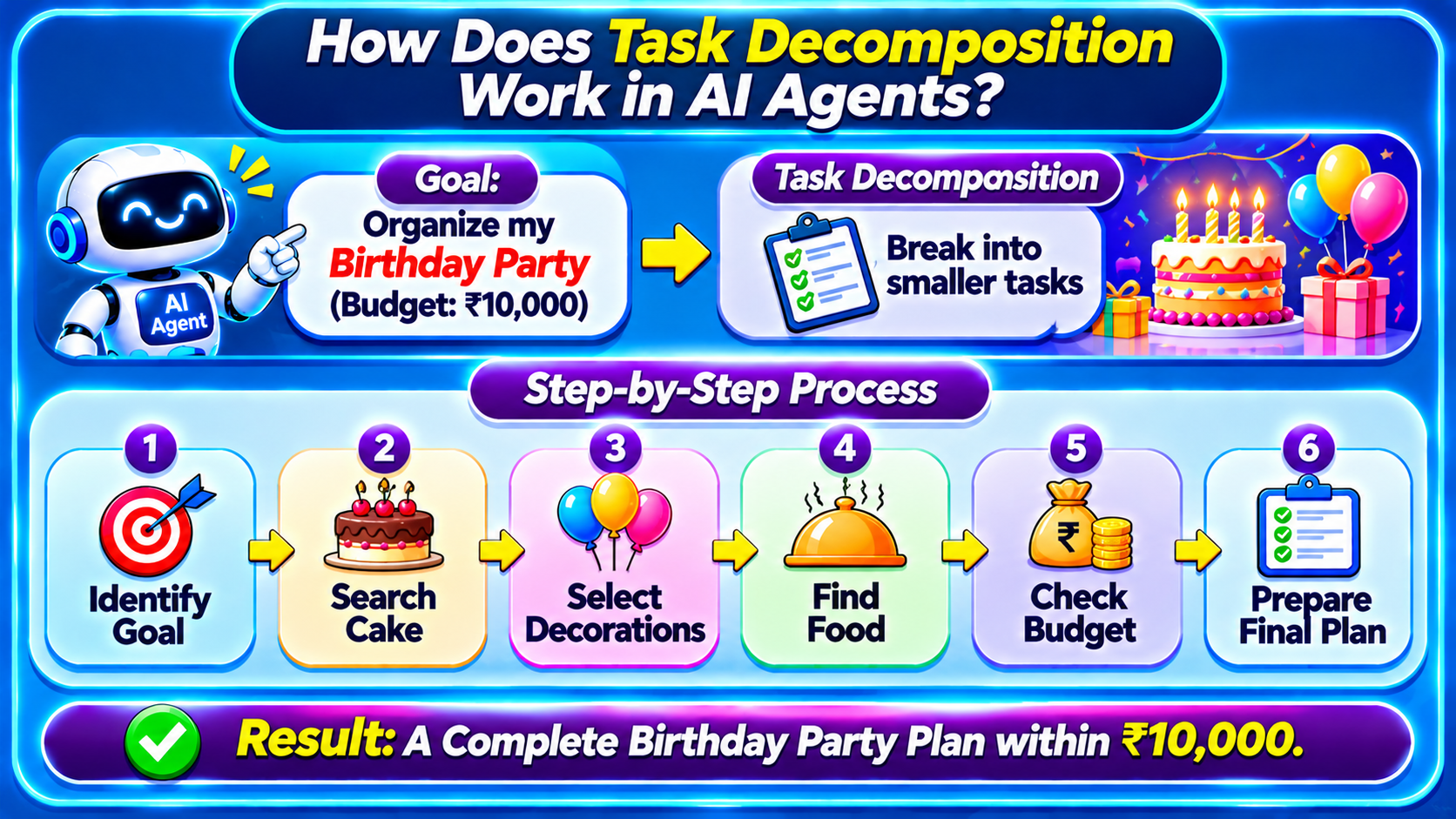
Task Decomposition generally begins when a user provides a goal or instruction to an AI Agent. The agent first understands the user’s requirements and identifies the different activities necessary to achieve the goal. It then divides the main task into smaller subtasks and determines how those subtasks should be handled.
Let’s understand this process through the birthday party example.
Imagine you ask an AI Agent: “Organize my birthday party within a budget of ₹10,000.”
The AI Agent needs to consider several things before it can help organize the party. It may divide the main task into the following smaller activities.
1. Identify the Main Goal
First, the AI Agent understands the user’s request. It identifies that the main objective is to organize a birthday party while staying within a budget of ₹10,000.
The agent also considers important requirements, such as the number of guests, preferred location, date, and type of celebration. If some essential information is missing, it may ask the user for clarification.
2. Search for Birthday Cakes
The next subtask is finding suitable birthday cakes. The AI Agent may search for different cake options based on the user’s preferences, required size, design, and price.
For example, it may identify a cake costing ₹1,500 that matches the user’s requirements.
3. Select Decoration Items
After considering the cake options, the agent moves to the decoration task. It may search for balloons, birthday banners, lights, candles, and other decoration materials.
It can compare different options based on their prices and suitability for the party.
4. Find Food Options
Food arrangements are another important part of organizing a birthday party. The AI Agent may identify suitable food options based on the number of guests and the available budget.
It may compare different menus, food packages, and catering options before selecting suitable choices.
5. Check the Budget
Once the agent gathers the estimated costs of the cake, decorations, and food, it checks whether the total expenses fit within the user’s ₹10,000 budget.
If the estimated expenses exceed the budget, the agent may reconsider some options, select more affordable alternatives, and adjust the plan.
6. Prepare the Final Plan
Finally, the AI Agent combines the results of the individual subtasks and prepares an organized birthday party plan. The plan may include cake details, decoration items, food arrangements, estimated costs, and a schedule for completing the preparations.
In this way, the AI Agent works toward completing one large goal by handling several smaller tasks.
Read also: What Is a Feedback Loop in AI Agents?
Why Is Task Decomposition Important in Agentic AI?
Task Decomposition is important because many real-world problems cannot be completed through a single action. They require multiple steps, decisions, and interactions with different tools or services.
By dividing a complex task into smaller activities, an AI Agent can organize its work more effectively. It can identify what needs to be completed first, understand which activities depend on other activities, and manage the overall task in a structured way.
For example, when organizing a birthday party, the agent needs to know the number of guests before estimating food requirements. It may also need to consider the budget before finalizing cake and decoration options. Breaking the main goal into smaller subtasks helps the agent manage these dependencies.
Another important benefit is that individual subtasks can be evaluated separately. If the selected cake is too expensive, the agent can reconsider the cake options without necessarily changing the entire party plan. Similarly, if the food arrangements exceed the budget, it can explore alternative food options.
Task Decomposition also makes it easier to use external tools. An AI Agent may use search tools to find cake options, shopping platforms to compare decoration items, and other available services to explore food arrangements. Each tool can support a specific subtask within the larger goal.
Real-World Applications of Task Decomposition
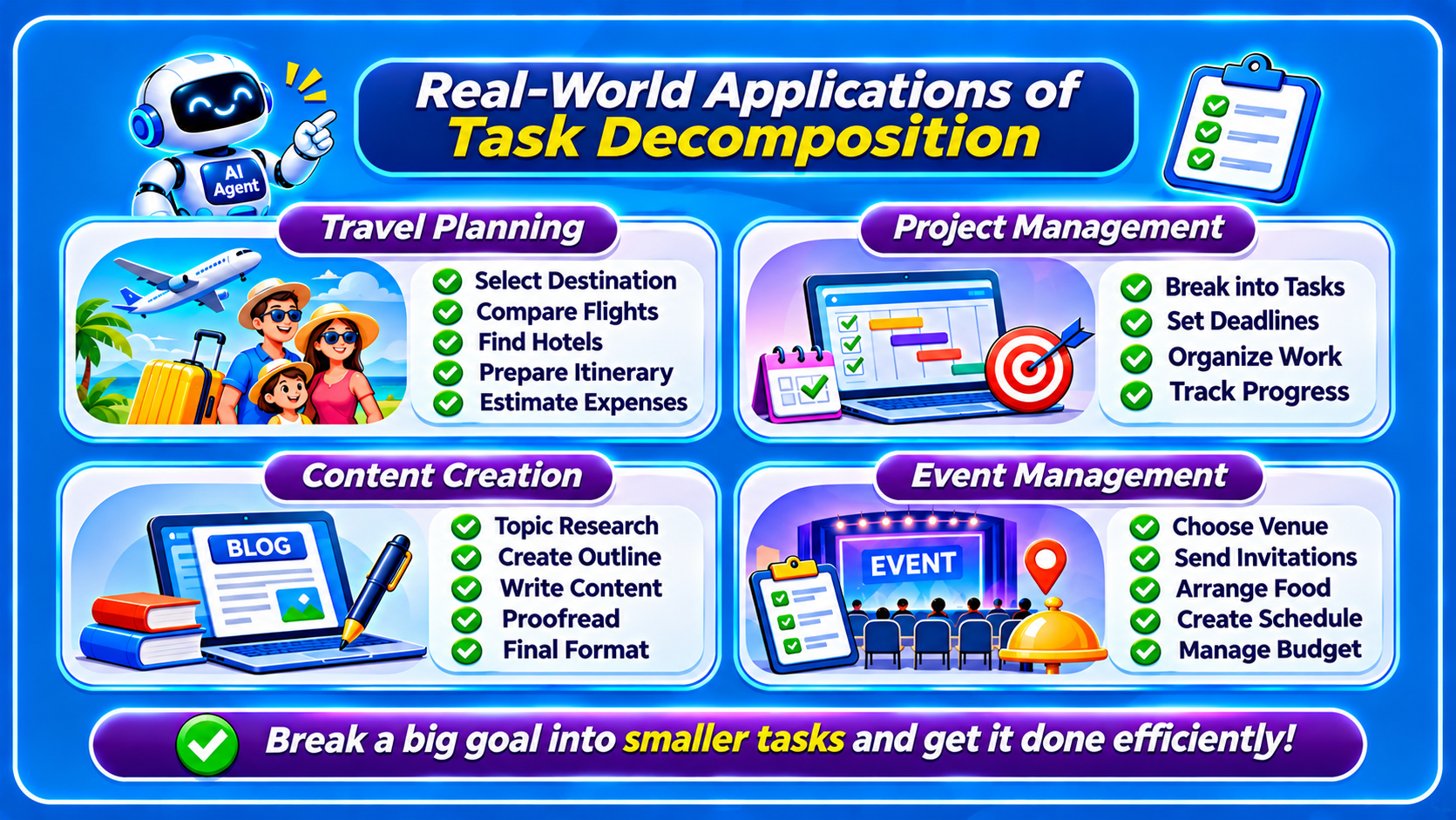
Task Decomposition is useful in many practical situations where a user gives an AI Agent a complex goal.
Travel Planning
When a user asks an AI Agent to plan a family vacation, the agent can divide the task into smaller activities such as selecting a destination, comparing flights, finding hotels, preparing an itinerary, and estimating travel expenses.
Project Management
An AI Agent can help manage a project by dividing the main objective into smaller tasks, identifying deadlines, organizing activities, and tracking progress.
Content Creation
When asked to create a blog article, an AI Agent can divide the work into topic research, outline preparation, introduction writing, section development, proofreading, and final formatting.
Event Management
For organizing a conference or business event, an AI Agent can break the task into venue selection, guest invitations, food arrangements, scheduling, and budget management.
These examples demonstrate how Task Decomposition can help AI Agents handle different types of complex activities in a structured manner.
Benefits of Task Decomposition
Task Decomposition offers several advantages in Agentic AI applications.
First, it makes complex tasks easier to manage because the agent works with smaller and more understandable activities instead of handling the entire goal at once.
Second, it improves task organization by helping the agent identify the sequence of activities and understand which steps should be completed before others.
Third, it supports better decision-making because the agent can evaluate different options for individual subtasks and select suitable approaches.
It also makes it easier to identify errors or incomplete activities. If one subtask does not produce the expected result, the agent can focus on that particular activity and attempt to improve it.
Finally, Task Decomposition supports the development of more advanced AI applications because it allows agents to coordinate multiple activities, use different tools, and work toward larger objectives.
Task Decomposition vs. Completing a Task in One Step
Consider two different approaches to organizing a birthday party.
In the first approach, the AI Agent tries to handle the entire request as one large task. This may make it difficult to organize all the requirements, compare options, and manage the budget effectively.
In the second approach, the AI Agent divides the request into smaller activities such as cake selection, decoration, food arrangements, and budget checking. It handles each activity separately and combines the results into a final plan.
The second approach provides a more structured way to manage the task because each activity has a clear purpose and contributes to the overall goal.
Conclusion
Task Decomposition is an important technique in Agentic AI that enables AI Agents to handle complex goals by dividing them into smaller, manageable subtasks. Instead of trying to complete everything in one step, the agent identifies the required activities, organizes them, and works toward completing them one by one.
Whether it is organizing a birthday party, planning a vacation, managing a project, or creating content, Task Decomposition helps AI Agents approach complex tasks in a more structured and organized way.
In simple terms, the concept can be understood as:
Big Task → Small Tasks → Step-by-Step Execution → Final Goal
Understanding Task Decomposition is an important step toward learning how intelligent AI Agents plan and execute real-world tasks.
Learn Agentic AI with Practical Examples
Want to understand how AI Agents work and how they handle real-world tasks? Join our AI Training Program to explore Generative AI, Agentic AI, AI Agent design patterns, frameworks, and practical applications. Learn important AI concepts through simple explanations and hands-on projects, and take your first step toward building intelligent AI applications.
Read Also: What Is Generative AI? A Simple Guide to AI That Creates New Content

