
Generative AI and Agentic AI: Technologies, Applications, and Real-World Projects
Introduction to Generative AI and Agentic AI
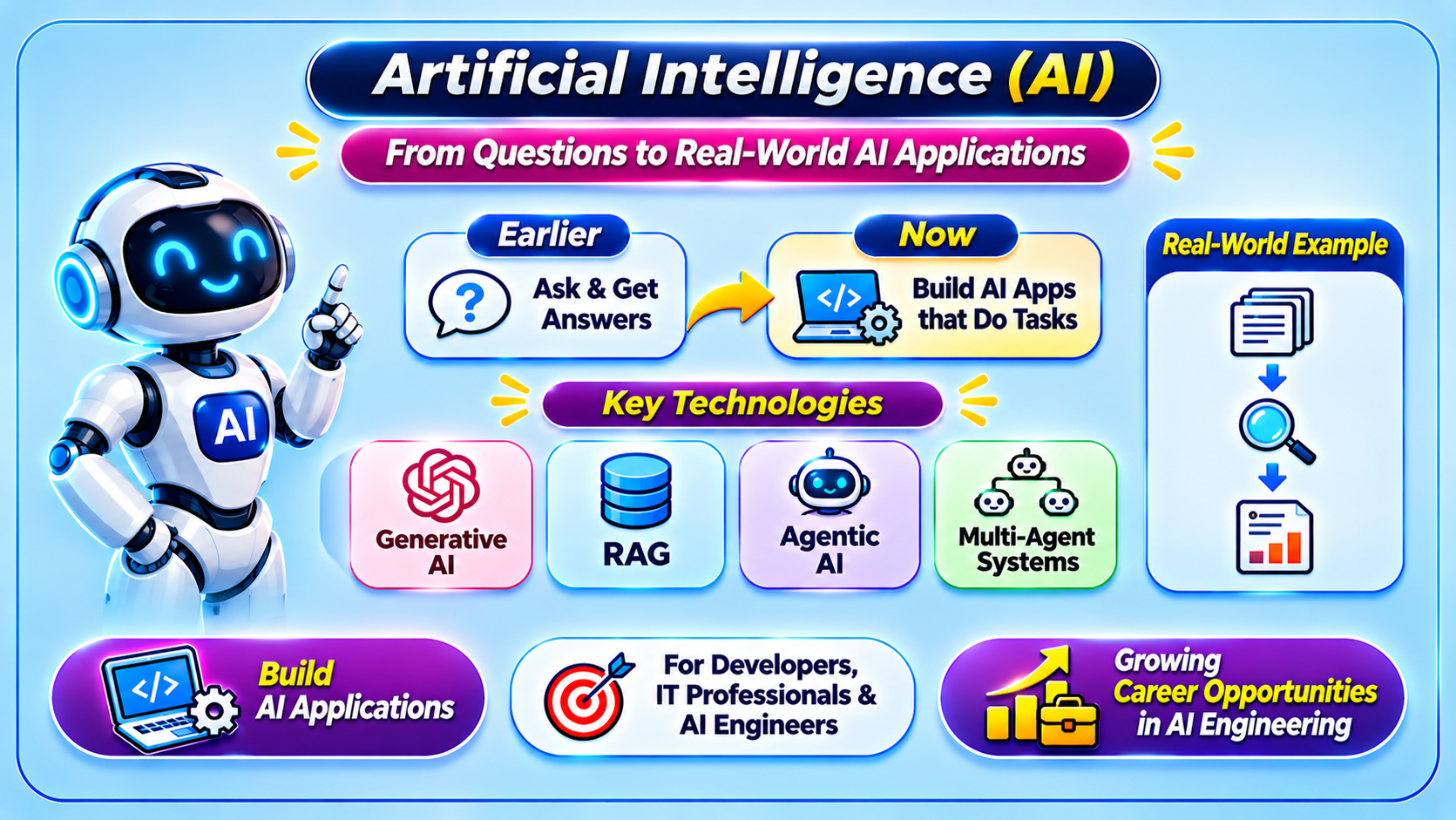
Artificial Intelligence is transforming the way people work, learn, communicate, and solve problems. In the past, most people interacted with AI mainly to ask questions, receive answers, or perform simple automated tasks. Today, AI has moved far beyond these basic capabilities. We can now build intelligent applications that generate content, understand information from documents, make decisions based on available context, use external tools, and perform multiple steps toward completing a task. Technologies such as Generative AI, Retrieval-Augmented Generation (RAG), Agentic AI, and Multi-Agent Systems are creating new opportunities for developers and organizations to build practical AI-powered solutions. For example, instead of simply asking an AI chatbot to explain a topic, we can build an application that reads company documents, answers questions using that information, searches for additional details, and prepares a structured report. This shift from simply generating answers to building applications that can perform useful tasks is one of the most important developments in modern Artificial Intelligence. Learning these technologies can help developers and IT professionals move toward building real-world AI applications and developing the skills required for AI Engineering.
What Is Generative AI?
Generative AI is a branch of Artificial Intelligence that focuses on creating new content based on user instructions, prompts, and learned patterns. Unlike traditional AI systems that may primarily classify information or make predictions, Generative AI models can produce human-like text, images, code, summaries, and other forms of content. Tools such as ChatGPT demonstrate how Generative AI can understand a user’s request and generate a relevant response. For example, if a user asks an AI tool to write an email, explain a Machine Learning concept, generate Python code, or summarize a document, the model can create the requested output based on the prompt. Generative AI is useful in many areas, including content creation, software development, education, customer support, business communication, and research. However, simply using an existing AI tool is different from developing an AI application. By learning Generative AI development, developers can understand how to work with AI models, design effective prompts, connect models to applications, process model responses, and build customized solutions for specific business requirements.
AI Training in Hyderabad – Get industry-focused AI training in Hyderabad with hands-on projects and expert guidance.
How Does Generative AI Work?
Generative AI applications typically work by receiving instructions from a user, processing the input using a trained AI model, and generating an appropriate response. The user provides a prompt describing what they need, and the model uses patterns and relationships learned during training to generate an output. For example, imagine that a student wants to understand the concept of Artificial Intelligence. The student enters a prompt asking for a simple explanation with real-life examples. The Generative AI model processes the instruction and creates an explanation that matches the requested context. In a software application, developers can connect an AI model through an API and send user prompts programmatically. The application receives the model’s response and presents it through a website, mobile application, chatbot, or another interface. This makes it possible to develop customized AI applications rather than depending only on publicly available AI chat tools. Understanding model APIs, prompt design, input and output processing, and application integration is an important foundation for Generative AI Engineering.
What Is RAG (Retrieval-Augmented Generation)?
One of the common limitations of a standalone Generative AI application is that the model may not have access to an organization’s latest internal information, private documents, or specific business data. For example, imagine that a company has thousands of pages of HR policies, technical documents, product manuals, and employee guidelines. An employee may ask an AI chatbot, “How many days of leave are available according to our company policy?” A general AI model may not know the company’s latest leave policy because that information is stored in private company documents. This is where Retrieval-Augmented Generation, commonly known as RAG, becomes useful. RAG is an approach that combines information retrieval with Generative AI. Instead of depending only on the model’s previously learned knowledge, the application first searches a connected knowledge source for relevant information. It then provides the retrieved information as context to the AI model, which uses that context to generate an answer. This allows organizations to build AI applications that respond based on their own documents and knowledge sources.
How Does RAG Work?
A RAG application generally begins when a user submits a question through an AI-powered application. The application converts the question into a suitable search representation and looks for relevant information in a connected knowledge source, such as company documents or a document database. The retrieved information is then combined with the original user question and provided to a Generative AI model as additional context. The model uses the question and retrieved content to prepare a response that is relevant to the available information. For example, imagine that an organization uploads its employee handbook, leave policy, and company guidelines into a knowledge-based AI application. When an employee asks about the leave approval process, the RAG system searches the relevant documents, retrieves the matching policy information, and passes that information to the AI model. The model then generates an answer based on the retrieved content. This approach is useful for building internal knowledge assistants, document question-answering systems, customer support applications, and enterprise AI solutions. RAG can also help reduce answers that are unsupported by the connected knowledge source, although the quality of the final response still depends on retrieval accuracy, document quality, and model behavior.
What Is Agentic AI?
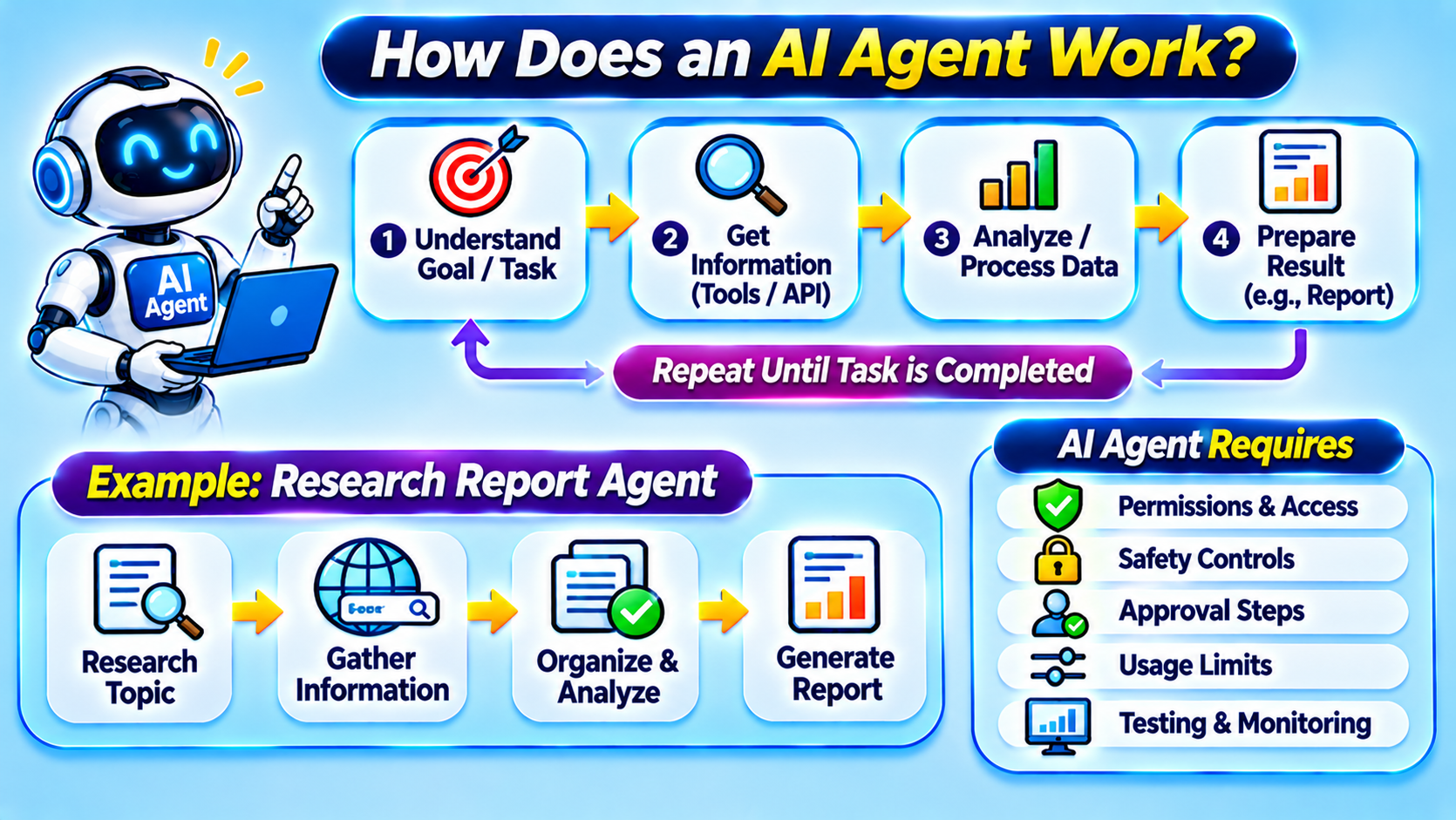
Agentic AI represents an approach in which AI systems can work toward achieving a defined goal by performing multiple steps rather than simply generating a single response. An AI Agent can receive a task, understand the objective, plan possible steps, use available tools, and continue working based on the results it receives. For example, imagine assigning an AI Agent a research task: collect information about Artificial Intelligence trends, analyze the findings, and prepare a report. Instead of simply explaining what Artificial Intelligence trends are, an appropriately designed AI Agent can use permitted search tools to collect information, organize the results, analyze relevant details, and prepare a structured report. Depending on its design and permissions, it may also use APIs, databases, code execution tools, or other external services. The important idea is that Agentic AI focuses on goal-oriented task execution. It combines an AI model with instructions, tools, decision-making logic, and sometimes memory or workflow capabilities to complete more complex tasks. This makes Agentic AI an important area for developers who want to build applications that do more than answer questions.
How Does an AI Agent Work?
An AI Agent typically starts with a goal or task provided by the user. It interprets the task, determines what information or actions may be required, and selects an appropriate next step. If the task requires external information, the agent may use a search tool or connect to an API. If it needs to analyze data, it may use a data-processing tool or execute code through an authorized environment. After receiving the result, the agent evaluates whether it has enough information to continue or whether another step is necessary. This process may repeat until the task is completed or the agent reaches a condition that requires human input. Consider an AI Agent designed to prepare a research report. First, it understands the research topic. Next, it gathers information from permitted sources, organizes the findings, analyzes the collected information, and prepares a report. The agent may need to verify information or handle errors during the process. In real-world applications, developers must also define clear permissions, safety controls, approval steps, and limits so that the agent performs only the actions it is authorized to perform. Therefore, building an AI Agent requires more than connecting a language model to a tool; it requires careful workflow design, testing, and monitoring.
What Are Multi-Agent Systems?
A Multi-Agent System is an approach in which multiple AI Agents work together to complete a larger task. Instead of assigning every responsibility to a single agent, developers can create different agents with specialized roles. Each agent handles a particular part of the overall workflow and shares relevant results with the other agents. For example, imagine building an AI-powered research application. One agent can collect information, another agent can analyze the collected data, and a third agent can prepare the final report. These agents work together toward the same objective, with each one focusing on a specific responsibility. This approach can help organize complex workflows and separate responsibilities into smaller tasks. Multi-Agent Systems are useful when a problem requires different types of expertise, multiple stages of processing, or coordination between specialized agents. However, creating a multi-agent architecture does not automatically make an application better. Developers must carefully design communication between agents, define their responsibilities, manage shared information, handle failures, and evaluate the quality of the final result.
Difference Between Generative AI, RAG, Agentic AI, and Multi-Agent Systems
Generative AI, RAG, Agentic AI, and Multi-Agent Systems are related technologies, but each addresses a different requirement in AI application development. Generative AI focuses on creating content such as text, code, summaries, and answers based on user instructions. RAG extends a Generative AI application by retrieving relevant information from external knowledge sources and providing that information to the model as context. Agentic AI focuses on achieving a goal by planning and carrying out multiple steps with the help of available tools. Multi-Agent Systems take this further by coordinating multiple specialized agents to complete a larger task. For example, a basic Generative AI application can write a summary about a topic. A RAG application can summarize a topic using information from an organization’s documents. An Agentic AI application can collect relevant information from permitted sources and prepare a report. A Multi-Agent System can divide the report preparation process among research, analysis, and report-writing agents. Understanding these differences helps developers select the right approach based on the requirements of the application.
AI Training in Bangalore – Explore AI training in Bangalore and gain practical skills in Generative AI, Machine Learning, and AI Agents.
Real-World Applications of Generative AI and Agentic AI
Generative AI and Agentic AI are being explored across several industries to improve productivity and support business processes. In education, Generative AI can help create learning materials, explain complex concepts, summarize lessons, and support personalized learning experiences. In software development, AI applications can assist developers with code generation, documentation, debugging suggestions, and code explanations. In customer support, RAG-based applications can answer questions using product documentation, company policies, and support knowledge bases. In business research, AI Agents can help collect information, organize findings, and prepare reports using authorized tools and data sources. In enterprise environments, Multi-Agent Systems can divide complex workflows into specialized tasks, such as information gathering, data analysis, and document preparation. These examples demonstrate how AI applications can support different activities. However, the level of automation depends on the application’s design, the quality of connected data, available tools, security permissions, and the need for human review.
Building Real-World AI Projects
Learning AI concepts becomes more valuable when they are applied to practical projects. Instead of limiting learning to theoretical explanations or simple demonstrations, developers should understand how to design, develop, test, and deploy complete AI applications. A RAG project, for example, can involve uploading documents, processing their content, retrieving relevant information, connecting a language model, and presenting answers through a user interface. An AI Agent project can involve defining a task, connecting external tools, managing the execution steps, and handling errors or unexpected results. A Multi-Agent project can involve creating specialized agents and coordinating their responsibilities to complete a larger workflow. Building such projects helps learners understand how different components work together in a real application. It also provides practical experience in identifying technical challenges, evaluating output quality, and improving application reliability.
Important Engineering Skills for AI Application Development
Developing a successful AI application involves much more than selecting a model and writing a prompt. Developers must understand how to test application behavior, handle errors, protect sensitive information, monitor performance, and control operational costs. Testing is important because an AI application may produce different responses for similar inputs, and developers need to evaluate whether the outputs are useful and accurate enough for the intended purpose. Error handling helps applications respond properly when an API is unavailable, a tool call fails, or an external service returns unexpected information. Security is essential when applications process private documents, customer details, or confidential business information. Developers must implement suitable authentication, authorization, access controls, and data-handling practices. Monitoring helps teams understand application performance, failures, usage patterns, and response quality after deployment. Cost control is also important because model usage, API requests, document processing, and agent workflows can generate operational expenses. These engineering practices help transform an AI prototype into a more reliable application suitable for real-world use.
Who Can Benefit from Generative AI and Agentic AI Training?
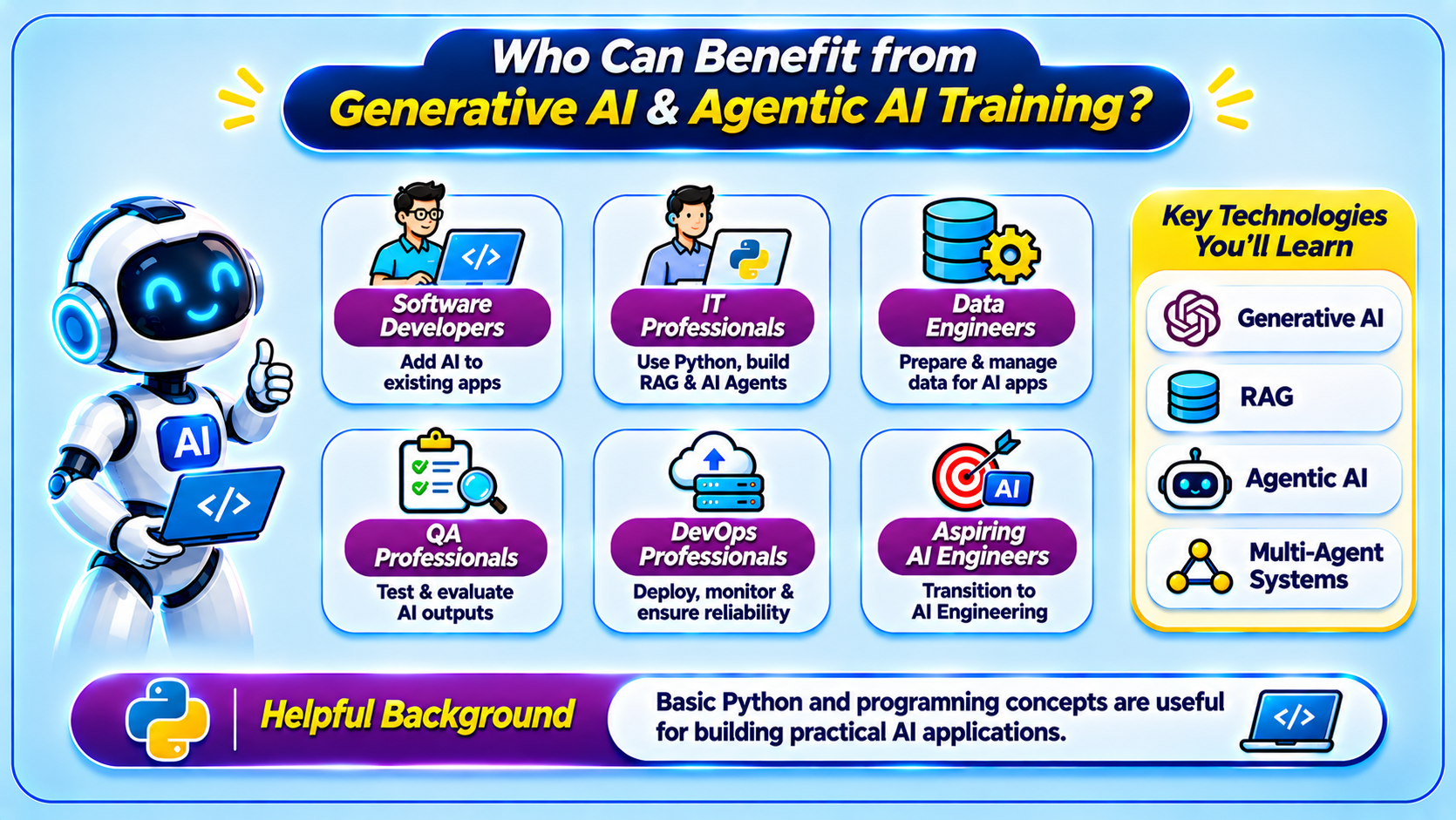
Generative AI and Agentic AI training can be useful for people who want to understand how modern AI applications are developed and used in practical environments. Software Developers can use these skills to extend existing applications with AI-powered capabilities. IT Professionals who have Python knowledge can explore how to connect language models, build RAG applications, and develop AI Agents. Data Engineers can learn how information is prepared and made available to AI applications. QA Professionals can explore methods for testing AI outputs, evaluating application behavior, and identifying failures in AI-powered workflows. DevOps Professionals can gain an understanding of deployment, monitoring, reliability, and operational considerations for AI applications. Professionals who want to transition toward AI Engineering can also benefit from learning the foundations of Generative AI, RAG, Agentic AI, and Multi-Agent Systems. A basic understanding of Python and programming concepts can be helpful because practical AI application development often involves working with APIs, data, and software components.
Why Learn Generative AI and Agentic AI?
The development of Artificial Intelligence is creating opportunities for professionals who can build practical AI-powered applications. Knowing how to use AI tools is useful, but understanding how to develop applications using these technologies provides a deeper technical foundation. Generative AI helps developers create applications that generate useful content, while RAG makes it possible to connect AI models with external knowledge sources. Agentic AI introduces goal-oriented workflows in which applications can use tools and perform multiple steps, while Multi-Agent Systems provide an approach for coordinating specialized agents. When these technologies are combined with software engineering practices such as testing, security, monitoring, deployment, and cost management, developers can work toward building more complete AI solutions. A structured 50-hour professional training program covering these areas can provide learners with a focused path to understand the concepts and apply them through practical projects.
Conclusion
Generative AI and Agentic AI are important technologies shaping the next generation of intelligent applications. The journey begins with understanding how Generative AI models create content and how developers can connect these models to software applications. RAG introduces the ability to retrieve information from external documents and use it to generate context-aware answers. Agentic AI takes applications beyond simple question-and-answer interactions by enabling them to work toward goals through planning and tool usage. Multi-Agent Systems introduce collaboration between specialized agents to handle complex tasks. However, building useful AI applications also requires practical engineering skills such as testing, error handling, security, monitoring, and cost control. For Software Developers, IT Professionals, Data Engineers, QA Professionals, DevOps Professionals, and aspiring AI Engineers, learning these technologies can be a valuable step toward developing real-world AI solutions. The future of AI is not only about asking questions and receiving answers; it is also about building applications that can use information, tools, and intelligent workflows to help solve real-world problems.
AI Training in India – Choose professional AI training in India to learn the latest AI technologies and build real-world applications.

