
What Are Missing Values in Machine Learning?
Introduction to Missing Values in Machine Learning

Data is one of the most important components of Machine Learning. Every Machine Learning model learns patterns, relationships, and trends from the data provided during training. The quality of the data directly influences how well a model performs. However, real-world datasets are not always complete or perfectly organized. Sometimes, certain information may be unavailable, some fields may be left blank, or data may not be collected properly. These incomplete entries are known as Missing Values. Handling missing values is an important step in Data Preprocessing because incomplete data can affect model training, analysis, and prediction accuracy.
Imagine a school collecting information about its students. The school maintains a dataset containing student names, ages, departments, and examination marks. Most students have complete information, but one student’s marks are missing because the student was absent during the examination or the marks were not entered into the system. In this situation, the marks field contains a Missing Value. Similarly, in real-world applications, a hospital dataset may have missing patient ages, a banking dataset may have missing income details, or an e-commerce dataset may have missing product ratings. These missing entries can create challenges when preparing data for Machine Learning models.
AI Training in Hyderabad – Get industry-focused AI training in Hyderabad with hands-on projects and expert guidance.
Why Do Missing Values Occur in Datasets?
Missing Values can occur for several reasons during data collection, storage, or processing. Sometimes, users forget to enter certain information while filling out online forms. In other situations, organizations may not have access to specific information, or a particular measurement may not have been recorded correctly. Technical issues can also result in missing data when applications fail to collect or transfer information properly.
For example, consider a hospital that collects patient information such as name, age, blood pressure, weight, and medical history. A patient may provide all details except weight because it was not measured during the visit. Similarly, a bank may collect customer details but may not have income information for every customer. When this information is stored in a dataset, the corresponding fields remain empty or contain null values. If these datasets are directly used for Machine Learning, the missing information may create problems during data analysis and model training.
How Do Missing Values Affect Machine Learning Models?
Missing Values can affect the performance and reliability of Machine Learning models. Many algorithms require complete numerical or categorical data to perform calculations and learn patterns. When important values are missing, some algorithms may generate errors or may not accept the dataset without additional preprocessing. Even when an algorithm can handle missing data, incomplete information may reduce the quality of the patterns learned by the model.
For example, imagine a Machine Learning model designed to predict student examination performance based on previous marks, attendance, study hours, and assignment scores. If marks are missing for several students, the model may not receive enough information to understand the relationship between these factors and student performance. Similarly, in banking applications, missing income information may affect a model that evaluates loan eligibility. Therefore, identifying and handling missing values before training a Machine Learning model is an important part of preparing a reliable dataset.
What Is Missing Value Imputation?
Missing Value Imputation is a Data Preprocessing technique used to replace missing entries with suitable estimated or selected values. Instead of leaving important fields empty, we use an appropriate method to fill those gaps based on the available information in the dataset. The main objective is to prepare a more complete dataset while preserving as much useful information as possible.
For example, suppose a school dataset contains the examination marks of five students, but one student’s marks are missing. Instead of immediately removing that student’s entire record, we can examine the marks of the other students and select a suitable value to fill the missing entry. The method used to select that replacement value depends on the type of data, its distribution, and the reason why the information is missing. Three commonly used techniques are Mean Imputation, Median Imputation, and Mode Imputation.
Mean Imputation: Replacing Missing Values with the Average
Mean Imputation is a simple technique in which we calculate the average of the available numerical values and use that average to replace missing entries. It is commonly used when numerical data is reasonably distributed and does not contain extreme outliers that could significantly affect the average.
Consider a school dataset containing the examination marks of five students: 60, 70, 80, 90, and one missing value. To fill the missing entry using Mean Imputation, we first calculate the average of the four available marks. The total is 300, and dividing it by four gives an average of 75. Therefore, we can use 75 to replace the missing marks.
Mean (Average) Formula:
Mean = (60 + 70 + 80 + 90) / 4
Mean = 300 / 4
Mean = 75
This technique is easy to understand and implement, especially when working with numerical datasets. However, Mean Imputation has a limitation. If the dataset contains extremely high or low values, the average may become misleading. For example, if most students score between 50 and 90 but one student scores 200 due to an incorrect data entry, the average will increase significantly. In such situations, Mean Imputation may not be the most suitable choice.
Median Imputation: Replacing Missing Values with the Middle Value
Median Imputation is another commonly used technique for handling missing numerical values. Instead of calculating the average, we arrange the available values in ascending order and identify the middle value. That middle value is called the Median. We then use it to replace the missing entry.
For example, imagine that the examination marks of five students are 40, 50, 60, 70, and one missing value. The median of the available marks is 55 because it is the average of the two middle values, 50 and 60. We can use 55 to fill the missing entry.
Median = (50 + 60) / 2
Median = 110 / 2
Median = 55
Median Imputation is particularly useful when the dataset contains outliers or values that are not evenly distributed. Unlike the mean, the median is less affected by extremely high or low observations. For example, when analyzing employee salaries, a small number of employees may receive exceptionally high salaries compared with the majority. In such situations, the median may represent the typical salary more accurately than the mean. Therefore, Median Imputation is often preferred when numerical data contains outliers or is skewed.
Mode Imputation: Replacing Missing Values with the Most Frequent Value
Mode Imputation is mainly used for categorical data, although it can also be applied to numerical data in suitable situations. The Mode is the value that appears most frequently in a dataset. When a particular entry is missing, we replace it with the most commonly occurring value.
For example, consider a dataset containing the departments of students in a college. The available department values are Computer Science, Commerce, Computer Science, Mechanical, and one missing entry. Since Computer Science appears more frequently than the other categories, we can use Computer Science to fill the missing value.
Mode Imputation is useful when handling categorical information such as department names, product categories, customer preferences, payment methods, and job roles. Unlike Mean and Median Imputation, which are generally used for numerical data, Mode Imputation helps fill missing categorical values without performing mathematical calculations. However, repeatedly replacing missing values with the most frequent category can increase the dominance of that category and may affect the original distribution of the dataset.
Should We Always Replace Missing Values?
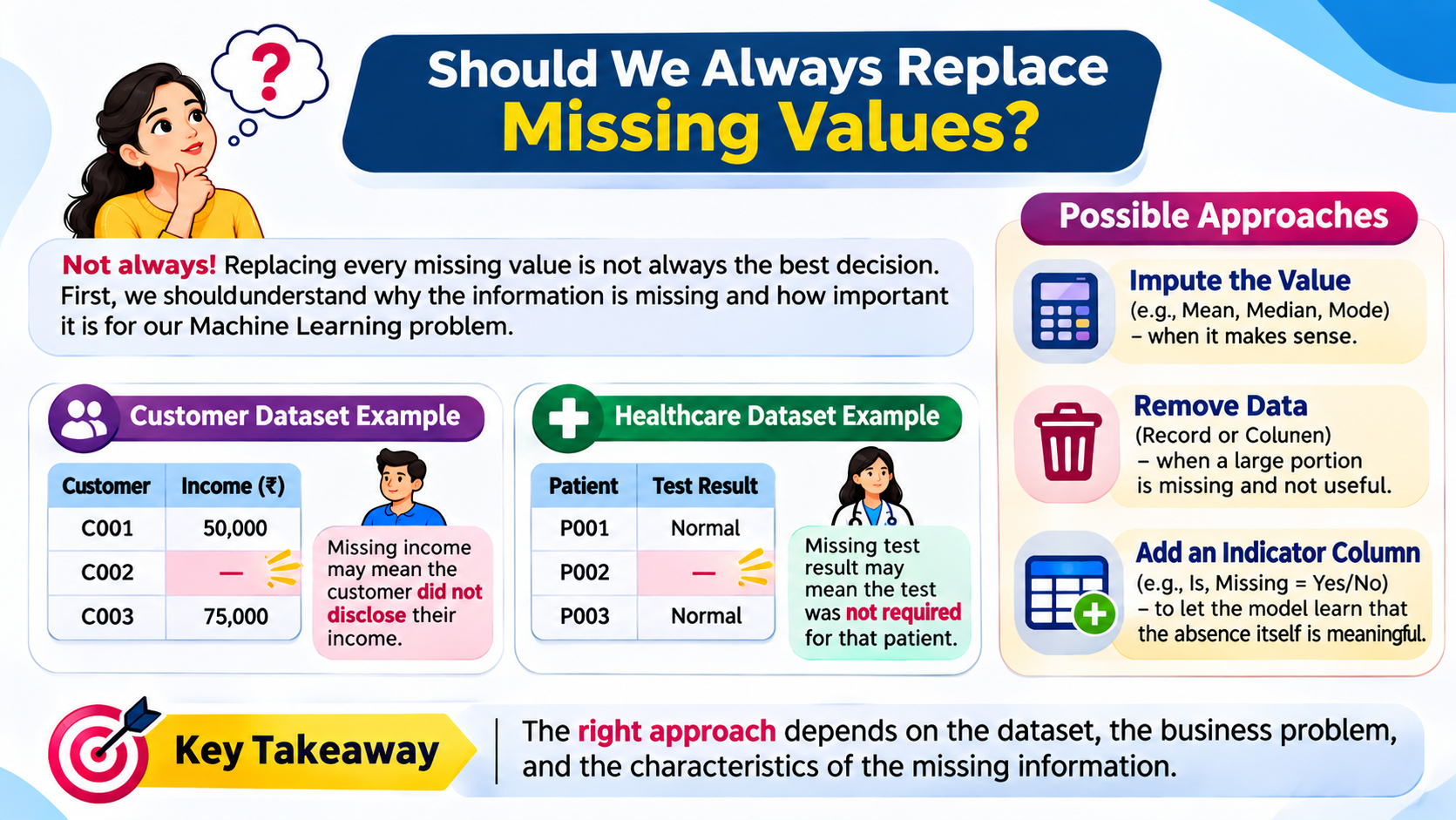
Although Mean, Median, and Mode Imputation are commonly used techniques, replacing every missing value is not always the best decision. Before selecting an imputation method, we should understand why the information is missing and how important that information is for the Machine Learning problem. Sometimes, missing values may contain useful information about the underlying situation.
For example, in a customer dataset, a missing income value may indicate that the customer did not disclose their income. In a healthcare dataset, a missing test result may mean that the test was not required for a particular patient. Replacing these values blindly with an average or the most frequent category may introduce misleading information into the dataset.
In some situations, removing a record or a particular column may be appropriate, especially when a large portion of the information is missing and the remaining data is not useful. Another approach is to create a separate indicator column that identifies whether the original value was missing. This can help a Machine Learning model learn whether the absence of information itself is meaningful. The correct approach depends on the dataset, the business problem, and the characteristics of the missing information.
Real-World Applications of Missing Value Imputation
Missing Value Imputation is used across many industries because real-world datasets frequently contain incomplete information. In healthcare, patient records may contain missing values for blood pressure, weight, age, or laboratory test results. Data scientists must carefully examine these gaps before using the information to build predictive models. In banking, customer datasets may have missing income, employment, or transaction details that can affect credit risk analysis and financial predictions.
In e-commerce applications, product datasets may contain missing ratings, review counts, or product specifications. In educational institutions, student records may have missing attendance, assignment scores, or examination marks. In all these situations, Data Preprocessing techniques help prepare the data for further analysis and Machine Learning model development. The important point is that the selected method should match the nature of the information rather than simply filling every blank with an arbitrary value.
AI Training in Bangalore – Explore AI training in Bangalore and gain practical skills in Generative AI, Machine Learning, and AI Agents.
Important Considerations When Handling Missing Values
Before applying an imputation technique, it is important to understand the percentage of missing data, the type of column, and the distribution of available values. A numerical column may require Mean or Median Imputation, whereas a categorical column may be better suited to Mode Imputation or a separate missing category. Data scientists should also check whether the missing values are concentrated in particular groups or whether they occur randomly across the dataset.
Another important consideration is Data Leakage. When preparing data for model training, imputation values should be calculated using the training dataset only and then applied to the validation or test datasets. For example, if we calculate the average marks using the complete dataset, including test records, information from the test data may unintentionally influence the training process. This can lead to an unrealistic evaluation of model performance. Using a proper preprocessing pipeline helps avoid this problem and ensures that the model is evaluated more reliably.
Conclusion: Why Is Handling Missing Values Important in Machine Learning?
Missing Values are a common problem in real-world datasets, and handling them correctly is an essential part of Data Preprocessing. When important information is missing, Machine Learning algorithms may face difficulties during training, and the quality of predictions can be affected. Techniques such as Mean Imputation, Median Imputation, and Mode Imputation help replace missing entries using suitable values based on the available data.
However, choosing the right technique is more important than simply filling empty fields. Data scientists should understand the dataset, identify the reason for missing information, examine the distribution of values, and select an appropriate preprocessing method. They should also avoid introducing bias or data leakage while preparing the dataset.
Remember, a successful Machine Learning model does not depend only on choosing the right algorithm. It also depends on preparing high-quality data. Identifying and handling missing values is one of the important steps toward building accurate, reliable, and effective AI and Machine Learning applications.
AI Training in India – Choose professional AI training in India to learn the latest AI technologies and build real-world applications.

