
What Is an Imbalanced Dataset in Machine Learning? Causes, Challenges, and How to Handle It
Introduction to Imbalanced Datasets in Machine Learning
Machine Learning models learn patterns from historical data and use those patterns to make predictions on new data. However, the quality and distribution of the training data play an important role in determining how well a model performs. In many real-world applications, datasets do not contain an equal number of records for every category or class. Sometimes, one class contains thousands of records, while another class contains only a few records. This situation is known as an Imbalanced Dataset. Dataset imbalance is a common challenge in Machine Learning, especially in applications such as fraud detection, disease diagnosis, spam detection, customer churn prediction, and cybersecurity. For example, in a banking system, most transactions are genuine, while only a small percentage of transactions may be fraudulent. If a Machine Learning model is trained on this highly uneven data without considering the imbalance, it may learn to predict the majority class more frequently and fail to identify important minority-class cases. Therefore, understanding imbalanced datasets and learning how to handle them is essential for building reliable Machine Learning models.

What Is an Imbalanced Dataset?
An Imbalanced Dataset is a dataset in which the number of records belonging to different classes is significantly unequal. In a classification problem, the class with the larger number of records is generally called the Majority Class, while the class with fewer records is called the Minority Class. For example, imagine that a bank has collected 10,000 transaction records for building a fraud detection model. Out of these transactions, 9,900 are genuine transactions and only 100 are fraudulent transactions. Here, genuine transactions represent the majority class, while fraudulent transactions represent the minority class. The model needs to learn how to identify both genuine and fraudulent transactions, even though the number of fraudulent examples is much smaller. This uneven distribution is called an Imbalanced Dataset. Such datasets are common in real-world applications because important events, such as financial fraud, rare diseases, and security attacks, may occur much less frequently than normal events.
AI Training in India: Discover AI Training in India and gain industry-relevant skills in Python, Machine Learning, Deep Learning, Generative AI, and Agentic AI to build your future in the AI industry.
Understanding Imbalanced Data with a Real-World Example
Let’s understand this concept using a simple banking example. Imagine that a bank wants to develop a Machine Learning model to identify fraudulent transactions. The bank provides 10,000 historical transaction records to train the model. Among these records, 9,900 transactions are genuine and only 100 transactions are fraudulent. The model learns from this historical information and tries to identify whether a new transaction is genuine or fraudulent. However, because genuine transactions make up 99% of the dataset, the model may learn to predict almost every transaction as genuine. If the model predicts all 10,000 transactions as genuine, it will correctly classify the 9,900 genuine transactions but fail to detect all 100 fraudulent transactions. At first glance, this model appears to perform very well because it achieves 99% accuracy. However, from the bank’s perspective, the model is not useful because it fails to identify the fraudulent transactions that the bank actually needs to detect. This example clearly demonstrates why dataset distribution and appropriate evaluation metrics are important in Machine Learning.
Why Is an Imbalanced Dataset a Problem?
An imbalanced dataset can create challenges during the training and evaluation of a Machine Learning model. When one class contains significantly more examples than another class, the model may become biased toward the majority class. Since the majority class appears more frequently in the training data, the model may learn its patterns more easily and fail to recognize the minority class effectively. This is particularly problematic when the minority class represents an important event, such as a fraudulent transaction, a serious medical condition, or a network security attack. Another major problem is that accuracy alone may give a misleading picture of model performance. As seen in the banking example, a model can achieve 99% accuracy simply by predicting every transaction as genuine, even though it fails to detect fraud. Therefore, developers and data scientists should not depend only on accuracy when working with imbalanced datasets. They should also evaluate how effectively the model identifies minority-class records using metrics such as Precision, Recall, and F1-Score.
What Is the Difference Between Majority Class and Minority Class?
In an imbalanced classification dataset, the Majority Class refers to the category that contains the largest number of records, whereas the Minority Class refers to the category that contains fewer records. Understanding this difference is important because many techniques used to handle class imbalance focus on adjusting the distribution between these two classes. For example, in a fraud detection dataset, genuine transactions are usually the majority class and fraudulent transactions are the minority class. In a medical diagnosis dataset, healthy patient records may represent the majority class, while records containing a rare disease may represent the minority class. In an email classification dataset, normal emails may be more common than spam emails, depending on the data collected. The objective is not necessarily to make every class contain exactly the same number of records. Instead, the objective is to help the model learn meaningful patterns from both classes and perform effectively on the cases that matter.
How Do We Handle an Imbalanced Dataset in Machine Learning?
There are several techniques that can help improve Machine Learning model performance when working with imbalanced datasets. The most common approaches include Oversampling, Undersampling, SMOTE, and Class Weights. Each technique handles class imbalance differently. Some methods adjust the number of records in the training dataset, while others change how much importance the model gives to different classes during training. The appropriate method depends on the dataset size, the level of imbalance, the type of Machine Learning algorithm, and the business requirement. Let’s understand these techniques with the banking fraud detection example.
Oversampling – Increasing Minority Class Samples
Oversampling is a technique used to increase the number of records belonging to the minority class. In an imbalanced dataset, the minority class may contain too few examples for the Machine Learning model to learn its patterns effectively. Oversampling attempts to address this issue by increasing the representation of the minority class in the training data. For example, imagine a banking dataset containing 9,900 genuine transactions and only 100 fraudulent transactions. Using a simple random oversampling approach, we can increase the number of fraudulent transaction samples by duplicating existing minority-class records. This gives the model more opportunities to learn from fraud-related examples during training. However, randomly duplicating records can sometimes cause overfitting because the model may memorize repeated examples instead of learning general patterns. Therefore, oversampling should be applied carefully, and the model should be evaluated using separate validation or test data that retains the original class distribution.
Undersampling – Reducing Majority Class Samples
Undersampling is another technique used to handle imbalanced datasets. Instead of increasing the minority class, this method reduces the number of records belonging to the majority class. For example, consider a dataset containing 9,900 genuine transactions and 100 fraudulent transactions. Using random undersampling, we can reduce the number of genuine transaction records so that the model receives a more balanced set of training examples. This approach can reduce training time and help prevent the model from being dominated by the majority class. However, one important disadvantage is that removing majority-class records may result in the loss of useful information. If the removed records contain important patterns, the model may not learn the complete behavior of genuine transactions. Therefore, undersampling is often more suitable when the dataset is very large and the majority class contains many redundant examples.
SMOTE – Synthetic Minority Over-sampling Technique
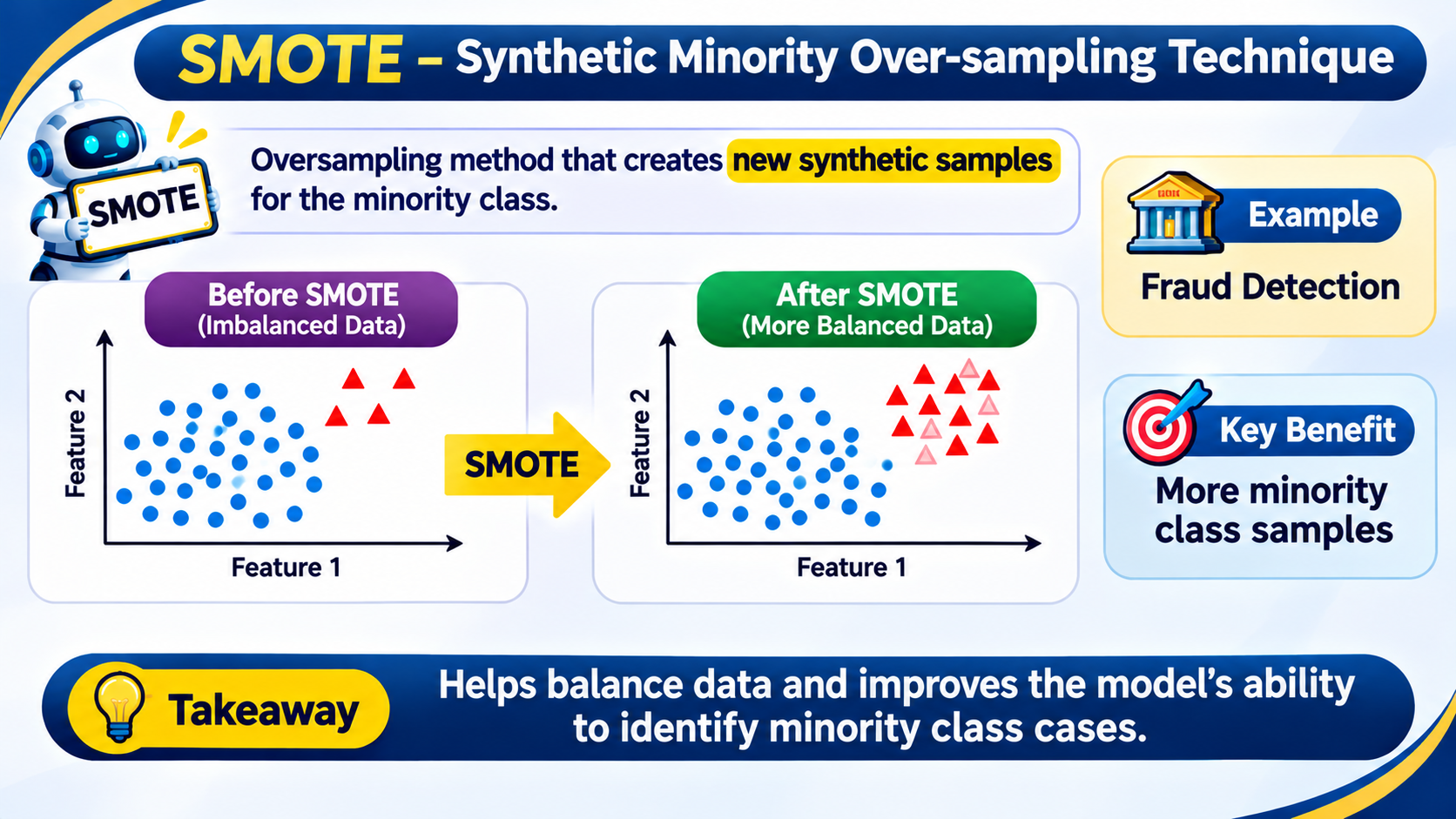
SMOTE stands for Synthetic Minority Over-sampling Technique. It is an oversampling method that generates new synthetic examples for the minority class instead of simply duplicating existing records. The technique creates synthetic samples by considering existing minority-class examples and their nearby minority-class neighbors. It generates new data points between selected examples in the feature space, helping increase the representation of the minority class in the training dataset. For example, imagine that a fraud detection dataset contains only a small number of fraudulent transactions. SMOTE can generate additional synthetic minority-class samples based on the patterns in the existing fraud records. This may help the model learn a wider range of minority-class patterns. However, SMOTE does not guarantee that every synthetic sample represents a realistic transaction. It should be used carefully, particularly when classes overlap or when the data contains categorical features. Specialized variations may be needed for datasets containing categorical variables. SMOTE should also be applied only to the training data after splitting the dataset to avoid data leakage.
Class Weights – Giving More Importance to Minority Class Errors
Class Weights are another approach for handling imbalanced datasets. Instead of changing the number of records in each class, this method assigns different weights to different classes during model training. A higher weight can be assigned to the minority class so that mistakes involving that class have a greater influence on the model’s training objective. For example, in a banking fraud detection application, the model may assign a higher penalty to incorrectly classifying a fraudulent transaction as genuine. This encourages the model to pay more attention to fraud-related patterns rather than focusing mainly on the majority class. Many Machine Learning algorithms support class-weight options or similar mechanisms. The actual impact depends on the algorithm and the selected weight values. Class weights can be useful when we want to retain the original training records without applying oversampling or undersampling. However, assigning very high weights may increase false positives, so the model’s performance should be evaluated carefully.
AI Training in Hyderabad: Explore professional AI Training in Hyderabad with industry-experienced trainers, hands-on projects, and practical learning in Machine Learning, Generative AI, RAG, and AI Agents.
How Do We Evaluate a Model Trained on an Imbalanced Dataset?
Evaluating a Machine Learning model trained on an imbalanced dataset requires more attention than simply calculating accuracy. Accuracy measures the percentage of total predictions that are correct, but it may not reveal whether the model is identifying the minority class effectively. For example, a fraud detection model that predicts every transaction as genuine may still achieve 99% accuracy when 99% of the dataset contains genuine transactions. Therefore, other classification evaluation metrics are important. Precision measures how many of the transactions predicted as fraudulent are actually fraudulent. Recall measures how many of the actual fraudulent transactions the model successfully identifies. The F1-Score combines Precision and Recall using their harmonic mean, providing a single measure that considers both metrics. These evaluation metrics help developers understand whether the model is missing important minority-class cases or incorrectly classifying too many majority-class records. Depending on the application, the Precision-Recall curve and other threshold-based evaluation methods can also provide useful insights.
Understanding Precision, Recall, and F1-Score
Precision, Recall, and F1-Score are particularly useful when evaluating classification models on imbalanced datasets. Imagine that a fraud detection model identifies 100 transactions as fraudulent, but only 80 of them are actually fraudulent. In this case, Precision is 80%, because 80 out of the 100 predicted fraud cases are correct. Now imagine that the dataset contains 100 actual fraudulent transactions and the model successfully identifies 80 of them. Its Recall is also 80%, because it detects 80 out of the 100 actual fraud cases. The F1-Score combines Precision and Recall into a single metric and is calculated as the harmonic mean of these two values. A higher F1-Score generally indicates a better balance between Precision and Recall. However, the most suitable metric depends on the business objective. In fraud detection, a bank may prioritize Recall because missing fraudulent transactions can be costly. In other applications, such as automatically blocking legitimate customer accounts, Precision may be especially important because false alarms can negatively affect genuine users.
Important Considerations When Handling Imbalanced Datasets
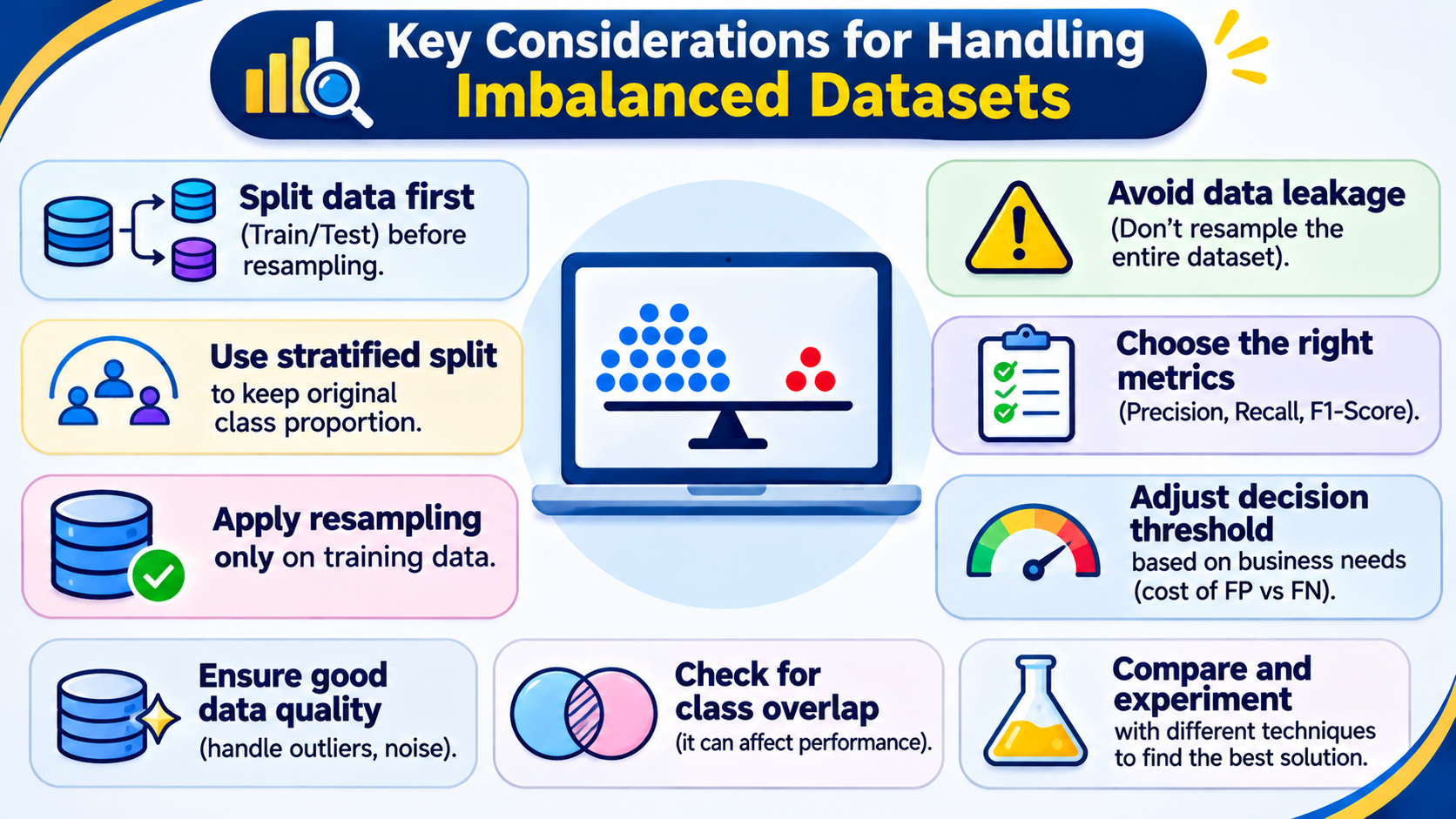
Handling an imbalanced dataset requires more than applying a resampling technique. One important consideration is to split the dataset into training and testing sets before applying oversampling, undersampling, or SMOTE. Resampling the entire dataset before splitting it can introduce data leakage and produce overly optimistic evaluation results. For classification problems, stratified splitting can help preserve the original class proportions across training and testing datasets. Resampling techniques should generally be applied only to the training data, while validation and test datasets should retain their natural distribution so that the model is evaluated under realistic conditions. Developers should also consider the cost of false positives and false negatives, select suitable evaluation metrics, and adjust the model’s decision threshold when appropriate. In addition, the quality of the data, the presence of outliers, and the overlap between different classes can influence model performance. Comparing different techniques through careful experimentation is often the best way to identify an effective solution.
Real-World Applications of Imbalanced Dataset Handling
Imbalanced datasets appear in many real-world Machine Learning applications where certain events occur less frequently than others. In banking and financial services, fraud detection models must identify a small number of fraudulent transactions among a very large number of genuine transactions. In healthcare, disease prediction systems may need to identify rare medical conditions from datasets containing many healthy patient records. In cybersecurity, intrusion detection models must recognize unusual or malicious activities that occur much less frequently than normal network traffic. In manufacturing, predictive maintenance systems may need to detect rare equipment failures using large amounts of normal operating data. Similarly, in customer analytics, churn prediction models may work with datasets where only a small proportion of customers leave a service. In all these applications, correctly identifying minority-class cases can be more important than achieving high overall accuracy. This is why techniques such as Oversampling, Undersampling, SMOTE, and Class Weights are important tools in practical Machine Learning development.
Conclusion
An Imbalanced Dataset is a common challenge in Machine Learning in which different classes contain significantly unequal numbers of records. When a dataset has a large majority class and a small minority class, a model may become biased toward the majority class and fail to identify important minority-class cases. As a result, accuracy alone may create a misleading impression of model performance. Techniques such as Oversampling, Undersampling, SMOTE, and Class Weights can help address this challenge by adjusting the training data or giving more importance to minority-class errors. Evaluation metrics such as Precision, Recall, and F1-Score provide a better understanding of how effectively the model identifies important cases. By selecting appropriate techniques, preventing data leakage, and evaluating models using metrics that match the business objective, developers can build more reliable Machine Learning solutions for real-world problems such as fraud detection, disease prediction, and cybersecurity. Understanding how to handle imbalanced datasets is therefore an important skill for anyone learning Machine Learning and Data Science.
AI Training in Bangalore: Join AI Training in Bangalore to learn the latest Artificial Intelligence technologies, work on real-time projects, and develop practical skills for building AI applications.

